

[Apr-2026] NSE7_CDS_AR-7.6 Braindumps – NSE7_CDS_AR-7.6 Questions to Get Better Grades
NSE7_CDS_AR-7.6 Exam Dumps - Try Best NSE7_CDS_AR-7.6 Exam Questions - DumpsTests
NEW QUESTION # 33
You are troubleshooting a FortiGate active-passive SDN connector solution in Microsoft Azure.
Which two mandatory SDN connector settings are required for a successful deployment?
(Choose two.)
- A. Client secret
- B. Directory ID
- C. Active FortiGate serial number
- D. FortiGate license file
Answer: A,B
Explanation:
For an Azure SDN connector to work with FortiGate in an active-passive setup, you must configure:
* Client secret (used for authentication with Azure AD).
* Directory ID (the Azure tenant identifier).
NEW QUESTION # 34
Refer to the exhibit.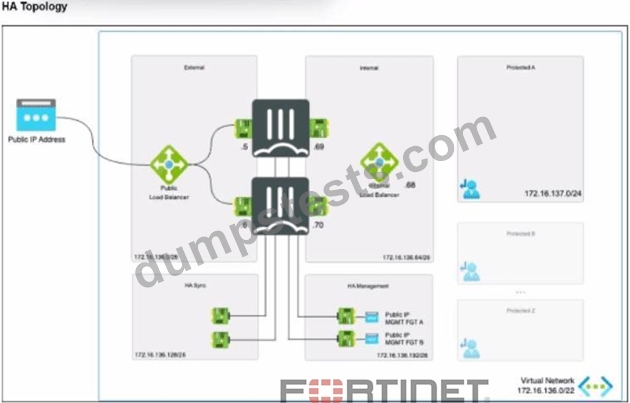
The exhibit shows an active-passive high availability FortiGate pair with external and internal Azure load balancers There is no SDN connector used in this solution.
Which configuration must the administrator implement on each FortiGate?
- A. Single BGP route to Azure probe IP address.
- B. One static route to Azure Lambda IP address.
- C. Two BGP routes lo Azure probe IP address.
- D. Two static routes to Azure probe IP address.
Answer: D
NEW QUESTION # 35
An organization is deploying FortiDevSec to enhance security for containerized applications, and they need to ensure containers are monitored for suspicious behavior at runtime.
Which FortiDevSec feature is best for detecting runtime threats?
- A. FortiDevSec static application security testing (SAST)
- B. FortiDevSec container scanner
- C. FortiDevSec software composition analysis (SCA)
- D. FortiDevSec dynamic application security testing (DAST)
Answer: B
NEW QUESTION # 36
Refer to the exhibit.
An experienced AWS administrator is creating a new virtual public cloud (VPC) flow log with the settings shown in the exhibit.
What is the purpose of this configuration?
- A. To monitor logs in real time
- B. To maximize the number of logs saved
- C. To troubleshoot a log flow issue
- D. To retain logs for a long term
Answer: D
NEW QUESTION # 37
An administrator decides to use the Use managed identity option on the FortiGate SDN connector with Microsoft Azure. However, the SDN connector is failing on the connection. What must the administrator do to correct this issue?
- A. Make sure to add the Client Secret on the FortiGate side of the configuration.
- B. Make sure to add the Tenant ID on the FortiGate side of the configuration.
- C. Make sure to set the type to system managed identity on FortiGate SDN connector settings.
- D. Make sure to enable the system-assigned managed identity on Azure.
Answer: D
NEW QUESTION # 38
Your monitoring team reports performance issues with a web application hosted in Azure. You suspect that the bottleneck might be due to unexpected inbound traffic spikes. Which method should you use to identify and analyze the traffic pattern?
- A. Enable NSG Flow Logs and analyze logs with Azure Monitor.
- B. Use Azure Traffic Manager to visualize all traffic to the application.
- C. Deploy Azure Firewall to log traffic by IP address.
- D. Enable Azure DDoS protection to prevent inbound traffic spikes.
Answer: A
Explanation:
To identify and analyze inbound traffic patterns, you should enable NSG Flow Logs and analyze them with Azure Monitor. This provides detailed insights into traffic flows, including source/destination IPs, ports, and volume, which helps detect spikes or unusual traffic behavior affecting the web application.
NEW QUESTION # 39
Refer to the exhibit.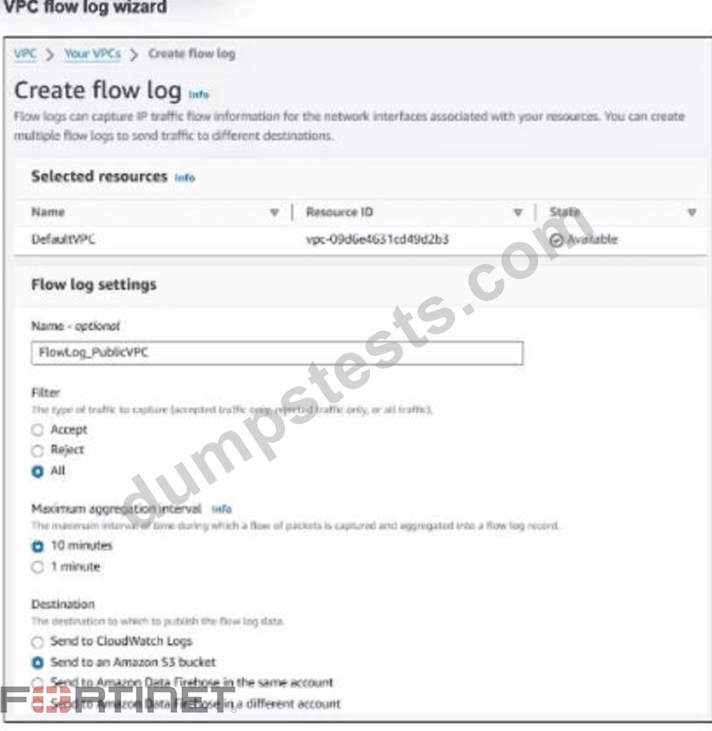
An experienced AWS administrator is creating a new virtual public cloud (VPC) flow log with the settings shown in the exhibit.
What is the purpose of this configuration?
- A. To monitor logs in real time
- B. To maximize the number of logs saved
- C. To troubleshoot a log flow issue
- D. To retain logs for a long term
Answer: D
NEW QUESTION # 40
You are using Ansible to modify the configuration of several FortiGate VMs. What is the minimum number of files you need to create, and in which file should you configure the target FortiGate IP addresses?
- A. One text file for all target devices, and one playbook file.
- B. One inventory file for each target device, and one playbook file.
- C. One playbook file for each target and the required tasks, and one inventory file.
- D. One .yaml file with the target IP addresses, and one playbook file with the tasks.
Answer: B
Explanation:
With Ansible, the minimum setup requires:
* One inventory file listing all target FortiGate devices with their IP addresses.
* One playbook file defining the tasks to be executed.
NEW QUESTION # 41
An AWS administrator must ensure that each member of the cloud deployment team has the correct permissions to deploy and manage resources using CloudFormation. The administrator is researching which tasks must be executed with CloudFormation and therefore require CloudFormation permissions.
Which task is run using CloudFormation?
- A. Installing a Helm chart to deploy a FortiWeb ingress controller in an EKS cluster
- B. Deploying a new pod with a service in an Elastic Kubernetes Service (EKS) cluster using the kubectl command
- C. Creating an EKS cluster with the eksctl create cluster command
- D. Changing the number of nodes in a EKS cluster from AWS CloudShell
Answer: C
Explanation:
Comprehensive and Detailed Explanation From FortiOS 7.6, FortiWeb 7.4 Exact Extract study guide:
Based on theFortinet NSE 7 - Public Cloud Security 7.4/7.6study materials and theFortiOS 7.6 AWS Administration Guide, understanding the underlying mechanisms of AWS deployment tools is essential for permission management.
* Infrastructure as Code and eksctl (Option C):In the context of Amazon EKS, the eksctl command- line tool is the official CLI for creating and managing clusters on EKS. When an administrator executes the eksctl create cluster command, eksctl does not interact with the EKS API directly to provision infrastructure; instead, it generates and executesAWS CloudFormation stacksto provision the necessary VPC, IAM roles, and the EKS control plane. Therefore, users running this command must have explicit permissions to create and manage CloudFormation stacks.
* Resource Provisioning via Stacks:CloudFormation is AWS's native service for Infrastructure as Code (IaC), allowing users to define resources in JSON or YAML templates. Commands like eksctl leverage these templates to ensure repeatable and organized deployments of complex architectures, such as those required for a FortiGate or FortiWeb cloud integration.
Why other options are incorrect:
* Option A:The kubectl command interacts directly with theKubernetes API serverinside the cluster to manage pods and services; it does not trigger AWS CloudFormation processes.
* Option B:Helm is a package manager for Kubernetes. While it manages "releases" within the EKS cluster, the installation of a Helm chart for a FortiWeb ingress controller happens at the Kubernetes software layer and does not utilize AWS CloudFormation stacks.
* Option D:Changing the node count via CloudShell using the AWS CLI or kubectl typically modifies an Auto Scaling Groupor a Kubernetes Deployment/DaemonSet directly, rather than initiating a new CloudFormation stack execution.
NEW QUESTION # 42
An administrator is looking for a solution that can provide insight into users and data stored in major SaaS applications in the multicloud environment.
Which product should the administrator deploy to have secure access to SaaS applications?
- A. FortiCASB
- B. FortiSIEM
- C. FortiWeb
- D. FortiSandbox
Answer: A
Explanation:
FortiCASB (Cloud Access Security Broker) provides visibility and control over users, data, and security policies in major SaaS applications across multicloud environments, ensuring secure access and compliance.
NEW QUESTION # 43
Refer to the exhibit. You are deploying two FortiGate VMs in HA active-passive mode with load balancers in Microsoft Azure.
Which two statements are true in this load balancing scenario? (Choose two.)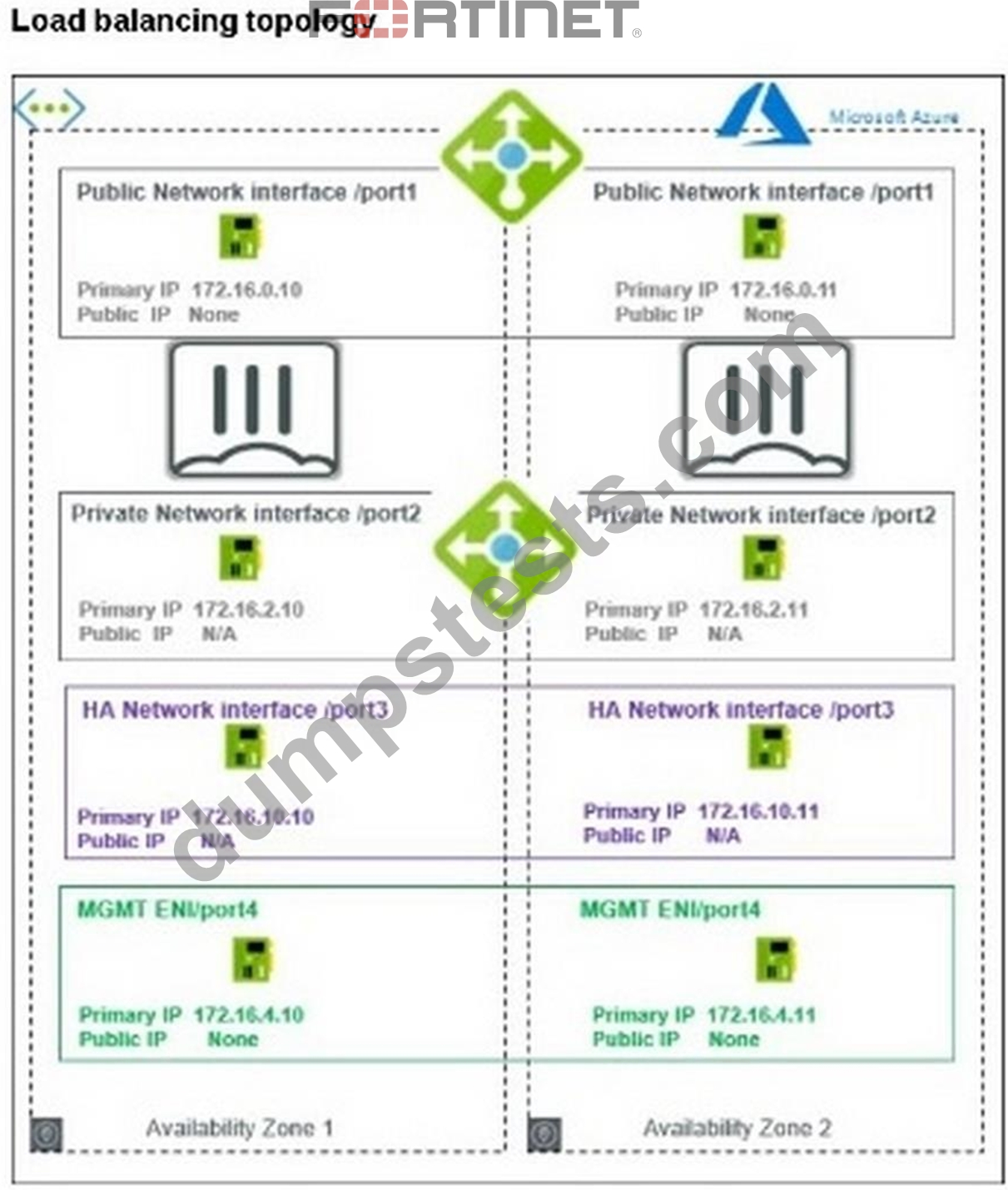
- A. You must add routes to the IP address used by the load balancers to send probes.
- B. The internal load balancer is the next-hop for outgoing traffic.
- C. The public IP of the active FortiGate is the next-hop for all the incoming traffic.
- D. A dedicated management interface can be used for load balancing.
Answer: A,B
Explanation:
In Azure HA active-passive FortiGate deployments, the internal load balancer acts as the next- hop for outgoing traffic, ensuring failover and session continuity.
Routes must be added to the FortiGate configuration so the firewalls respond correctly to the health probes from Azure load balancers, which use specific probe IPs.
NEW QUESTION # 44
An administrator is configuring a software-defined network (SDN) connector in FortiWeb to dynamically obtain information about existing objects in an Amazon Elastic Kubernetes Service (EKS) cluster.
Which AWS policy should the administrator attach to a user to achieve this goal?
- A. AmazonEKSServicePolicy
- B. AmazonEKSConnectorServiceRolePolicy
- C. AmazonEKSClusterPolicy
- D. AmazonEKSComputePolicy
Answer: C
NEW QUESTION # 45
What would be the impact of confirming to delete all the resources in Terraform?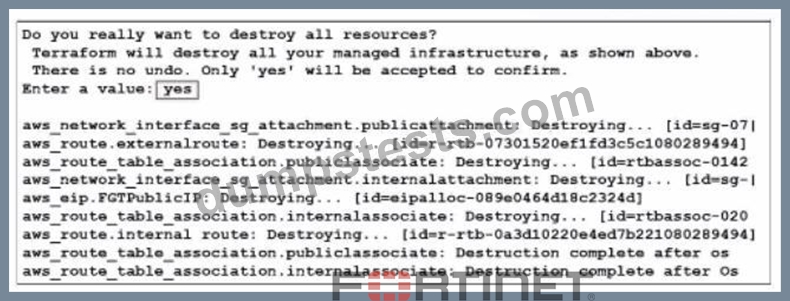
- A. It destroys all the resources in the resource group.
- B. It destroys all the resources in the .tfstate file.
- C. It destroys all the resources tied to the AWS Identity and Access Management (IAM) user.
- D. It destroys all the resources in the .tfvars file.
Answer: B
NEW QUESTION # 46
Refer to the exhibit. You have deployed a Linux EC2 instance in Amazon Web Services (AWS) with the settings shown in the exhibit.
What next step must the administrator take to access this instance from the internet?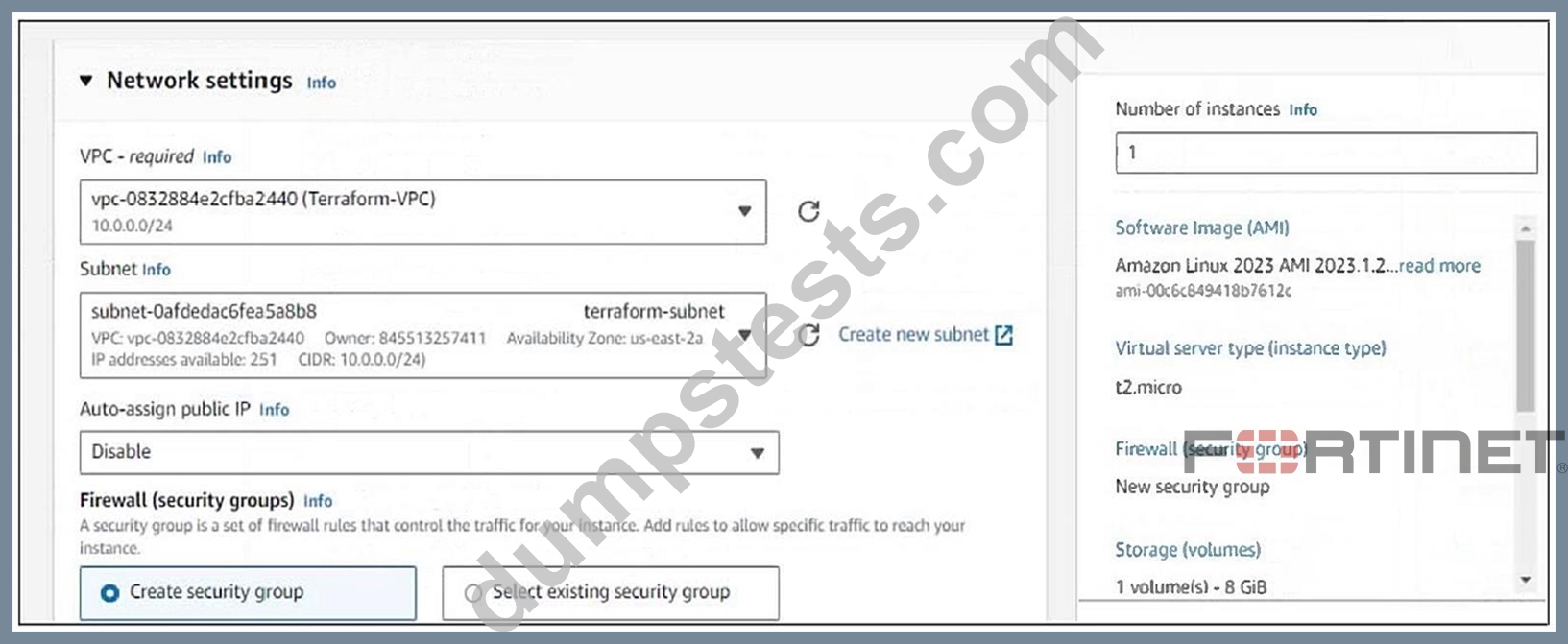
- A. Enable SSH and allocate it to the device.
- B. Configure the user name and password.
- C. Create a VIP on FortiGate to allow access.
- D. Allocate an Elastic IP address and assign it to the instance.
Answer: D
Explanation:
In the exhibit, Auto-assign public IP is disabled, meaning the instance has no public IP for internet access. To make the Linux EC2 instance reachable from the internet, the administrator must allocate an Elastic IP address and assign it to the instance.
NEW QUESTION # 47
You are experiencing intermittent connectivity issues in a FortiGate HA cluster deployed with Azure gateway load balancer. Traffic is being dropped when it passes through the cluster. What is the cause of the issue?
(Choose one answer)1
- A. The Azure gateway load balancer is configured with an incorrect health probe port.
- B. The protected VMs are running an application that fragments packets.
- C. The Azure gateway load balancer is blocking large packets, causing traffic failures.
- D. The FortiGate firewalls are using the default maximum transmission unit (M2TU) size supported by Azure.
Answer: D
Explanation:
Comprehensive and Detailed Explanation From FortiOS 7.6, FortiWeb 7.4 Exact Extract study guide:
According to theFortiOS 7.6 Azure Administration Guideand thePublic Cloud Securitydocumentation regarding Azure Gateway Load Balancer (GWLB) integration:
* Encapsulation Overhead:Azure Gateway Load Balancer usesVXLAN(Virtual eXtensible LAN) to encapsulate the traffic before sending it to the FortiGate-VM HA cluster. This encapsulation adds a header that typically consists of 50 bytes for regular IPv4 traffic (Ethernet, IP, UDP, and VXLAN headers).
* MTU Mismatch (Option A):The default maximum transmission unit (MTU) in Azure is1500 bytes. If a protected VM sends a packet at the maximum default size (1500 bytes), and the GWLB then adds the
50-byte VXLAN header, the resulting encapsulated packet becomes1550 bytes.
* Packet Drops:If the FortiGate-VM's network interfaces are left at the default MTU of1500 bytes, they will not be able to process the 1550-byte encapsulated frames without fragmentation. Because many network paths or configurations (including Azure's fabric for certain flows) may drop packets that require fragmentation or have theDon't Fragment (DF) flagset, this results in the observed intermittent connectivity issues and dropped traffic.
* Required Resolution:To resolve this issue, administrators mustincrease the MTUon the FortiGate- VM interfaces (specifically the one receiving GWLB traffic) to at least1570 bytesto accommodate both IPv4 and IPv6 VXLAN overhead.
Why other options are incorrect:
* Option B:While an incorrect health probe port would cause the GWLB to mark the FortiGate as down, it would typically lead to a complete loss of traffic flow through that instance rather than intermittent packet drops within an active flow.
* Option C:The GWLB itself is the component adding the overhead; it is theFortiGate'sinability to receive the larger resulting frame (due to its own default MTU setting) that causes the failure.
* Option D:Packet fragmentation by the application is a secondary effect. The primary "intermittent" issue described in GWLB deployments is almost always related to thetunneling overheadexceeding the receiving interface's MTU.
NEW QUESTION # 48
An administrator is trying to implement FortiCNP with Microsoft Azure Security integration.
However, FortiCNP is not able to extract any cloud integration data from Azure; therefore, real- time cloud security monitoring is not possible.
What is causing this issue?
- A. The organization is using a free Azure AD license.
- B. The FortiCNP account in Azure has the Storage Blob Data Reader role.
- C. The Azure account doesn't have the Global Administrator role.
- D. The administrator enabled the wrong Defender plan for servers.
Answer: B
Explanation:
For FortiCNP integration with Azure Security, the Azure account must have sufficient permissions to extract security and resource data. If the account only has the Storage Blob Data Reader role, it can read storage blobs but cannot access the required security or resource information, which prevents FortiCNP from performing real-time monitoring.
NEW QUESTION # 49
Refer to the exhibit.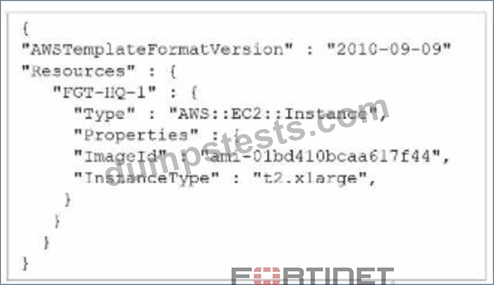
A senior administrator in a multinational organization needs to include a comment in the template shown in the exhibit to ensure that administrators from other regions change the Amazon Machine Image (AMI) ID to one that is valid in their location.
How can the administrator add the required comment in that section of the file?
- A. The administrator can add the comment starting with the # character next to the "Resources" section.
- B. The administrator can include the comment with the aws cloudformation update-stack command.
- C. The administrator must update the AWSTemplateFormatVersion to the latest version.
- D. The administrator must convert the template file to YAML format to add a comment.
Answer: D
Explanation:
According to the FortiOS 7.6 AWS Administration Guide and the Fortinet 7.4 Public Cloud Security study materials regarding infrastructure as code (IaC) for cloud deployments:
* JSON Format Limitations (Option B): The exhibit shows an AWS CloudFormation template in JSON (JavaScript Object Notation) format. JSON, by its official specification, does not support comments. There is no native syntax (like // or /* */) to include remarks that are ignored by the CloudFormation parser.
* YAML Support: To add descriptive comments-such as instructing other regional administrators to update the AMI ID-the administrator must convert the template into YAML format. YAML is a superset of JSON and specifically supports comments using the # character.
* Best Practice for Multinational Deployments: For organizations operating across multiple AWS regions, using YAML is the recommended standard because it allows for inline documentation, making templates more maintainable and easier for different teams to understand regional requirements.
Why other options are incorrect:
* Option A: Comments are part of the template file itself, not a parameter or flag within the aws cloudformation update-stack CLI command.
* Option C: While # is the correct character for comments in YAML, it is invalid syntax in JSON and would cause the CloudFormation stack creation to fail with a parsing error.
* Option D: The AWSTemplateFormatVersion "2010-09-09" is currently the only valid version for CloudFormation templates; updating it does not add JSON comment support.
NEW QUESTION # 50
Which statement about Transit Gateway (TGW) in Amazon Web Services (AWS) is true?
- A. TGW can have multiple TGW route tables.
- B. Both the TGW attachment and propagation must be in the same TGW route table.
- C. The TGW default route table cannot be disabled.
- D. A TGW attachment can be associated with multiple TGW route tables.
Answer: A
Explanation:
In AWS, a Transit Gateway (TGW) can indeed have multiple TGW route tables, allowing flexible routing policies for different VPCs and VPN attachments. Each attachment can be associated with only one route table, but TGW supports multiple route tables for segmentation and control.
NEW QUESTION # 51
Your organization has several FortiGate VMs deployed in Azure. You need to implement a solution with Azure native tools that allows you to determine whether packets are being permitted or blocked by the FortiGate VMs.
Which solution can you use to meet these requirements?
- A. Insert the VM traffic logs in Azure Sentinel.
- B. Configure Azure Advisor to analyze the network traffic.
- C. Use IP flow verify for each of the VMs.
- D. Install the Azure Monitor agent in all VMs.
Answer: C
Explanation:
Azure IP flow verify is part of Network Watcher and lets you check if traffic is allowed or denied for a specific VM by analyzing its effective security rules and routing. This provides visibility into whether packets are being permitted or blocked for the FortiGate VMs.
NEW QUESTION # 52
Refer to the exhibit. An experienced AWS administrator is creating a new Virtual Private Cloud (VPC) flow log with the settings shown in the exhibit.
What is the purpose of this configuration?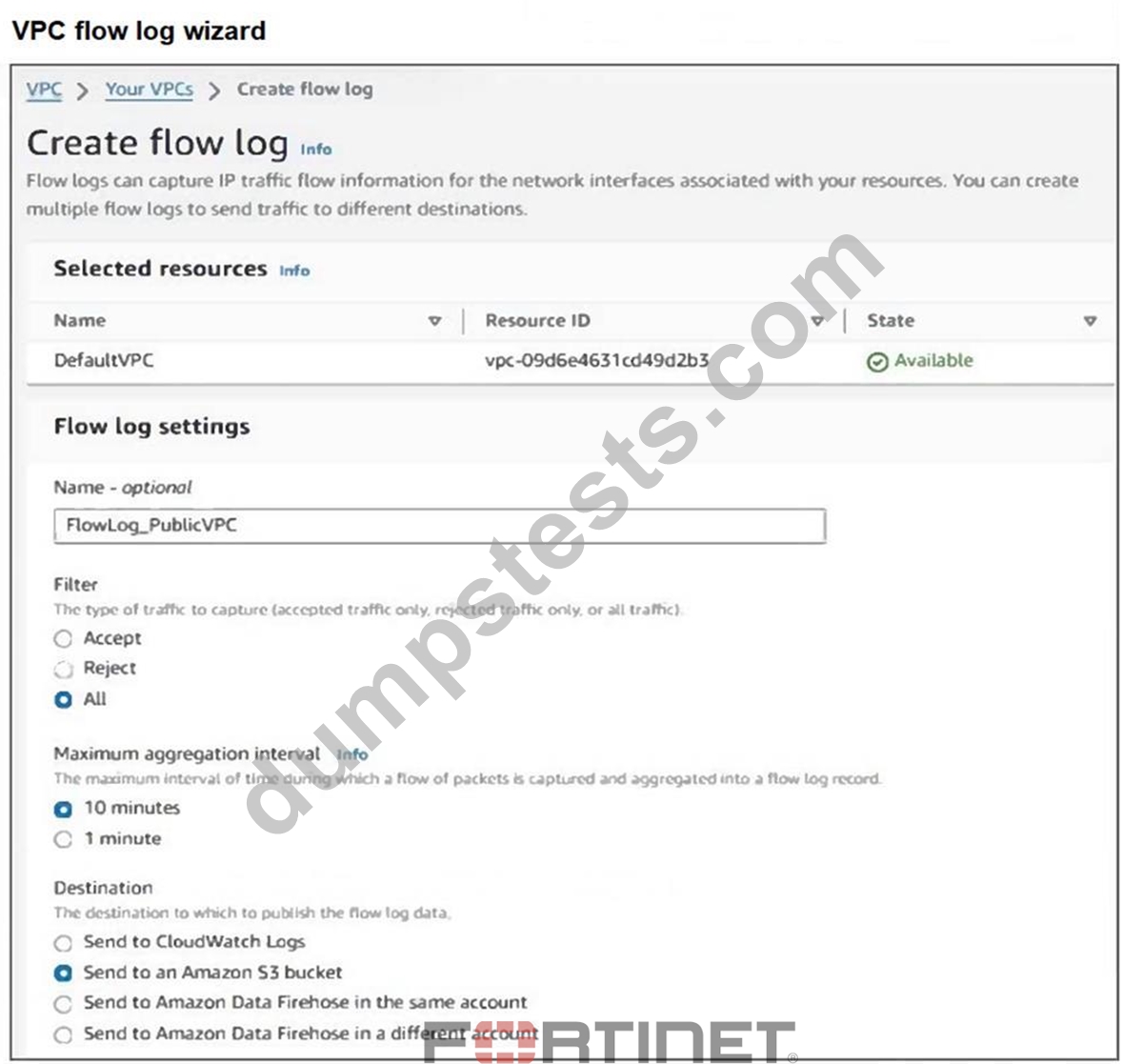
- A. To monitor logs in real time
- B. To maximize the number of logs saved
- C. To troubleshoot a log flow issue
- D. To retain logs for a long term
Answer: D
Explanation:
In the exhibit, the destination is set to Amazon S3, which is typically used for long-term storage and retention of VPC flow logs. CloudWatch or Data Firehose would be chosen for real-time monitoring or analysis, but S3 ensures the logs are retained cost-effectively for long durations.
NEW QUESTION # 53
You are investigating an attack path for a top risky host. You notice that the Common Vulnerability Scoring System (CVSS) and the vulnerability impact scores are very high. However, the attack path severity for the top risky host itself is low. Which two pieces of contextualized information can help you understand why?
(Choose two answers)
- A. The vulnerability score
- B. The FortiCNAPP risk score
- C. The fix version
- D. The package status
Answer: B,D
NEW QUESTION # 54
You have onboarded the organization's Microsoft Azure account on FortiCNAPP using the automated configuration approach. However, FortiCNAPP does not appear to be receiving any workload scanning data.
How can you remedy this? (Choose one answer)
- A. Add a FortiCNAPP threat policy to monitor Azure workloads.
- B. Add a new Azure App Registration.
- C. Add a service principal in the Azure Cloud Shell.
- D. Add the appropriate integration type using the guided configuration.
Answer: D
Explanation:
Comprehensive and Detailed Explanation From FortiOS 7.6, FortiWeb 7.4 Exact Extract study guide:
Based on theFortiCNAPP 24.x Administration Guideregarding Microsoft Azure onboarding and feature activation:
* Separation of Integration Types (Option D):In FortiCNAPP, onboarding a cloud account via the automated configuration approach often initializes theCloud Security Posture Management (CSPM) andCloud Infrastructure Entitlement Management (CIEM)features. However,Workload Scanning (specifically Agentless Scanning) is treated as a distinct integration type within the platform.
* Guided Configuration Requirement:Even after the account is onboarded, the administrator must navigate to theIntegrationsorOnboardingsection and specifically add theWorkload Scanning integration for that Azure account. This "Guided Configuration" ensures that the necessary additional permissions (such as those required to create snapshots of disks and scan them) and resources (like the scanner VNet or regional scanners) are properly deployed within the Azure environment.
* Why other options are incorrect:
* Option A & B:Automated onboarding already handles the creation of necessary App Registrations and Service Principals. Manually adding more without following the specific integration workflow will not activate the workload scanning engine.
* Option C:Threat policies are used to generate alerts based on existing data. If the raw workload scanning data is not being received from Azure, a policy will have no data to analyze; the issue is at the ingestion/integration layer, not the policy layer.
NEW QUESTION # 55
......
Fortinet NSE7_CDS_AR-7.6 Exam Syllabus Topics:
| Topic | Details |
|---|---|
| Topic 1 |
|
| Topic 2 |
|
| Topic 3 |
|
| Topic 4 |
|
Verified NSE7_CDS_AR-7.6 exam dumps Q&As with Correct 76 Questions and Answers: https://prep4sure.dumpstests.com/NSE7_CDS_AR-7.6-latest-test-dumps.html