

100% Free ISM CPSM CORe Dumps PDF Demo Cert Guide Cover
PDF Exam Material 2026 Realistic CORe Dumps Questions
The HBX CORe Final Examination is the final step in the program and is a requirement for learners who wish to earn the CORe credential. CORe exam is a comprehensive assessment of the knowledge and skills acquired throughout the program. It covers all three core subjects, and includes multiple-choice questions as well as case study analysis. CORe exam is timed and must be completed within a designated timeframe. Those who pass the exam receive the CORe credential, which is recognized by employers globally as a mark of readiness for a career in business.
One of the most important components of the HBX CORe program is the final examination. The final examination is designed to assess students' understanding of the material covered in the program. CORe examination consists of multiple-choice questions and short-answer questions that require students to apply their knowledge to real-world scenarios.
NEW QUESTION # 11
Which of the following options is an example of an implicit transaction?
- A. An invoice for an item of plant equipment that was just purchased
- B. A depreciation expense for an asset placed in service eight months ago
- C. An invoice for services provided by the pension fund administrator
- D. A sales order from a customer for a product to be shipped in two weeks
Answer: B
NEW QUESTION # 12
A supply manager Is conducting negotiations with a supplier. The supplier states that it cannot offer a lower price because the product under negotiation is covered by a government contract. In this situation, the supply manager should
- A. require the supplier to provide specifics on the government contract restrictions
- B. negotiate the other terms and conditions, and return to the issue of price at a later time
- C. offer to reduce the order quantity
- D. conclude that this is in fact the best price that the supplier can legally offer
Answer: A
Explanation:
When a supplier states that a product is covered by a government contract, implying that they cannot offer a lower price, it is essential for the supply manager to verify this claim. The supply manager should require the supplier to provide specifics on the government contract restrictions. This will help determine if the price is indeed fixed by the government or if there are other negotiable aspects. By understanding the exact restrictions, the supply manager can better navigate the negotiation process, ensuring compliance while potentially identifying areas for negotiation that are not restricted.
References:
* Federal Acquisition Regulation (FAR) guidelines on government contracts.
* "The Art of Negotiation" by Michael Wheeler.
* Institute for Supply Management (ISM) guidelines on government contract negotiations.
NEW QUESTION # 13
Which of the following is MOST important to address in an exit plan when an organization Is transitioning to a new supplier?
- A. Identifying how costs will be shared
- B. Ensuring continuity of supply
- C. Determining how assets will be transferred or sold
- D. Defining ownership and destruction of data
Answer: B
Explanation:
When transitioning to a new supplier, the most critical aspect to address in an exit plan is ensuring continuity of supply. This means making sure that there are no interruptions in the availability of materials or services during the transition period. Addressing this ensures that the organization's operations continue smoothly without any supply chain disruptions.
References
* CIPS (Chartered Institute of Procurement & Supply). Managing supplier transitions.
* ISM (Institute for Supply Management). Supply continuity planning.
NEW QUESTION # 14
GHI, Inc. manufactures and sells high-end headphones. Each pair of headphones is packaged with a kit of customizable parts. GHI sources these customizable parts from a specialty supplier. Recently, GHI received a shipment of the parts from the supplier, and although the materials arrived on time, they were not bagged and labeled individually as the contract requires, but rather arrived in bulk.
GHI needs the parts as soon as possible to complete its holiday orders. Given this situation, which of the following is the BEST course of action for GHI's supply manager to take?
- A. Refuse to pay any invoice until the supplier corrects the mistake by repackaging the materials
- B. Return the materials as nonconforming items for replacement
- C. Have the parts properly packaged with the supplier's agreement to cover the costs
- D. Send GHI's quality team to the supplier's facility
Answer: C
Explanation:
* Immediate Need: GHI requires the parts as soon as possible to complete holiday orders.
* Supplier Error: The parts arrived in bulk rather than individually packaged and labeled as required.
* Optimal Solution: Negotiating with the supplier to properly package the parts and cover the associated costs ensures that GHI can use the parts quickly without additional delays.
* Avoiding Delays: This approach avoids the time-consuming process of returning the materials or sending a team, ensuring that production schedules are maintained.
References
* Burt, D. N., Petcavage, S. D., & Pinkerton, R. L. (2010). Supply Management. McGraw-Hill Education.
* Lysons, K., & Farrington, B. (2016). Procurement and Supply Chain Management. Pearson.
NEW QUESTION # 15
A company had the following trial balance on Dec. 31, 2013: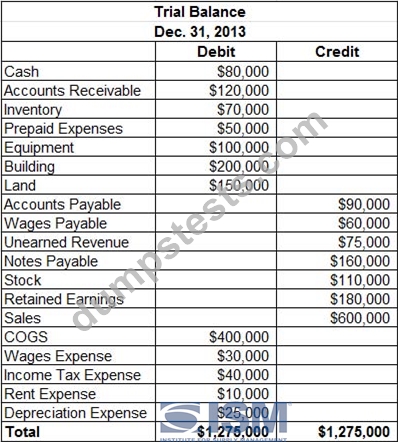
What is the company's net income for 2013?
- A. $120,000
- B. $170,000
- C. $45,000
- D. $95,000
Answer: D
NEW QUESTION # 16
An automobile manufacturer learns that its supplier for brake parts cannot maintain a steady workforce of machinists. In this instance, it is likely that the manufacturer failed to examine which of the following during supplier performance evaluations?
- A. Business continuity
- B. Labor stability
- C. Quality metrics
- D. Financial stability
Answer: B
NEW QUESTION # 17
A supply manager negotiates an agreement with a salesperson from the supplier's organization. With regard to signing the agreement, which of the following is MOST correct?
- A. The supply manager and the salesperson should sign the agreement.
- B. The presidents of both the buying firm and the supplier should sign the agreement.
- C. No signatures are required, as the deal was already agreed upon between the supply manager and the salesperson.
- D. An authorized person from the buying firm and an authorized person from the supplier should sign the agreement.
Answer: D
Explanation:
* Authorized Signatures: An agreement should be signed by authorized persons from both the buying firm and the supplier to ensure that the contract is legally binding.
* Authority Verification: The supply manager and the salesperson may negotiate the terms, but the signatures should come from individuals with the authority to bind their respective organizations legally.
* Risk Mitigation: This ensures that the agreement is enforceable and reduces the risk of any party later
* claiming that the agreement is invalid due to unauthorized signatures.
* Organizational Policy Compliance: This practice ensures compliance with organizational policies regarding contract signing authority.
References:
* ISM: "Contract Management and Negotiation Strategies"
* CIPS: "Legal Aspects of Procurement and Supply"
NEW QUESTION # 18
A regulatory agency decides to enforce a price ceiling equal to marginal cost for a local utility provider which acts as a monopoly. Which of the following observations is true?
- A. The government might have to pay the firm a subsidy to prevent it from exiting the industry.
- B. New utility companies will be incentivized to enter the industry.
- C. The price will be exactly the same as it would be without regulation.
- D. The demand curve will shift outward.
Answer: A
NEW QUESTION # 19
DEF, Inc. has a choice of several transportation providers in the immediate area. The firm decides to conduct a spend analysis to identify opportunities for cost savings through service standardization. In this situation, which of the following will be MOST Important for the company to analyze?
- A. Pricing for alternative travel modes such as rail and air
- B. Local laws and regulations regarding transportation
- C. Labor rates for frequently utilized locations
- D. Pricing at international locations
Answer: A
Explanation:
DEF, Inc. wants to conduct a spend analysis to identify opportunities for cost savings through service standardization. In this context:
Option A, analyzing pricing for alternative travel modes such as rail and air, is crucial. Understanding the cost differences between various modes of transport can help DEF, Inc. identify the most cost-effective options and standardize services based on cost efficiency.
Option B, labor rates for frequently utilized locations, while important, is more relevant to operational costs rather than transportation cost savings.
Option C, local laws and regulations regarding transportation, is necessary for compliance but not directly related to cost savings through standardization.
Option D, pricing at international locations, is also important but might not provide the immediate opportunities for cost savings through standardization in the immediate area.
Therefore, analyzing pricing for alternative travel modes will offer the most significant insights for cost-saving opportunities.
References:
* Spend analysis methodologies in logistics.
* Research on cost-saving strategies through transportation mode comparison.
NEW QUESTION # 20
PQR Inc. sponsors numerous large events involving all of its divisions. PQR's supply manager proposes that the firm coordinate this spend to bring significant savings and simplify administration. However, PQR's top management believes that each division would prefer to deal with its own event planners. In this situation, which of the following is the BEST course of action for the supply manager to take?
- A. Invite leading suppliers to make presentations to management
- B. Assemble a team representing all divisions to discuss future meeting needs
- C. Implement the proposed program on a trial basis and evaluate the results
- D. Gather updated information and re-introduce the proposal to top management
Answer: B
NEW QUESTION # 21
A rapidly-growing food service company Is creating a service level agreement (SLA) for laundry services. The current supply base has invested in new machines. Which of the following should be the PRIMARY focus area of the new SLA?
- A. Quality
- B. Distance from the company
- C. Supplier capacity
- D. Cost
Answer: A
Explanation:
When creating a service level agreement (SLA) for laundry services, especially for a rapidly growing food service company, it is crucial to focus on the most impactful area.
* Distance from the company: Relevant for logistics but not the primary concern.
* Cost: Important but secondary to ensuring service quality.
* Quality: This should be the primary focus to ensure that the laundry services meet the necessary standards, which is critical for maintaining hygiene and customer satisfaction in the food service industry.
* Supplier capacity: Important to ensure they can handle the volume but can be addressed within the quality parameters.
Therefore, the primary focus area of the new SLA should be quality.
References:
* Service level agreement best practices.
* Quality management in service procurement.
NEW QUESTION # 22
A stockbroker wishes to examine the relationship between merger failures and stock prices. For 30 days, data were collected for closing stock prices each day and the number of merger failures announced that day. After reviewing the data, the stockbroker believes that merger failures affect stock market prices for more than one day. Which of the following measures would help the stockbroker incorporate that effect into the regression model?
- A. Introduce a variable that is collinear with number of news reports on merger failure
- B. Include other independent variables, such as the number of news reports on dividend released each day
- C. Include dummy variables
- D. Include lagged variables
Answer: D
NEW QUESTION # 23
Which of the following explains external category market conditions by describing competitive factors within an industry?
- A. Supplier analysis
- B. SWOT analysis
- C. Request for information
- D. Porter's Five Forces
Answer: D
Explanation:
* External Category Market Conditions: These are factors outside the organization that can affect the supply market.
* Porter's Five Forces: This framework analyzes the competitive forces within an industry, which include:
* The threat of new entrants
* The bargaining power of buyers
* The bargaining power of suppliers
* The threat of substitute products or services
* The intensity of competitive rivalry
* Application: Using Porter's Five Forces helps in understanding the dynamics of the industry and how they affect the company's position and strategy.
* Strategic Decision Making: This analysis informs supply managers about potential risks and opportunities, enabling them to make better strategic sourcing decisions. References
* Michael E. Porter's "Competitive Strategy: Techniques for Analyzing Industries and Competitors".
NEW QUESTION # 24
A firm wants to leverage supply contracts by making maintenance, repair, and operations (MRO) supplies available to all of its subsidiaries. Which of the following is the MOST efficient and cost-effective way to provide product details to potential users?
- A. Conduct train-the-trainer sessions for supply management staff at the subsidiaries
- B. Require suppliers to provide secure ordering portals tailored to specific contracts
- C. Create internal online catalogs with ordering instructions and links to suppliers' sites
- D. Email a list of suppliers' websites to contacts at each subsidiary
Answer: C
Explanation:
To leverage supply contracts and make MRO supplies available to all subsidiaries efficiently and cost-effectively:
* Require suppliers to provide secure ordering portals tailored to specific contracts: While secure, this approach places the burden on suppliers and may lead to inconsistencies in user experience.
* Conduct train-the-trainer sessions for supply management staff at the subsidiaries: Effective for training, but not the most efficient way to provide ongoing product details.
* Create internal online catalogs with ordering instructions and links to suppliers' sites: This approach centralizes information, making it easily accessible for all subsidiaries. It ensures consistency in ordering procedures and allows for efficient updates.
* Email a list of suppliers' websites to contacts at each subsidiary: Simple but lacks centralization and can lead to outdated or inconsistent information.
Therefore, the most efficient and cost-effective way is to create internal online catalogs with ordering instructions and links to suppliers' sites.
References:
* Supply chain management best practices on internal cataloging.
* Institute for Supply Management (ISM) guidelines on centralized procurement systems.
NEW QUESTION # 25
A manufacturing company has numerous sites around the country. Supply management teams at each location do not have the same understanding of the different Internal processes. Which of the following should senior supply management do in order to correct this problem?
- A. Establish, communicate and reinforce a supply chain map
- B. Contact suppliers to explain the processes and ask them not to collaborate with non-complying employees
- C. Centralize the purchasing activities at the firm's headquarters
- D. Contact supply managers at each site to implement disciplinary actions against buyers deviating from the process
Answer: A
Explanation:
To ensure a consistent understanding of internal processes across all sites, senior supply management should establish, communicate, and reinforce a supply chain map. A supply chain map visually represents the flow of materials, information, and finances throughout the supply chain. By standardizing this information and ensuring it is communicated effectively, all team members can have a clear and consistent understanding of the processes. This helps to align activities, improve coordination, and ensure compliance with standardized procedures.
References:
* Lambert, D. M., & Cooper, M. C. (2000). Issues in Supply Chain Management. Industrial Marketing Management.
* Burt, D. N., Dobler, D. W., & Starling, S. L. (2003). World Class Supply Management.
NEW QUESTION # 26
......
The HBX CORe program and Final Examination provide students with a comprehensive understanding of business concepts and a valuable certification of completion from Harvard Business School. The program is flexible, accessible, and delivered entirely online, making it ideal for students with a wide range of backgrounds and experience levels. Passing the HBX CORe Final Examination is a significant achievement that can open up new opportunities for students and help them stand out in a crowded job market.
Updated ISM CORe Dumps – PDF & Online Engine: https://prep4sure.dumpstests.com/CORE-latest-test-dumps.html