

[2026] ISO-14001-Lead-Auditor All-in-One Exam Guide Practice To your ISO-14001-Lead-Auditor Exam!
Preparations of ISO-14001-Lead-Auditor Exam 2026 ISO 14001 Unlimited 68 Questions
PECB ISO-14001-Lead-Auditor Exam Syllabus Topics:
| Topic | Details |
|---|---|
| Topic 1 |
|
| Topic 2 |
|
| Topic 3 |
|
| Topic 4 |
|
| Topic 5 |
|
| Topic 6 |
|
NEW QUESTION # 25
Which one of the following options best describes the main purpose of a Stage 2 third-party audit?
- A. To check for legal compliance by the organisation.
- B. To get to know the organisation's management system.
- C. To identify nonconformances against a standard.
- D. To determine readiness for certification.
Answer: C
Explanation:
According to ISO/IEC 17021-1:2015 (used alongside ISO 14001 for certification audits), the certification process includes Stage 1 and Stage 2 audits:
The purpose of the Stage 1 audit is to review the management system documentation and assess the organization's preparedness for Stage 2.
The Stage 2 audit's main objective is to evaluate the implementation, including the effectiveness, of the organization's management system. This includes assessing conformity with all the requirements of ISO
14001:2015.
As per ISO/IEC 17021-1:2015 Clause 9.3.2.2.2:
"The stage 2 audit shall take place at the site(s) of the organization. It shall include at least the following:
information and evidence about conformity to all requirements of the applicable management system standard." Thus, the Stage 2 audit is where auditors identify nonconformities and gather evidence to support certification decisions.
Reference: ISO/IEC 17021-1:2015 Clause 9.3.2.2.2; ISO 14001 Lead Auditor Course Guide - Certification Process Module.
NEW QUESTION # 26
A large public library established an EMS following the requirements of ISO 14001, which was third-party certified 10 years ago. You are performing the second surveillance audit of the third certification cycle. The audit plan included an audit of the Director as the last interview before the closing meeting.
During the interview with the Director, you audit clause 6.2, Objectives and planning to achieve them. The dialogue is as follows:
You: Could you please tell me which environmental objectives were defined for last year and show evidence of their achievement?
Director: Yes. We had defined three objectives. As you can see from our Annual Plan, one of them was to separate our waste into four categories: paper, plastics, metals, and food. Before, we had only three, because plastic and paper were disposed of together. We developed an Action Plan to achieve this objective.
Which six of the questions would you ask related to the Action Plan?
- A. How did you measure it?
- B. Who was responsible for the completion of the plan?
- C. How was progress of the plan being monitored?
- D. Did you estimate what resources would you need?
- E. Is it consistent with the environmental policy?
- F. Did you define any method for monitoring progress?
- G. Were actions integrated into the organisation's business processes?
- H. Was it approved by the Director?
Answer: A,B,D,E,F,G
Explanation:
The correct answers are A, B, D, E, F and H .
This question relates to ISO 14001:2015 Clause 6.2 - Environmental objectives and planning to achieve them , especially Clause 6.2.1 and Clause 6.2.2 .
For environmental objectives, the organisation must ensure that objectives are consistent with the environmental policy, measurable where practicable, monitored, communicated, and updated as appropriate.
When planning how to achieve environmental objectives, the organisation must determine what will be done, what resources will be required, who will be responsible, when it will be completed, how the results will be evaluated, including indicators for monitoring progress, and how actions to achieve objectives can be integrated into business processes.
A). Who was responsible for the completion of the plan? - Correct
The action plan should identify who is responsible for achieving the objective.
B). Is it consistent with the environmental policy? - Correct
The objective and related action plan should support the environmental policy, such as pollution prevention, environmental protection, compliance obligations, and improvement of environmental performance.
D). How did you measure it? - Correct
The objective should be measurable where practicable. For waste separation, measurement could include quantities of paper, plastic, metal, and food waste separated, contamination rates, or disposal/recycling records.
E). Were actions integrated into the organisation's business processes? - Correct ISO 14001 expects the organisation to consider how actions to achieve environmental objectives can be integrated into business processes. For a library, this may include cleaning routines, waste collection contracts, staff instructions, signage, and user-facing waste segregation points.
F). Did you define any method for monitoring progress? - Correct
The organisation should determine how progress toward the environmental objective will be monitored, such as periodic waste checks, contractor reports, internal inspections, or monthly waste data review.
H). Did you estimate what resources would you need? - Correct
The action plan should identify required resources. This could include separate bins, labels, staff time, communication materials, waste contractor arrangements, or training.
The two options not selected are:
C). How was progress of the plan being monitored? - Not selected
This is very similar to option F , but option F is the stronger wording because it asks whether a method for monitoring progress was defined as part of the planning process.
G). Was it approved by the Director? - Not required
ISO 14001 requires roles, responsibilities, resources, monitoring, evaluation, and integration into processes, but it does not specifically require every environmental objective action plan to be approved by the Director.
NEW QUESTION # 27
You have been nominated as audit team leader for the second recertification to ISO 14001 of ABC, a public transport organisation in a big city. The audit is planned to take place in two months.
The audit program manager asks you to review the answer provided by ABC to a nonconformity raised by another auditor during the last surveillance audit carried out eight months ago.
The nonconformity reads as follows:
*"ABC does not always communicate its relevant environmental requirements to external providers.
Evidence: A two-month contract signed with a new external provider of the maintenance for ABC's buses did not contain any relevant environmental requirements."* Which two would you consider to be the best corrective actions from ABC?
- A. We retrained procurement personnel on the ISO 14001 requirements.
- B. We revised the procurement process.
- C. We asked the EMS to include this issue in the next internal audit.
- D. We revised the contract to add the relevant environmental requirements.
- E. We will discuss the issue during the next management review.
- F. We identified environmental aspects related to the external provider's activities.
Answer: B,D
Explanation:
The correct answers are A and B.
The nonconformity concerns ABC's failure to communicate relevant environmental requirements to an external provider. This relates mainly to ISO 14001:2015 Clause 8.1 - Operational planning and control, which requires the organisation to ensure that outsourced processes are controlled or influenced and that relevant environmental requirements are communicated to external providers.
A). We revised the contract to add the relevant environmental requirements - Correct This is the immediate correction. The specific contract that caused the nonconformity has been amended so that the maintenance provider receives the relevant environmental requirements.
B). We revised the procurement process - Correct
This is the stronger systemic corrective action. Revising the procurement process helps prevent recurrence by ensuring future contracts or purchasing arrangements include relevant environmental requirements before external providers are approved or work begins.
The other options are less suitable:
C may be useful background work, but it does not directly correct the failure to communicate requirements.
D is only a future discussion, not a completed corrective action.
E may help verify effectiveness later, but it is not the corrective action itself.
F may support implementation, but training alone is weaker than changing the process that allowed the omission.
Therefore, the best corrective actions are A and B.
NEW QUESTION # 28
A key audit process is the way auditors gather information and determine the findings' characteristics. Put the actions in the correct order to complete this process.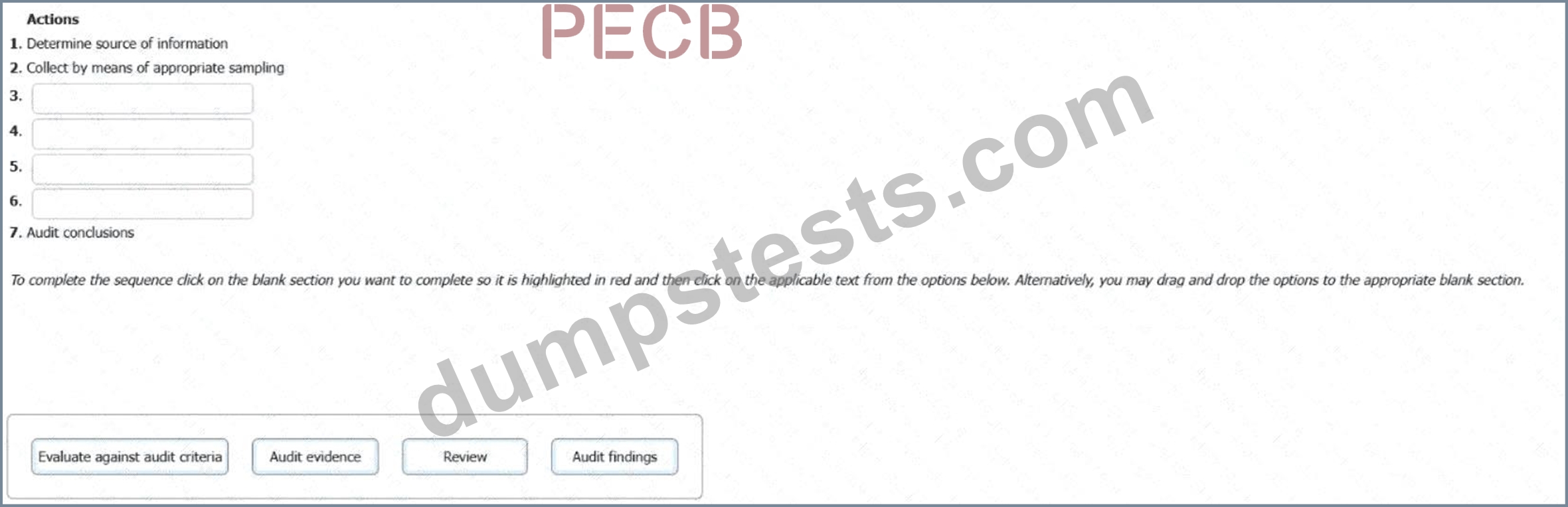
Answer:
Explanation:
Explanation:
A screenshot of a computer AI-generated content may be incorrect.
This sequence is derived from ISO 19011:2018 - Guidelines for Auditing Management Systems, which is used in conjunction with ISO 14001:2015 by auditors. Specifically, the audit process steps during the
"conducting the audit" phase include:
Determining the source of information (Clause 6.4.5): Includes documents, interviews, records, and observations.
Collecting data by sampling (Clause 6.4.6): Sampling helps in managing resources and gathering relevant evidence effectively.
Gathering audit evidence (Clause 3.8): Audit evidence is the data collected and verified to support findings.
Evaluating against audit criteria (Clause 3.9): Evidence must be evaluated against standards such as ISO
14001 requirements, internal policies, etc.
Developing audit findings (Clause 6.4.9): Conclusions regarding conformance, nonconformance, and opportunities for improvement.
Review of findings (Clause 6.4.10): Cross-verification and validation before finalizing results.
Audit conclusions (Clause 6.4.11): Final statements summarizing the audit based on findings.
This structured process ensures audits are performed impartially, with verifiable, evidence-based outcomes that contribute to continual improvement.
Reference:
ISO 19011:2018, Clauses 6.4.5 to 6.4.11
ISO 14001:2015, Clause 9.2 - Internal audit requirements
NEW QUESTION # 29
Which two of the following phrases would apply to "audit criteria"?
- A. Audit conclusions
- B. Financial objectives
- C. Auditor competence
- D. Nonconformity report
- E. ISO 14001 requirements
- F. Management policy
Answer: E,F
Explanation:
According to ISO 19011:2018 Clause 3.3 (Terms and definitions):
Audit criteria are defined as:
"Set of policies, procedures or requirements used as a reference against which objective evidence is compared." ISO 14001 requirements (F) and the organization's own management policy (A) are valid audit criteria.
Nonconformity report (C) and audit conclusions (D) are audit outputs, not criteria.
Financial objectives (B) and auditor competence (E) are not used as audit criteria.
Reference: ISO 19011:2018 Clause 3.3; ISO 14001:2015 Clause 5.2.
NEW QUESTION # 30
An organisation (ABC) plans to carry out a second-party audit of the environmental management system of a supplier (XYZ). Both, ABC and XYZ, have a certified Environmental Management System (EMS) to ISO
14001 by the same certification body.
Which one of these statements is correct?
- A. ABC should request to see a copy of the last certification body audit report from XYZ.
- B. ABC should not ask permission from the certification body to carry out the audit to XYZ.
- C. ABC should inform the certification body that it is planning to audit XYZ.
- D. ABC should invite, as an observer, an auditor of the certification body when it carries out the audit to XYZ.
Answer: B
Explanation:
According to ISO 19011:2018 Clause 3.5 (Second-party audit):
Second-party audits are conducted directly by customers on their suppliers for contractual or commercial purposes.
There is no obligation to inform or involve the certification body in such audits unless contractually required.
Certification body audit reports are confidential to the certified organization and the certification body.
Reference: ISO 19011:2018 Clause 3.5; ISO 14001 Lead Auditor Course Guide.
NEW QUESTION # 31
An oil organisation has a natural gas treatment plant on land crossed by several small rivers. On one particular day, after heavy rainfall for 48 hours, some of those rivers burst their banks and flooded the water treatment facilities of the plant. The oil-contaminated water reached some scarcely populated areas nearby.
Soon after, an internal audit was carried out to particularly analyse this event that was considered a nonconformity. There were no records of such heavy rainfall in the past 200 years.
Which three of the following actions are 'corrections'?
- A. Reinforce the riverbanks with cement
- B. Clean up the affected land
- C. Revise the existing emergency plan
- D. Build up some additional protection to the water treatment plant
- E. Send the contaminated land for processing
- F. Clean up the houses of the persons affected
- G. Offer loans to the persons affected to build new houses far from the plant
- H. Relocate the water treatment plant to lower ground
Answer: B,E,F
NEW QUESTION # 32
Which two of the following options are an advantage of using a sampling plan for the audit?
- A. Use of the plan for consecutive audits
- B. Implements the audit plan efficiently
- C. Reduces the audit duration
- D. Overrules the auditor's instincts
- E. Prevents conflict within the audit team
- F. Gives confidence in the audit results
Answer: C,F
Explanation:
According to ISO 19011:2018 Clause 5.3.2 and Annex B (Audit Sampling):
Sampling allows auditors to:
Reduce audit time while still covering sufficient evidence (A),
Provide statistically valid assurance and confidence in the results (C).
Sampling does not replace auditor judgment (D), nor is it intended to prevent conflict (F) or be reused blindly for future audits (E).
Reference: ISO 19011:2018 Clause 5.3.2, Annex B.
NEW QUESTION # 33
You are responsible for the second surveillance audit of ABC, a medium-sized metal mechanical manufacturing organisation. The significant environmental aspects are loud noise, solid waste, energy consumption and liquid waste.
During the opening meeting, you are informed that when COVID-19 started, sales increased considerably, so they had to open a third shift, from 10 pm to 6 am. You interview the Production Manager.
You: How did you carry out this change and how did you evaluate the impact on ABC's EMS?
PM: It was very simple, we just did it.
You: Did you introduce any change in the EMS?
PM: No. It is the same processes, the same products, the same materials, therefore the same environmental aspects.
You: What about the people?
PM: We distributed the most experienced workers among the three shifts. They trained the newly hired personnel.
Which of the six key questions from the following list would you ask? Have you...
- A. reviewed the environmental objectives?
- B. evaluated the extra amount of waste that will be generated?
- C. developed any formal documented plan to change the EMS?
- D. revised the internal audit programme?
- E. reviewed the documented operational procedures?
- F. reviewed the needs and expectations of interested parties?
- G. reviewed the authorities and responsibilities of all roles?
- H. reviewed the infrastructure maintenance plan?
- I. reviewed the emergency response plans?
Answer: A,B,D,E,F,I
Explanation:
The correct six questions are A, B, D, F, H and I .
Opening a third shift is a significant operational change, even if the products, materials and processes remain the same. The scale, timing and conditions of operation have changed. This can affect energy use, waste generation, noise impacts, emergency arrangements, operational controls, interested parties and the internal audit programme.
A). Revised the internal audit programme - Correct
The internal audit programme should consider changes affecting the organisation. A new night shift may need to be included in the audit programme because environmental controls may operate differently at night. ISO
/TC 207's reviewed interpretations confirm that the EMS audit programme considers environmental importance, organisational changes and previous audit results.
B). Reviewed the environmental objectives - Correct
Environmental objectives should remain relevant to significant aspects and environmental performance. If production has increased, objectives related to waste, energy, liquid waste or noise may need to be reviewed or updated.
D). Evaluated the extra amount of waste that will be generated - Correct The Production Manager's statement is incomplete. The same process can still create greater environmental impact if it operates for more hours. More production may mean more solid waste, liquid waste and energy consumption.
F). Reviewed the needs and expectations of interested parties - Correct A night shift may affect interested parties differently, especially because loud noise is a significant environmental aspect. Neighbours, regulators, landlords, customers or local authorities may have expectations or requirements linked to night-time operations.
H). Reviewed the emergency response plans - Correct
Emergency arrangements may need revision because the site now operates during the night. Staffing levels, trained emergency responders, spill response, fire response, external communication and access to emergency services may differ during the 10 pm to 6 am shift. ISO/TC 207 interpretations also confirm that relevant information and training on emergency preparedness and response apply to persons working under the organisation's control where appropriate.
I). Reviewed the documented operational procedures - Correct
Operational procedures and controls should be reviewed to confirm that environmental controls are effective on all three shifts. ISO/TC 207 interpretations confirm that ISO 14001 clause 8.1 remains focused on planning and controlling operations associated with significant environmental aspects, compliance obligations, risks and opportunities, and environmental objectives.
Why the other options are not selected:
C may be useful, but it is not one of the strongest ISO 14001 change-impact questions in this scenario.
E is not correct because ISO 14001 does not specifically require a formal documented plan every time the EMS changes.
G is too broad as written; affected responsibilities may need review, but reviewing "all roles" is not the best key question compared with the six selected.
NEW QUESTION # 34
A chain of 10 paint shops in a city has established an EMS following the requirements of ISO 14001, which was third-party certified 10 years ago. You are performing a second-party audit. The audit plan included an interview with the General Manager (GM). The dialogue was as follows:
You: Hi, good evening, I have seen a well-developed environmental risk assessment process. However, I did not find the identification of emergency situations included in the results of this process. The Environmental Manager (EM) could not provide me with an acceptable answer to this question.
GM: The EM joined us 2 months ago, and he may not know some decisions we made some time ago, when we first certified our EMS. During those days, I met with all 10 supervisors and asked them what the emergencies were that they feared most. They unanimously said: fire. That was it. This is the only emergency we care of. As far as I remember we do not test the plan very often because the supervisors of all our 10 shops know it very well. The auditors of our certification body accepted this. We did not have a fire in the last 10 years.
What evidence would you need to review to determine conformity with ISO 14001 in this scenario? Select six.
- A. Minutes of the meeting with supervisors where a fire was determined as the only emergency situation
- B. Records of the specific fire combat training of workers
- C. Replacements of supervisors of each shop when they are absent (for any reason)
- D. General competence records of all 10 supervisors
- E. Signage related to health and safety in each shop
- F. Shops that have tested the plan in the last 10 years
- G. Reports of the last two fire drills you performed
- H. Reports of audits from the certification body
- I. Reports of the management reviews
- J. More details on whether the risk assessment process was applied to emergencies
- K. Results of the inspection of fire extinguishers
Answer: B,F,G,I,J,K
NEW QUESTION # 35
You are auditing the ISO 14001 management system of a primary school (School 21st Century) located in downtown Lima, Peru. There are 400 students, attending classes from 9 am until 5.30 pm.
You have presented a nonconformity at the closing meeting:
Non-conformity - No environmental aspect has been identified related to the impact of the education provided by the school on students' awareness (as future adults) related to generic environmental issues.
Select the three best acceptable corrections that the school may take.
- A. Hire an environmentalist next month to deliver a couple of lectures on the environment to all employees of the school, except students
- B. Hire an environment expert next week to deliver a lecture on the environment to all students
- C. Add the education on generic environmental issues to the list of environmental aspects of the school's EMS
- D. Establish environmental objectives for the school
- E. Thoroughly review the syllabus for next year to include environmental issues whenever appropriate
- F. Ask the National Environmental Agency for reading materials to give to students before the lecture by the expert
- G. Revise the school's environmental policy to include environmental concerns
- H. Review the procedure for waste management in the school
Answer: B,C,E
NEW QUESTION # 36
Wash-it-up is an organisation that provides window cleaning services for the industrial sector. It has been certified to ISO 14001 for some time and has appointed a new EMS Manager. The audit plan during a surveillance audit includes the improvement actions and the auditor asks to see the most recent management review meeting minutes.
Which two statements would represent an input to the management review process?
- A. Decision to purchase new spillage kits for operators
- B. Minutes of previous management reviews
- C. Improvement in the organisation's profitability
- D. Changes in EMS leadership
- E. Allocation of a bigger budget for the EMS department
- F. Report of performance of EMS objectives in the last year
Answer: D,F
Explanation:
The correct answers are B and D .
This question relates to ISO 14001:2015 Clause 9.3 - Management review . Management review inputs include changes in internal and external issues relevant to the EMS and information on environmental performance, including the extent to which environmental objectives have been achieved.
B). Changes in EMS leadership - Correct
A new EMS Manager is a change in the organisation's internal situation that may affect the EMS. Leadership, responsibilities, competence, communication, and EMS coordination can all be affected, so this is a valid management review input.
D). Report of performance of EMS objectives in the last year - Correct
ISO 14001 requires management review to consider the extent to which environmental objectives have been achieved. A report on EMS objective performance is therefore a direct input to management review.
The other options are not the best answers:
A). Allocation of a bigger budget for the EMS department - Incorrect
This is more likely to be a management review output , because management review outputs include decisions and actions related to resources.
C). Decision to purchase new spillage kits for operators - Incorrect
This is also more likely to be an output or action from review, not an input.
E). Improvement in the organisation's profitability - Incorrect
Profitability alone is not a specific ISO 14001 management review input unless it is directly linked to EMS resources or environmental performance.
F). Minutes of previous management reviews - Incorrect as written
ISO 14001 requires consideration of the status of actions from previous management reviews , not simply the previous minutes themselves. The records may help provide evidence, but the actual required input is the status of previous actions.
Therefore, the two best inputs are B. Changes in EMS leadership and D. Report of performance of EMS objectives in the last year .
NEW QUESTION # 37
Which two of the following do not participate in a second-party audit to ISO 14001?
- A. An auditor trained in the CQI and IRCA scheme
- B. An auditor certified by an auditor certification body
- C. An auditor from a customer
- D. A certification body auditor
- E. An auditor employed by an external consultancy organisation
- F. An auditor from an accreditation body
Answer: D,F
NEW QUESTION # 38
An audit team leader arrives at a steel fabrication organisation that manufactures fire escape stairs to carry out a Stage 2 certification audit. At a meeting with the EMS Manager, she is told that they have won their biggest contract from a construction organisation to manufacture and install fire escape stairs. They appointed a subcontractor to perform the installation work. The EMS Manager wants the ISO 14001 audit extended to cover the installation site and has set environmental objectives for the subcontractor in line with the EMS policy below:
"It is the policy of the organisation to protect the environment by acting with responsibility at all times, to comply with relevant legislation and to set objectives that will enhance our environmental performance." The auditor seeks evidence of the awareness of subcontractor personnel of the environmental policy set by management.
From the following options, select two issues that all subcontractor personnel should be aware of relating to the organisation's environmental policy.
- A. Conducting environmental risk assessments
- B. Addressing customer complaints
- C. Communicating with trade unions
- D. Commitment to environmental protection
- E. Continual improvement of the EMS
- F. Complying with legal requirements
Answer: D,F
Explanation:
The correct answers are A and D .
This question relates mainly to ISO 14001:2015 Clause 7.3 - Awareness and Clause 5.2 - Environmental policy .
Persons doing work under the organisation's control, including subcontractor personnel where relevant, need to be aware of the organisation's environmental policy. In this scenario, the environmental policy specifically includes two clear commitments:
A). Complying with legal requirements - Correct
The policy states that the organisation will "comply with relevant legislation." Therefore, subcontractor personnel must be aware that their work must comply with applicable legal and environmental requirements.
This is especially important because installation work may involve paint, waste, emissions, spill risks, drainage controls, and site environmental rules.
D). Commitment to environmental protection - Correct
The policy states that the organisation will "protect the environment by acting with responsibility at all times." Therefore, subcontractor personnel should understand their responsibility to protect the environment while carrying out installation activities.
The other options are not the best answers:
B). Continual improvement of the EMS - Incorrect in this context
Continual improvement is an ISO 14001 policy requirement generally, but the policy text given in the question focuses on protecting the environment, complying with legislation, and setting objectives to enhance environmental performance. It is not one of the two clearest issues directly stated in the provided policy wording.
C). Addressing customer complaints - Incorrect
Customer complaints may be relevant to performance evaluation or corrective action, but they are not a stated commitment in the environmental policy.
E). Communicating with trade unions - Incorrect
This is not an environmental policy awareness requirement in the scenario.
F). Conducting environmental risk assessments - Incorrect
Risk assessment may be part of EMS planning, but the question asks what subcontractor personnel should be aware of in relation to the environmental policy, not what technical EMS activities they must conduct.
Therefore, the two correct issues are A. Complying with legal requirements and D. Commitment to environmental protection .
NEW QUESTION # 39
Which one of the following conclusions in the audit report is not required by the certification body when deciding to grant certification?
- A. The organisation fully complies with all legal and other requirements applicable to the Environmental Management System.
- B. The scope of certification has been fulfilled.
- C. The corrections taken by the organisation related to major nonconformities have been accepted.
- D. The plans to address corrective actions related to minor nonconformities have been accepted.
Answer: A
Explanation:
According to ISO/IEC 17021-1:2015 Clause 9.4.5 and 9.5.1:
Certification decisions are based on:
The audit conclusions,
Acceptance of corrective action plans for minor nonconformities (A),
Acceptance of corrections for major nonconformities (C),
Confirmation that the scope is fulfilled (B).
Full legal compliance (D) is not a requirement for certification decisions rather, it is the effectiveness of the management system to meet compliance obligations that is assessed.
Reference: ISO/IEC 17021-1:2015 Clause 9.4.5 and 9.5.1; ISO 14001:2015 Clause 9.1.2.
NEW QUESTION # 40
Which two audit characteristics are features of a Stage 1 initial certification audit?
- A. The audit team's recommendation regarding certification is the key outcome of this stage.
- B. Gaps in the EMS against the requirements of ISO 14001 are reported as 'areas of concern'.
- C. The purpose of this audit is to determine if the EMS is effectively implemented and maintained.
- D. Except for a pandemic or other natural disaster, this audit must be performed onsite at the auditee's location.
- E. To conduct an analysis of the organisation's environmental system processes to determine compliance obligations.
- F. Reviewing some of the auditee's documentation.
Answer: B,F
Explanation:
According to ISO/IEC 17021-1:2015 Clause 9.3.2.1:
Stage 1 includes:
Reviewing management system documentation (E).
Identifying areas of concern that could become nonconformities at Stage 2 (C).
Evaluating readiness for Stage 2, but not making certification decisions (D).
Stage 1 focuses on preparedness; Stage 2 evaluates full implementation (F).
Onsite requirement (B) is generally true but flexibility is permitted per IAF MD rules.
Reference: ISO/IEC 17021-1:2015 Clause 9.3.2.1; ISO 14001 Lead Auditor Course Guide.
NEW QUESTION # 41
You work for a certification body. In two months, you will have to lead an audit of a pharmaceutical organisation, ABC, that manufactures vaccines to combat a pandemic. When planning the audit team, you select one of the certification body auditors who is professionally qualified in Biochemistry and Pharmacy.
However, she is not fully aware of all legal applicable requirements. You recommend the certification body hire a compliance expert to assist the audit team. In which two clauses of ISO 14001:2015 would you consider that auditors may need the help of the expert?
- A. 9.2 Internal audits
- B. 9.1.2 Compliance obligations
- C. 5.1 Leadership
- D. 4.2 Understanding needs and expectations of interested parties
- E. 7.1 Resources
- F. 5.2 Environmental Policy
Answer: B,D
Explanation:
According to ISO 14001:2015:
Clause 4.2:
The organization must understand the needs and expectations of interested parties, which includes regulatory bodies and applicable legal requirements. Legal expertise may be necessary to fully assess this.
Clause 9.1.2:
The organization must evaluate compliance obligations, which requires understanding applicable legal requirements.
Legal compliance evaluation often requires specialized legal or regulatory knowledge, especially in highly regulated sectors like pharmaceuticals.
Reference: ISO 14001:2015 Clauses 4.2 and 9.1.2.
NEW QUESTION # 42
You are starting the opening meeting of an unannounced audit of MX, a spare parts supplier of ABC; you are an external consultant who regularly performs second-party audits for ABC.
MX's Production Manager seems to be quite surprised. He says:
PM: I do not understand what you are doing here. I am fully aware that our contract with ABC includes unannounced audits, but under the condition that ABC keeps placing orders to MX. In the last 12 months, after ABC's last audit, we did not get any orders. So, what are you planning to see?
You: ABC gave me a list of external providers to audit 10 months ago. I am just following the plan. I think that I can audit the production processes of whatever product you are manufacturing.
PM: Sorry, Sir. You should audit our processes when we are manufacturing products for ABC. So, therefore, I propose to close the meeting right now.
What would you say?
- A. Can we have a break? I will contact ABC's Purchasing Manager to clarify the contract.
- B. Let's prepare and sign a brief minute of this meeting where we both state our position.
- C. I insist on carrying out the audit.
- D. Can I speak with the General Manager?
Answer: A
Explanation:
The correct answer is C .
This is a second-party audit , where the auditor is acting on behalf of ABC, the audit client. The auditee, MX, is challenging the auditor's right to continue because the contractual condition for unannounced audits may no longer apply if ABC has not placed orders in the last 12 months.
In this situation, the auditor should not insist on carrying out the audit and should not continue without confirming the contractual authority and agreed audit scope. The correct professional response is to pause the meeting and contact the relevant ABC representative, such as the Purchasing Manager or audit programme contact, to clarify the contractual basis for the audit.
C is correct because it respects the auditee's concern, avoids escalating conflict, and seeks clarification from the audit client before proceeding.
The other options are weaker:
A may be appropriate later if the audit cannot proceed, but the first action should be to clarify the contract with ABC.
B may escalate internally within MX, but the issue concerns ABC's contractual audit rights, so ABC must clarify it.
D is inappropriate because an auditor should not force an audit when the authority, scope, or contractual basis is in dispute.
Therefore, the best response is C. Can we have a break? I will contact ABC's Purchasing Manager to clarify the contract.
NEW QUESTION # 43
Showitoff is an organisation specialising in the design and production of wall decorating materials for the domestic market. During an ISO 14001 certification audit of the site, the auditor comes across an open, walled area just outside the maintenance department. It contains various scraps of wood and metal as well as several rusty components. They are lying on an oily floor. When asked about it, the EMS Manager states that he presumes that the materials come from maintenance work.
The auditor interviews the Maintenance Manager in his department. He notes that shelves containing various spares are well labelled and neatly stacked. He asked about the "dump" outside and is told that it contains some excess materials that the Manager likes to keep in case they come in handy at some stage. The auditor points out that the "dump" might be classed under regulations as a landfill site, which requires an operating licence. The Maintenance Manager is not aware of such a licence.
The auditor decides to review the process for evaluation of compliance with environmental regulations in more depth.
Select three options that provide a meaningful audit trail for this process.
- A. How are maintenance staff made aware of regulatory requirements?
- B. What environmental aspects have been identified as being associated with regulations?
- C. What are the qualifications of the EMS and Maintenance Managers?
- D. How is the cost of unused or excess materials calculated?
- E. How is the handling of waste materials monitored?
- F. Are operators trained in the identification of legal requirements?
- G. Is a regulatory expert employed on the internal audit programme?
- H. How is the material content of scrap items verified?
Answer: A,B,E
NEW QUESTION # 44
A large chemical organisation, CrackerPRO, has a plant located in a rural area surrounded by livestock farms.
When cleaning several vessels 4-5 times per day, it releases water vapor with a strong acidic smell lasting for
10 minutes each time.
You are conducting a second-stage initial certification audit at the plant. When auditing the processes of assessing impacts and identifying environmental aspects with the Environmental Supervisor, you find that the emission of that acidic vapor has not been evaluated as a significant aspect. During further auditing, you learn that neighbouring farmers have made repeated complaints in the last 6 months about the acid smells and reported an increase in animals becoming sick as a result.
The Environmental Supervisor states that the farmers are looking for financial compensation from the company which their lawyers are resisting. She insists that no legal requirements have been broken and that all complaints have been rejected.
You raise a nonconformity against ISO 14001. Based on the scenario, select one of the options which would constitute an acceptable nonconformity.
- A. 6.1.3 - CrackerPRO failed to meet its compliance obligations concerning its environmental impacts on neighbouring farms.
- B. 7.4.3 - CrackerPRO failed to communicate to neighbouring farmers concerning the release of acidic vapours resulting from its chemical cleaning operations.
- C. 4.2.c - The needs and expectations of neighbouring farmers were not incorporated into the Environmental Management System as compliance obligations.
- D. 6.1.2 - The organisation failed to review its decision on not considering the significant aspect of acidic vapour emissions when interested parties reported serious impacts resulting from these emissions.
Answer: D
Explanation:
The correct answer is B .
This scenario relates most directly to ISO 14001:2015 Clause 6.1.2 - Environmental aspects . The organisation must determine the environmental aspects of its activities, products and services that it can control or influence, and identify those that have or can have significant environmental impacts.
The acidic vapour release occurs 4-5 times per day , creates a strong acidic smell, and has led to repeated complaints from neighbouring farmers who allege impacts on livestock. This is strong audit evidence that the organisation should have reviewed whether the emission is a significant environmental aspect. Simply rejecting the complaints or saying no legal requirement has been broken does not remove the need to evaluate the environmental aspect and its potential impact.
Why B is correct:
CrackerPRO failed to adequately review the significance of acidic vapour emissions when new evidence became available through complaints and reported impacts from interested parties. This supports a nonconformity against Clause 6.1.2 .
Why the other options are not the best answer:
A). Clause 7.4.3 - External communication is not the strongest finding because the key failure is not simply communication with farmers; it is the failure to evaluate the environmental aspect properly.
C). Clause 4.2.c - Interested parties and compliance obligations is not correct because farmers' needs and expectations do not automatically become compliance obligations. The organisation must determine which needs and expectations become compliance obligations.
D). Clause 6.1.3 - Compliance obligations is not supported because the scenario says no legal requirements have been broken, and there is no clear evidence of a specific compliance obligation that was not met.
Therefore, the acceptable nonconformity is B - Clause 6.1.2 .
NEW QUESTION # 45
During discussions with the individual(s) managing the audit programme of a certification body, the EMS Manager of the client organisation asks that only one auditor is used for the audit duration to save on travel expenses.
Which combination of the following responses should the individual(s) managing the audit programme make?
Select two.
- A. Advise that the audit team make-up is a decision for the Certification Body.
- B. Advise that a remote audit could be conducted instead of an on-site audit.
- C. Suggest asking the Certification Body management to consider the request.
- D. Advise that the contract has already been signed and cannot be revised.
- E. Suggest that the EMS Manager choose another Certification Body.
- F. Advise the EMS Manager that his request can be considered for future audits.
Answer: A,C
Explanation:
The correct answers are A and E .
A). Advise that the audit team make-up is a decision for the Certification Body - Correct For a certification audit, the Certification Body is responsible for determining the audit team composition.
This includes deciding the number of auditors, required competence, audit duration, technical expertise, impartiality, and ability to cover the full audit scope. The client may express a preference or raise a concern, but the client cannot dictate the audit team structure simply to reduce costs.
E). Suggest asking the Certification Body management to consider the request - Correct The request may be passed to appropriate Certification Body management for review. The Certification Body can consider whether the request is possible without compromising audit duration, competence, impartiality, coverage of the audit scope, or certification requirements. However, any change must remain under the Certification Body's control.
The other options are not appropriate:
B). Advise the EMS Manager that his request can be considered for future audits - Incorrect This avoids the current request rather than addressing it properly. The Certification Body may consider the request now, but only through its own competent review process.
C). Suggest that the EMS Manager choose another Certification Body - Incorrect This is unprofessional and unnecessary. The correct approach is to explain the Certification Body's responsibility and review the request appropriately.
D). Advise that the contract has already been signed and cannot be revised - Incorrect A signed contract does not automatically prevent changes. Changes may be possible if reviewed and approved by the Certification Body, provided audit integrity is maintained.
F). Advise that a remote audit could be conducted instead of an on-site audit - Incorrect Remote auditing cannot simply be substituted to reduce travel expenses. The use of remote audit methods must be justified and must still allow the Certification Body to achieve the audit objectives. For many certification audit activities, especially where operational controls and site conditions must be verified, on-site evaluation may be necessary.
Therefore, the best two responses are A and E .
NEW QUESTION # 46
You are conducting a Stage 2 certification audit of VitalSpark, a pharmaceutical organisation manufacturing vitamins and other healthcare medicines. In a separate area in the centre of their large site, a supplier produces oxygen supplies piped directly into the manufacturing processes of VitalSpark. They also deliver oxygen in bulk tankers to other customers. When you review the environmental aspects register, you find that the only environmental aspect recorded for this arrangement relates to the heavy goods vehicles of the supplier transiting the site.
You ask the EMS Manager about the environmental consequences to VitalSpark of this arrangement and are told that they are not significant since the supplier has its own services for water, sewage, waste and energy.
The EMS Manager tried unsuccessfully to communicate with the supplier who is located inside the VitalSpark site and outside the scope of the EMS.
You raise a non-conformance against clause 6.1.2 of ISO 14001:
"VitalSpark does not maintain documented information on aspects/impacts related to activities, products and services of the oxygen supplier." Which combination of two of the following actions proposed by VitalSpark would permit you to close out the nonconformity?
- A. The oxygen supplier will be requested to undertake a full environmental survey of its processes.
- B. VitalSpark will update its documented information on aspects/impacts to include those related to the oxygen supplier.
- C. The oxygen supplier will be requested to implement an ISO 14001 management system within the next
3 months. - D. VitalSpark will expand its audit programme to include audits of the oxygen supplier's organisation.
- E. VitalSpark will retrieve environmental data on a monthly basis from the on-site supplier.
- F. VitalSpark will suggest that the oxygen supplier should undertake training in environmental awareness.
Answer: B,E
NEW QUESTION # 47
Which two of the following do not participate in a second-party audit to ISO 14001?
- A. An auditor trained in the CQI and IRCA scheme
- B. An auditor certified by an auditor certification body
- C. An auditor from a customer
- D. A certification body auditor
- E. An auditor employed by an external consultancy organisation
- F. An auditor from an accreditation body
Answer: D,F
Explanation:
The correct answers are D and F .
A second-party audit is an external audit carried out by an organization that has an interest in the auditee, such as a customer auditing a supplier , or by another party acting on that customer's behalf.
Therefore:
C). An auditor from a customer - participates
This is the clearest example of a second-party audit.
A). An auditor employed by an external consultancy organisation - may participate A consultancy auditor may conduct the audit on behalf of the customer or interested party, so this can still be a second-party audit.
B). An auditor certified by an auditor certification body - may participate Auditor certification is a competence credential. It does not determine whether the audit is first-party, second- party, or third-party.
E). An auditor trained in the CQI and IRCA scheme - may participate
Training or qualification does not define the audit type. Such an auditor may participate in a second-party audit if acting for the customer or interested party.
D). A certification body auditor - does not participate in a second-party audit A certification body auditor performs third-party audits , such as ISO 14001 certification audits.
F). An auditor from an accreditation body - does not participate in a second-party audit An accreditation body auditor assesses certification bodies, not suppliers or organizations as part of a customer-related second-party audit.
So, the two roles that do not participate in a second-party ISO 14001 audit are D. Certification body auditor and F. Auditor from an accreditation body .
NEW QUESTION # 48
An internal auditor of a manufacturer of aluminium products for the car industry raised a nonconformity against section 6.2.2 of ISO 14001 in Report IA202. The nonconformity (NC3) stated:
"Top management has not analysed why none of the environmental objectives set for the last year have been met." A third-party auditor reviewing the internal audit process came across the nonconformity and found that no corrective action was documented. The EMS Manager confirmed no action had been taken, but added he expected a number of objectives to be achieved in the next three months so there was no need for further action. He explained in confidence that the organisation was fighting a takeover bid and resources for environmental projects had been cut.
From the information, select three non-conformities options that the auditor could raise to ISO 14001.
- A. 7.1 - The top management failed to provide the resources needed to meet the objectives
- B. 10.2.a - Management failed to take corrective action to deal with the audit nonconformity
- C. 9.2.2 - Report IA202 contained a nonconformity (NC3) lacking in necessary detail
- D. 6.2.1 - New environmental objectives associated with the takeover should be set
- E. 9.3 - A management review should be undertaken to determine the implications of the takeover on the EMS
- F. 7.4.2 - Staff were not made aware that environmental projects were being scaled back
- G. 6.2.2 - Actions were not taken to fully implement the environmental objectives set by management
- H. 7.4.3 - Management should communicate the impacts of the takeover on the EMS to the bidders
Answer: A,B,G
NEW QUESTION # 49
......
Focus on ISO-14001-Lead-Auditor All-in-One Exam Guide For Quick Preparation: https://prep4sure.dumpstests.com/ISO-14001-Lead-Auditor-latest-test-dumps.html