

[Aug 29, 2024] Passing Key To Getting Databricks-Certified-Professional-Data-Engineer Certified Exam Engine PDF
Databricks-Certified-Professional-Data-Engineer Exam Dumps Pass with Updated Aug-2024 Tests Dumps
Databricks Certified Professional Data Engineer exam is a rigorous and comprehensive assessment of a candidate's skills in designing, building, and maintaining data pipelines on the Databricks platform. Databricks-Certified-Professional-Data-Engineer exam covers a wide range of topics, including data storage and retrieval, data processing, data transformation, and data visualization. Candidates are tested on their ability to design and implement scalable and reliable data architectures, as well as their proficiency in troubleshooting and optimizing data pipelines.
NEW QUESTION # 32
How are Delt tables stored?
- A. A Directory where parquet data files are stored, a sub directory _delta_log where meta data, and the transaction log is stored as JSON files.
- B. A Directory where parquet data files are stored, all of the metadata is stored in parquet files
- C. A Directory where parquet data files are stored, all of the meta data is stored in memory
- D. A Directory where parquet data files are stored in Data plane, a sub directory _delta_log where meta data, history and log is stored in control pane.
- E. Data is stored in Data plane and Metadata and delta log are stored in control pane
Answer: A
Explanation:
Explanation
The answer is A Directory where parquet data files are stored, a sub directory _delta_log where meta data, and the transaction log is stored as JSON files.
Timeline Description automatically generated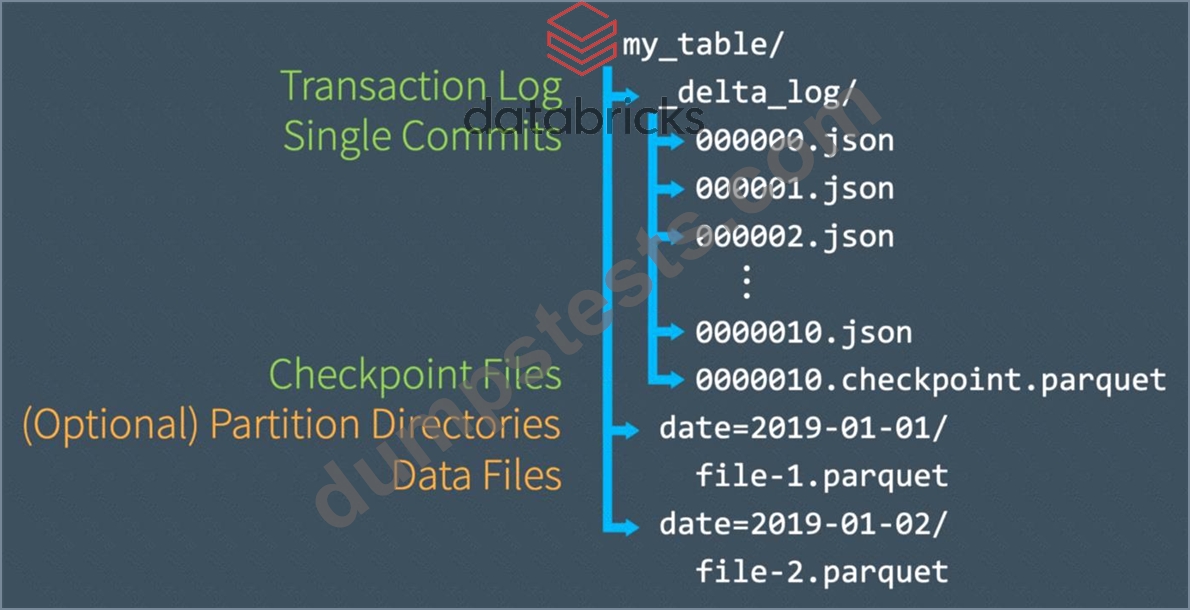
NEW QUESTION # 33
You are tasked to set up a set notebook as a job for six departments and each department can run the task parallelly, the notebook takes an input parameter dept number to process the data by department, how do you go about to setup this up in job?
- A. A task in the job cannot take an input parameter, create six notebooks with hardcoded dept number and setup six tasks with linear dependency in the job
- B. A parameter can only be passed at the job level, create six jobs pass department number to each job with linear job dependency
- C. A task accepts key-value pair parameters, creates six tasks pass department number as parameter foreach task with no dependency in the job as they can all run in parallel.
(Correct) - D. A parameter can only be passed at the job level, create six jobs pass department number to each job with no job dependency
- E. Use a single notebook as task in the job and use dbutils.notebook.run to run each note-book with parameter in a different cell
Answer: C
Explanation:
Explanation
Here is how you setup
Create a single job and six tasks with the same notebook and assign a different parameter for each task , Graphical user interface, text, application, email Description automatically generated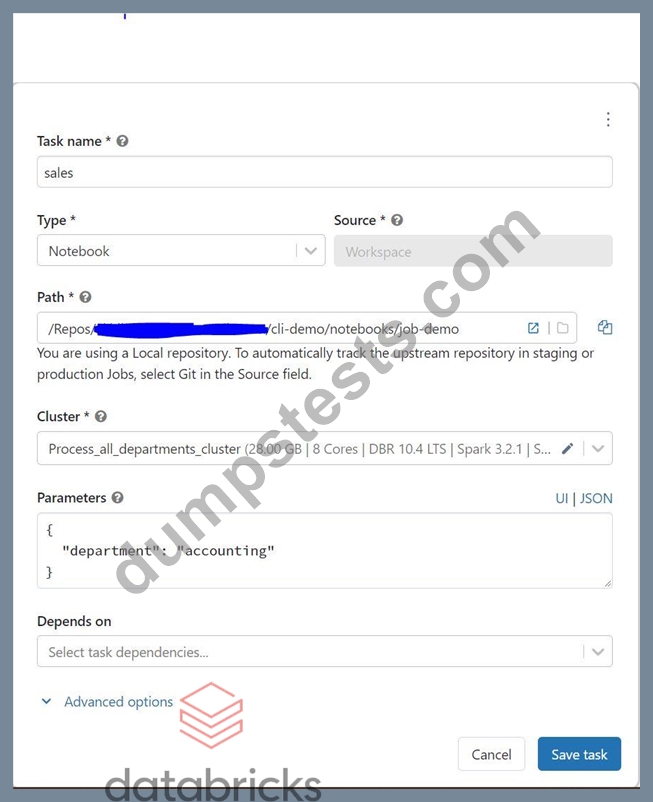
All tasks are added in a single job and can run parallel either using single shared cluster or with individual clusters.
Graphical user interface, application, Teams Description automatically generated
NEW QUESTION # 34
Which statement characterizes the general programming model used by Spark Structured Streaming?
- A. Structured Streaming is implemented as a messaging bus and is derived from Apache Kafka.
- B. Structured Streaming leverages the parallel processing of GPUs to achieve highly parallel data throughput.
- C. Structured Streaming relies on a distributed network of nodes that hold incremental state values for cached stages.
- D. Structured Streaming uses specialized hardware and I/O streams to achieve sub-second latency for data transfer.
- E. Structured Streaming models new data arriving in a data stream as new rows appended to an unbounded table.
Answer: E
Explanation:
This is the correct answer because it characterizes the general programming model used by Spark Structured Streaming, which is to treat a live data stream as a table that is being continuously appended. This leads to a new stream processing model that is very similar to a batch processing model, where users can express their streaming computation using the same Dataset/DataFrame API as they would use for static data. The Spark SQL engine will take care of running the streaming query incrementally and continuously and updating the final result as streaming data continues to arrive. Verified References: [Databricks Certified Data Engineer Professional], under "Structured Streaming" section; Databricks Documentation, under "Overview" section.
NEW QUESTION # 35
An upstream system is emitting change data capture (CDC) logs that are being written to a cloud object storage directory. Each record in the log indicates the change type (insert, update, or delete) and the values for each field after the change. The source table has a primary key identified by the fieldpk_id.
For auditing purposes, the data governance team wishes to maintain a full record of all values that have ever been valid in the source system. For analytical purposes, only the most recent value for each record needs to be recorded. The Databricks job to ingest these records occurs once per hour, but each individual record may have changed multiple times over the course of an hour.
Which solution meets these requirements?
- A. Iterate through an ordered set of changes to the table, applying each in turn; rely on Delta Lake's versioning ability to create an audit log.
- B. Create a separate history table for each pk_id resolve the current state of the table by running a union all filtering the history tables for the most recent state.
- C. Use merge into to insert, update, or delete the most recent entry for each pk_id into a bronze table, then propagate all changes throughout the system.
- D. Use Delta Lake's change data feed to automatically process CDC data from an external system, propagating all changes to all dependent tables in the Lakehouse.
- E. Ingest all log information into a bronze table; use merge into to insert, update, or delete the most recent entry for each pk_id into a silver table to recreate the current table state.
Answer: C
Explanation:
This is the correct answer because it meets the requirements of maintaining a full record of all values that have ever been valid in the source system and recreating the current table state with only the most recent value for each record. The code ingests all log information into a bronze table, which preserves the raw CDC data as it is. Then, it uses merge into to perform an upsert operation on a silver table, which means it will insert new records or update or delete existing records based on the change type and the pk_id columns. This way, the silver table will always reflect the current state of the source table, while the bronze table will keep the history of all changes. Verified References: [Databricks Certified Data Engineer Professional], under "Delta Lake" section; Databricks Documentation, under "Upsert into a table using merge" section.
NEW QUESTION # 36
Which of the statements is correct when choosing between lakehouse and Datawarehouse?
- A. Traditional Data warehouses have special indexes which are optimized for Machine learning
- B. SQL support is only available for Traditional Datawarehouse's, Lakehouses support Python and Scala
- C. Traditional Data warehouses are the preferred choice if we need to support ACID, Lakehouse does not support ACID.
- D. Lakehouse replaces the current dependency on data lakes and data warehouses uses an open standard storage format and supports low latency BI workloads.
- E. Traditional Data warehouses can serve low query latency with high reliability for BI workloads
Answer: D
Explanation:
Explanation
The lakehouse replaces the current dependency on data lakes and data warehouses for modern data companies that desire:
* Open, direct access to data stored in standard data formats.
* Indexing protocols optimized for machine learning and data science.
* Low query latency and high reliability for BI and advanced analytics.
NEW QUESTION # 37
A data engineering team has been using a Databricks SQL query to monitor the performance of an ELT job.
The ELT job is triggered by a specific number of input records being ready to process. The Databricks SQL
query returns the number of minutes since the job's most recent runtime.
Which of the following approaches can enable the data engineering team to be notified if the ELT job has not
been run in an hour?
- A. This type of alerting is not possible in Databricks
- B. They can set up an Alert for the query to notify them if the returned value is greater than 60
- C. They can set up an Alert for the accompanying dashboard to notify when it has not re-freshed in 60
minutes - D. They can set up an Alert for the accompanying dashboard to notify them if the returned value is greater
than 60 - E. They can set up an Alert for the query to notify when the ELT job fails
Answer: B
NEW QUESTION # 38
A newly joined team member John Smith in the Marketing team currently has access read access to sales tables but does not have access to update the table, which of the following commands help you accomplish this?
- A. GRANT UPDATE TO TABLE table_name ON [email protected]
- B. GRANT MODIFY ON TABLE table_name TO [email protected]
- C. GRANT USAGE ON TABLE table_name TO [email protected]
- D. GRANT MODIFY TO TABLE table_name ON [email protected]
- E. GRANT UPDATE ON TABLE table_name TO [email protected]
Answer: B
Explanation:
Explanation
The answer is GRANT MODIFY ON TABLE table_name TO [email protected]
https://docs.microsoft.com/en-us/azure/databricks/security/access-control/table-acls/object-privileges#privileges
NEW QUESTION # 39
Create a schema called bronze using location '/mnt/delta/bronze', and check if the schema exists before creating.
- A. CREATE SCHEMA IF NOT EXISTS bronze LOCATION '/mnt/delta/bronze'
- B. Schema creation is not available in metastore, it can only be done in Unity catalog UI
- C. if IS_SCHEMA('bronze'): CREATE SCHEMA bronze LOCATION '/mnt/delta/bronze'
- D. Cannot create schema without a database
- E. CREATE SCHEMA bronze IF NOT EXISTS LOCATION '/mnt/delta/bronze'
Answer: A
Explanation:
Explanation
https://docs.databricks.com/sql/language-manual/sql-ref-syntax-ddl-create-schema.html
1.CREATE SCHEMA [ IF NOT EXISTS ] schema_name [ LOCATION schema_directory ]
NEW QUESTION # 40
What is the output of below function when executed with input parameters 1, 3 :
1.def check_input(x,y):
2. if x < y:
3. x= x+1
4. if x>y:
5. x= x+1
6. if x <y:
7. x = x+1
8. return x
- A. 0
- B. 1
- C. 2
- D. 3
- E. 4
Answer: E
NEW QUESTION # 41
The data science team has created and logged a production using MLFlow. The model accepts a list of column names and returns a new column of type DOUBLE.
The following code correctly imports the production model, load the customer table containing the customer_id key column into a Dataframe, and defines the feature columns needed for the model.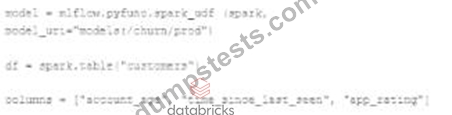
Which code block will output DataFrame with the schema'' customer_id LONG, predictions DOUBLE''?
- A. Df.apply(model, columns). Select (''customer_id, prediction''
- B. Model, predict (df, columns)
- C. Df, map (lambda k:midel (x [columns]) ,select (''customer_id predictions'')
- D. Df. Select (''customer_id''.
Model (''columns) alias (''predictions'')
Answer: B
Explanation:
Given the information that the model is registered with MLflow and assuming predict is the method used to apply the model to a set of columns, we use the model.predict() function to apply the model to the DataFrame df using the specified columns. The model.predict() function is designed to take in a DataFrame and a list of column names as arguments, applying the trained model to these features to produce a predictions column.
When working with PySpark, this predictions column needs to be selected alongside the customer_id to create a new DataFrame with the schema customer_id LONG, predictions DOUBLE.
References:
* MLflow documentation on using Python function models:
https://www.mlflow.org/docs/latest/models.html#python-function-python
* PySpark MLlib documentation on model prediction:
https://spark.apache.org/docs/latest/ml-pipeline.html#pipeline
NEW QUESTION # 42
Which statement characterizes the general programming model used by Spark Structured Streaming?
- A. Structured Streaming is implemented as a messaging bus and is derived from Apache Kafka.
- B. Structured Streaming leverages the parallel processing of GPUs to achieve highly parallel data throughput.
- C. Structured Streaming relies on a distributed network of nodes that hold incremental state values for cached stages.
- D. Structured Streaming uses specialized hardware and I/O streams to achieve sub-second latency for data transfer.
- E. Structured Streaming models new data arriving in a data stream as new rows appended to an unbounded table.
Answer: A
Explanation:
This is the correct answer because it characterizes the general programming model used by Spark Structured Streaming, which is to treat a live data stream as a table that is being continuously appended. This leads to a new stream processing model that is very similar to a batch processing model, where users can express their streaming computation using the same Dataset/DataFrame API as they would use for static data. The Spark SQL engine will take care of running the streaming query incrementally and continuously and updating the final result as streaming data continues to arrive. Verified References: [Databricks Certified Data Engineer Professional], under "Structured Streaming" section; Databricks Documentation, under "Overview" section.
NEW QUESTION # 43
A junior data engineer seeks to leverage Delta Lake's Change Data Feed functionality to create a Type 1 table representing all of the values that have ever been valid for all rows in abronzetable created with the propertydelta.enableChangeDataFeed = true. They plan to execute the following code as a daily job: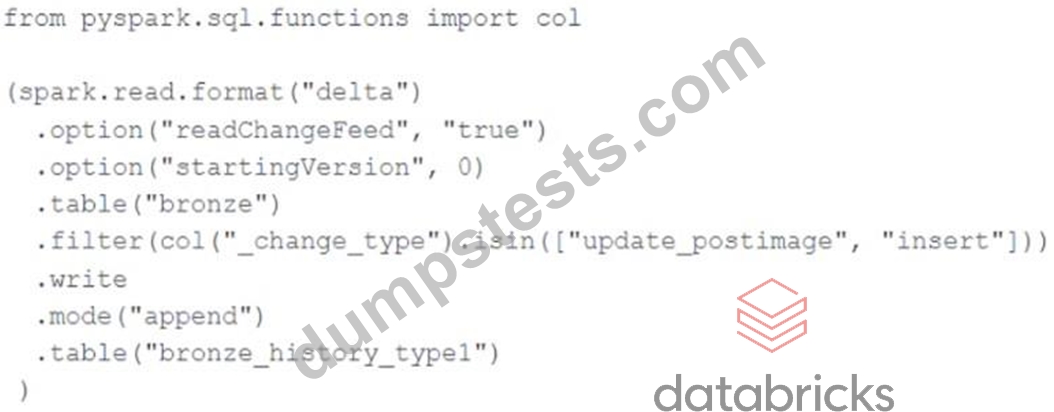
Which statement describes the execution and results of running the above query multiple times?
- A. Each time the job is executed, only those records that have been inserted or updated since the last execution will be appended to the target table giving the desired result.
- B. Each time the job is executed, the target table will be overwritten using the entire history of inserted or updated records, giving the desired result.
- C. Each time the job is executed, the differences between the original and current versions are calculated; this may result in duplicate entries for some records.
- D. Each time the job is executed, the entire available history of inserted or updated records will be appended to the target table, resulting in many duplicate entries.
- E. Each time the job is executed, newly updated records will be merged into the target table, overwriting previous values with the same primary keys.
Answer: B
Explanation:
Explanation
This is the correct answer because it describes the execution and results of running the above query multiple times. The query uses the readChanges function to read all change events from a bronze table that has enabled change data feed. The readChanges function takes two arguments: version and options. The version argument specifies which version of the table to read changes from, and can be either a specific version number or -1 to indicate all versions. The options argument specifies additional options for reading changes, such as whether to include deletes or not. In this case, the query reads all changes from all versions of the bronze table and filters out delete events by setting includeDeletes to false. Then, it uses write.format("delta").mode("overwrite") to overwrite a target table using the entire history of inserted or updated records, giving the desired result of a Type 1 table representing all values that have ever been valid for all rows in the bronze table. Verified References: [Databricks Certified Data Engineer Professional], under
"Delta Lake" section; Databricks Documentation, under "Read changes in batch queries" section.
NEW QUESTION # 44
A table named user_ltv is being used to create a view that will be used by data analysts on various teams.
Users in the workspace are configured into groups, which are used for setting up data access using ACLs.
The user_ltv table has the following schema:
email STRING, age INT, ltv INT
The following view definition is executed: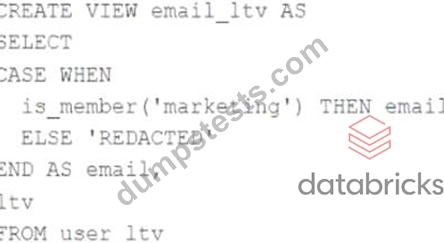
An analyst who is not a member of the marketing group executes the following query:
SELECT * FROM email_ltv
Which statement describes the results returned by this query?
- A. The email and ltv columns will be returned with the values in user itv.
- B. Only the email and ltv columns will be returned; the email column will contain the string
"REDACTED" in each row. - C. The email, age. and ltv columns will be returned with the values in user ltv.
- D. Three columns will be returned, but one column will be named "redacted" and contain only null values.
- E. Only the email and itv columns will be returned; the email column will contain all null values.
Answer: B
Explanation:
The code creates a view called email_ltv that selects the email and ltv columns from a table called user_ltv, which has the following schema: email STRING, age INT, ltv INT. The code also uses the CASE WHEN expression to replace the email values with the string "REDACTED" if the user is not a member of the marketing group. The user who executes the query is not a member of the marketing group, so they will only see the email and ltv columns, and the email column will contain the string "REDACTED" in each row.
Verified References: [Databricks Certified Data Engineer Professional], under "Lakehouse" section; Databricks Documentation, under "CASE expression" section.
NEW QUESTION # 45
You were asked to identify number of times a temperature sensor exceed threshold temperature (100.00) by each device, each row contains 5 readings collected every 5 minutes, fill in the blank with the appropriate functions.
Schema: deviceId INT, deviceTemp ARRAY<double>, dateTimeCollected TIMESTAMP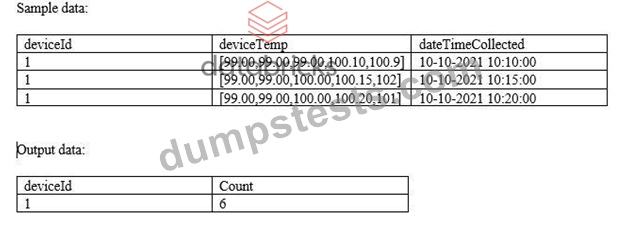
SELECT deviceId, __ (__ (__(deviceTemp], i -> i > 100.00)))
FROM devices
GROUP BY deviceId
- A. SUM, SIZE, SLICE
- B. SUM, COUNT, SIZE
- C. SUM, SIZE, ARRAY_FILTER
- D. SUM, SIZE, FILTER
- E. SUM, SIZE, ARRAY_CONTAINS
Answer: D
Explanation:
Explanation
FILER function can be used to filter an array based on an expression
SIZE function can be used to get size of an array
SUM is used to calculate to total by device
Diagram Description automatically generated
NEW QUESTION # 46
What are the different ways you can schedule a job in Databricks workspace?
- A. Continuous, Incremental
- B. Cron, On Demand runs
- C. Once, Continuous
- D. Cron, File notification from Cloud object storage
- E. On-Demand runs, File notification from Cloud object storage
Answer: B
Explanation:
Explanation
The answer is, Cron, On-Demand runs
Supports running job immediately or using can be scheduled using CRON syntax
NEW QUESTION # 47
......
Databricks-Certified-Professional-Data-Engineer certification exam is a valuable credential for data engineers who work with Databricks. Databricks Certified Professional Data Engineer Exam certification demonstrates the candidate's expertise in Databricks technology and data engineering concepts. Databricks Certified Professional Data Engineer Exam certification also demonstrates the candidate's commitment to professional development and continuous learning.
Databricks-Certified-Professional-Data-Engineer exam questions for practice in 2024 Updated 125 Questions: https://prep4sure.dumpstests.com/Databricks-Certified-Professional-Data-Engineer-latest-test-dumps.html