

[Dec 16, 2024] 100% Latest Most updated AZ-500 Questions and Answers
Try with 100% Real Exam Questions and Answers
To prepare for the exam, candidates can utilize various resources, including Microsoft's official study guide, online training courses, and practice exams. It is recommended that candidates have a solid understanding of Azure fundamentals and hands-on experience with Azure security technologies before taking the exam. Additionally, candidates must have experience with security technologies and concepts, including identity and access management, threat protection, and compliance management.
NEW QUESTION # 57
You plan to use Azure Resource Manager templates to perform multiple deployments of identically configured Azure virtual machines. The password for the administrator account of each deployment is stored as a secret in different Azure key vaults.
You need to identify a method to dynamically construct a resource ID that will designate the key vault containing the appropriate secret during each deployment. The name of the key vault and the name of the secret will be provided as inline parameters.
What should you use to construct the resource ID?
- A. a parameters file
- B. a linked template
- C. an automation account
- D. a key vault access policy
Answer: A
Explanation:
Explanation
https://docs.microsoft.com/en-us/azure/azure-resource-manager/templates/key-vault-parameter?tabs=azure-cli#re
NEW QUESTION # 58
You have an Azure subscription that contains the virtual machines shown in the following table.
Subnet1 and Subnet2 have a Microsoft.Storage service endpoint configured.
You have an Azure Storage account named storageacc1 that is configured as shown in the following exhibit.
For each of the following statements, select Yes if the statement is true. Otherwise, select No.
Answer:
Explanation: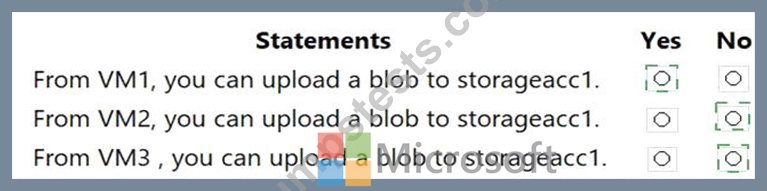
Explanation:
Box 1: Yes
The public IP of VM1 is allowed through the firewall.
Box 2: No
The allowed virtual network list is empty so VM2 cannot access storageacc1 directly. The public IP address of VM2 is not in the allowed IP list so VM2 cannot access storageacc1 over the Internet.
Box 3: No
The allowed virtual network list is empty so VM3 cannot access storageacc1 directly. VM3 does not have a public IP address so it cannot access storageacc1 over the Internet.
Reference:
https://docs.microsoft.com/en-gb/azure/storage/common/storage-network-security
NEW QUESTION # 59
What is the membership of Group1 and Group2? To answer, select the appropriate options in the answer area.
NOTE: Each correct selection is worth one point.
Answer:
Explanation:
Explanation
Box 1: User1, User2, User3, User4
Contains "ON" is true for Montreal (User1), MONTREAL (User2), London (User 3), and Ontario (User4) as string and regex operations are not case sensitive.
Box 2: Only User3
Match "*on" is only true for London (User3).
Scenario:
Contoso.com contains the users shown in the following table.
Contoso.com contains the security groups shown in the following table.
References:
https://docs.microsoft.com/en-us/azure/active-directory/users-groups-roles/groups-dynamic-membership
NEW QUESTION # 60
You have an Azure subscription that contains an Azure Data Lake Storage Gen2 account named storage1. You deploy an Azure Synapse Analytics workspace named synapsews1 to a managed virtual network. You need to enable access from synapsews1 to storage1. What should you configure?
- A. peering
- B. a private endpoint
- C. a network security group (NSG)
- D. a virtual network gateway
Answer: B
NEW QUESTION # 61
You are evaluating the security of VM1, VM2, and VM3 in Sub2.
For each of the following statements, select Yes if the statement is true. Otherwise, select No.
NOTE: Each correct selection is worth one point.
Answer:
Explanation: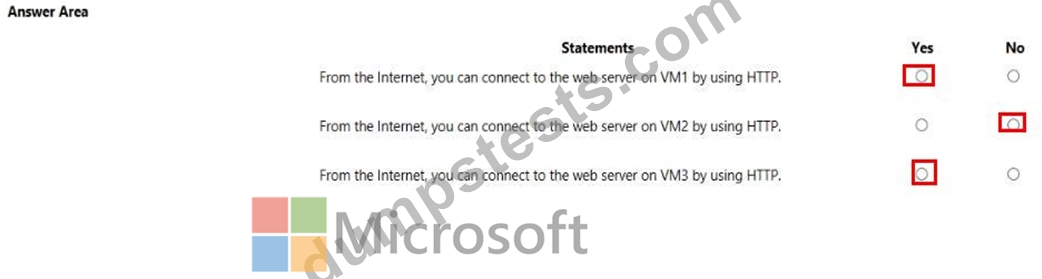
Topic 3, Fabrikam inc
Overview
This is a case study. Case studies are not timed separately. You can use as much exam time as you would like to complete each case. However, there may be additional case studies and sections on this exam. You must manage your time to ensure that you are able to complete all questions included on this exam in the time provided.
To answer the questions included in a case study, you will need to reference information that is provided in the case study. Case studies might contain exhibits and other resources that provide more information about the scenario that is described in the case study. Each question is independent of the other questions in this case study.
At the end of this case study, a review screen will appear. This screen allows you to review your answers and to make changes before you move to the next section of the exam. After you begin a new section, you cannot return to this section.
To start the case study
To display the first question in this case study, click the Next button. Use the buttons in the left pane to explore the content of the case study before you answer the questions. Clicking these buttons displays information such as business requirements, existing environment, and problem statements. If the case study has an All Information tab, note that the information displayed is identical to the information displayed on the subsequent tabs. When you are ready to answer a question, click the Question button to return to the question.
General Overview
Fabrikam, Inc. is a consulting company that has a main office in Montreal and branch offices in Seattle and New York. Fabrikam has IT, human resources (HR), and finance departments.
Existing Environment
Network Environment
Fabrikam has a Microsoft 365 subscription and an Azure subscription named subscription1.
The network contains an on-premises Active Directory domain named Fabrikam.com. The domain contains two organizational units (OUs) named OU1 and OU2. Azure AD Connect cloud sync syncs only OU1.
The Azure resources hierarchy is shown in the following exhibit.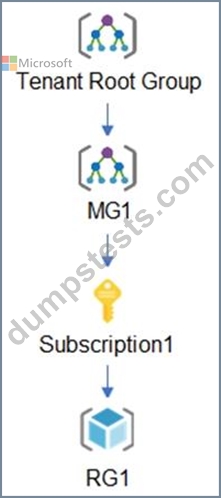
The Azure Active Directory (Azure AD) tenant contains the users shown in the following table.
Azure AD contains the resources shown in the following table.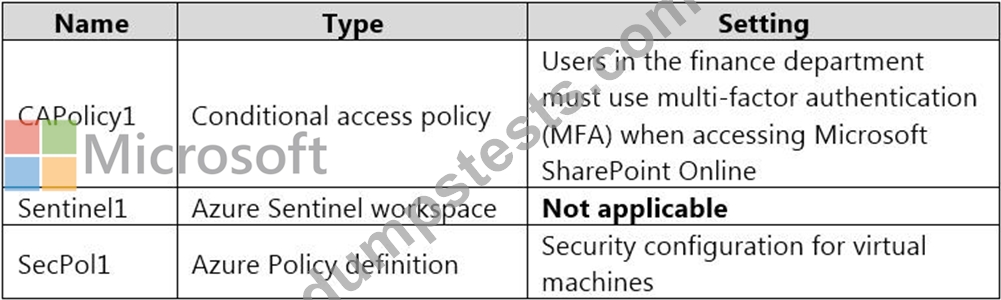
Subscription1 Resources
Subscription1 contains the virtual networks shown in the following table.
Subscription1 contains the network security groups (NSGs) shown in the following table.
Subscription1 contains the virtual machines shown in the following table.
Subscription1 contains the Azure key vaults shown in the following table.
Subscription1 contains a storage account named storage1 in the West US Azure region.
Planned Changes and Requirements
Planned Changes
Fabrikam plans to implement the following changes:
Create two application security groups as shown in the following table.
Associate the network interface of VM1 to ASG1.
Deploy SecPol1 by using Azure Security Center.
Deploy a third-party app named App1. A version of App1 exists for all available operating systems.
Create a resource group named RG2.
Sync OU2 to Azure AD.
Add User1 to Group1.
Technical Requirements
Fabrikam identifies the following technical requirements:
The finance department users must reauthenticate after three hours when they access SharePoint Online.
Storage1 must be encrypted by using customer-managed keys and automatic key rotation.
From Sentinel1, you must ensure that the following notebooks can be launched:
Entity Explorer - Account
Entity Explorer - Windows Host
Guided Investigation Process Alerts
VM1, VM2, and VM3 must be encrypted by using Azure Disk Encryption.
Just in time (JIT) VM access for VM1, VM2, and VM3 must be enabled.
App1 must use a secure connection string stored in KeyVault1.
KeyVault1 traffic must NOT travel over the internet.
NEW QUESTION # 62
You have an Azure subscription that contains the custom roles shown in the following table.
In the Azure portal, you plan to create new custom roles by cloning existing roles. The new roles will be configured as shown in the following table.
Which roles can you clone to create each new role? To answer, select the appropriate options in the answer area.
NOTE: Each correct selection is worth one point.
Answer:
Explanation:
Explanation:
Graphical user interface, text, application, email Description automatically generated
Reference:
https://docs.microsoft.com/en-us/azure/active-directory/roles/custom-create
https://docs.microsoft.com/en-us/azure/role-based-access-control/custom-roles-portal
NEW QUESTION # 63
You plan to use Azure Disk Encryption for several virtual machine disks.
You need to ensure that Azure Disk Encryption can retrieve secrets from the KeyVault11641655 Azure key vault.
To complete this task, sign in to the Azure portal and modify the Azure resources.
Answer:
Explanation:
See the explanation below.
Explanation
1. In the Azure portal, type Key Vaults in the search box, select Key Vaults from the search results then select KeyVault11641655. Alternatively, browse to Key Vaults in the left navigation pane.
2. In the Key Vault properties, scroll down to the Settings section and select Access Policies.
3. Select the Azure Disk Encryption for volume encryption
4. Click Save to save the changes.
NEW QUESTION # 64
You have an Azure subscription named Subscription1 that contains the resources shown in the following table.
You have an Azure subscription named Subscription2 that contains the following resources:
An Azure Sentinel workspace
An Azure Event Grid instance
You need to ingest the CEF messages from the NVAs to Azure Sentinel.
What should you configure for each subscription? To answer, select the appropriate options in the answer area.
NOTE: Each correct selection is worth one point.
Answer:
Explanation: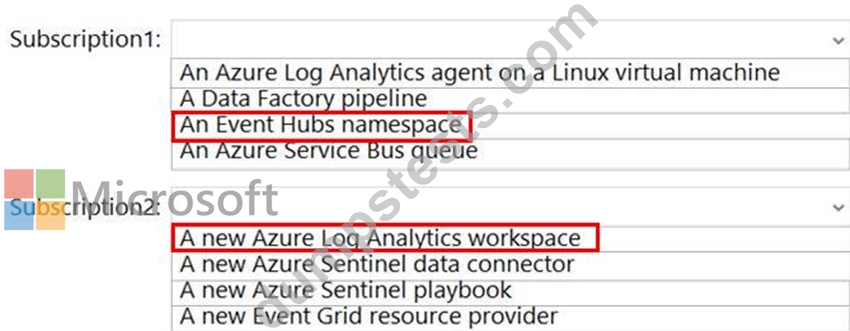
NEW QUESTION # 65
You have an Azure subscription that contains a user named Admin1 and a resource group named RG1.
In Azure Monitor, you create the alert rules shown in the following table.
Admin1 performs the following actions on RG1:
* Adds a virtual network named VNET1
* Adds a Delete lock named Lock1
Which rules will trigger an alert as a result of the actions of Admin1? To answer, select the appropriate options in the answer area.
NOTE: Each correct selection is worth one point.
Answer:
Explanation:
Explanation
NEW QUESTION # 66
You have the Azure virtual networks shown in the following table.
You have the Azure virtual machines shown in the following table.
The firewalls on all the virtual machines allow ping traffic.
NSG1 is configured as shown in the following exhibit.
Inbound security rules
Outbound security rules
For each of the following statements, select Yes if the statement is true. Otherwise, select No.
NOTE: Each correct selection is worth one point.
Answer:
Explanation:
Explanation:
NEW QUESTION # 67
You plan to use Azure Resource Manager templates to perform multiple deployments of identically configured Azure virtual machines. The password for the administrator account of each deployment is stored as a secret in different Azure key vaults.
You need to identify a method to dynamically construct a resource ID that will designate the key vault containing the appropriate secret during each deployment. The name of the key vault and the name of the secret will be provided as inline parameters.
What should you use to construct the resource ID?
- A. a parameters file
- B. a linked template
- C. an automation account
- D. a key vault access policy
Answer: A
Explanation:
Explanation
You reference the key vault in the parameter file, not the template. The following image shows how the parameter file references the secret and passes that value to the template.
Reference:
https://docs.microsoft.com/en-us/azure/azure-resource-manager/resource-manager-keyvault-parameter
NEW QUESTION # 68
You have an Azure subscription that contains the storage accounts shown in the following, table.
You enable Microsoft Defender for Storage.
Which storage services of storages are monitored by Microsoft Defender for Storage, and which storage accounts are protected by Microsoft Defender for Storage? To answer, select the appropriate options in the answer area.
Answer:
Explanation:
Answer as below.
NEW QUESTION # 69
You have an Azure subscription that contains the resources shown in the following table.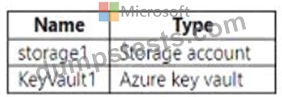
You need to configure storage1 to regenerate keys automatically every 90 days. Which cmdlet should you run?
- A. Add-AsKeyVaultmanageStorageAccount
- B. set -A=StorageAccount
- C. Set-A;StorageAccountimanagementPolicy
- D. Add-A:StorogcAccountmanagementPolicyAction
Answer: A
NEW QUESTION # 70
You need to deploy Microsoft Antimalware to meet the platform protection requirements.
What should you do? To answer, select the appropriate options in the answer area.
NOTE: Each correct selection is worth one point.
Answer:
Explanation: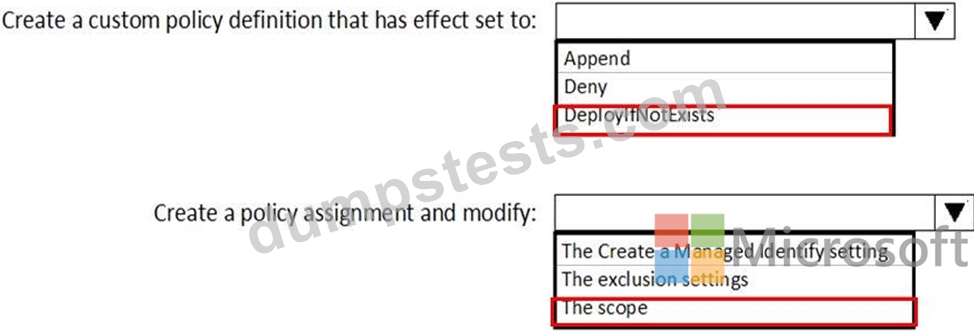
NEW QUESTION # 71
You have an Azure subscription that contains a storage account named storage1 and several virtual machines. The storage account and virtual machines are in the same Azure region. The network configurations of the virtual machines are shown in the following table.
The virtual network subnets have service endpoints defined as shown in the following table.
You configure the following Firewall and virtual networks settings for storage1:
Allow access from: Selected networks
Virtual networks: VNET3\Subnet3
Firewall - Address range: 52.233.129.0/24
For each of the following statements, select Yes if the statement is true. Otherwise, select No.
NOTE: Each correct selection is worth one point.
Answer:
Explanation:
NEW QUESTION # 72
You have an Azure subscription named Sub1 that contains an Azure Log Analytics workspace named LAW1.
You have 500 Azure virtual machines that run Windows Server 2016 and are enrolled in LAW1.
You plan to add the System Update Assessment solution to LAW1.
You need to ensure that System Update Assessment-related logs are uploaded to LAW1 from 100 of the virtual machines only.
Which three actions should you perform in sequence? To answer, move the appropriate actions from the list of actions to the answer area and arrange them in the correct order.
Answer:
Explanation:
References:
https://docs.microsoft.com/en-us/azure/azure-monitor/insights/solution-targeting
NEW QUESTION # 73
On Monday, you configure an email notification in Microsoft Defender for Cloud to notify user1
@contoso.com about alerts that have a severity level of Low, Medium, or High. On Tuesday, Microsoft Defender for Cloud generates the security alerts shown in the following table.
How many email notifications will user1 @contoso.com receive on Tuesday? To answer, select the appropriate options in the answer area. NOTE: Each correct selection is worth one point.
Answer:
Explanation:
Explanation
NEW QUESTION # 74
You have an Azure Active Directory (Azure AD) tenant named contoso.onmicrosoft.com.
The User administrator role is assigned to a user named Admin1.
An external partner has a Microsoft account that uses the [email protected] sign in.
Admin1 attempts to invite the external partner to sign in to the Azure AD tenant and receives the following error message: "Unable to invite user [email protected] Generic authorization exception." You need to ensure that Admin1 can invite the external partner to sign in to the Azure AD tenant.
What should you do?
- A. From the Roles and administrators blade, assign the Security administrator role to Admin1.
- B. From the Custom domain names blade, add a custom domain.
- C. From the Organizational relationships blade, add an identity provider.
- D. From the Users blade, modify the External collaboration settings.
Answer: D
Explanation:
You need to allow guest invitations in the External collaboration settings.
NEW QUESTION # 75
You have an Azure subscription that contains the resources shown in the following table.
User1 is a member of Group1. Group1 and User2 are assigned the Key Vault Contributor role for Vault1.
On January 1, 2019, you create a secret in Vault1. The secret is configured as shown in the exhibit. (Click the Exhibit tab.)
User2 is assigned an access policy to Vault1. The policy has the following configurations:
Key Management Operations: Get, List, and Restore
Cryptographic Operations: Decrypt and Unwrap Key
Secret Management Operations: Get, List, and Restore
Group1 is assigned an access to Vault1. The policy has the following configurations:
Key Management Operations: Get and Recover
Secret Management Operations: List, Backup, and Recover
For each of the following statements, select Yes if the statement is true. Otherwise, select No.
Answer:
Explanation: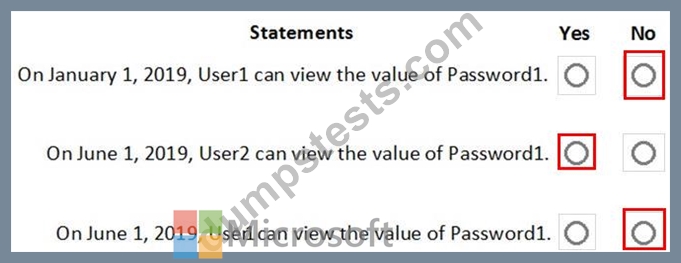
NEW QUESTION # 76
......
Earning the Microsoft AZ-500 certification demonstrates your expertise in securing Azure cloud services and can help you advance your career in the cloud security field. Microsoft Azure Security Technologies certification is also a prerequisite for other advanced Azure certifications, such as the Microsoft Certified: Azure Security Engineer Associate.
Microsoft AZ-500 exam is designed to test an individual's understanding and proficiency in various security aspects of the Azure platform. Microsoft Azure Security Technologies certification is suitable for security professionals, Azure architects, and anyone who is responsible for securing the Azure environment. It covers topics such as identity and access management, platform protection, data and application protection, and security management.
New Microsoft AZ-500 Dumps & Questions: https://prep4sure.dumpstests.com/AZ-500-latest-test-dumps.html