

[Jan-2022] Verified Admission Tests GRE Bundle Real Exam Dumps PDF
GRE Dumps PDF New [2022] Ultimate Study Guide
NEW QUESTION 163
The public has not reacted favorably to the majority of the policies adopted by the present government. If.
however, the electoral landslide by which the government achieved power five years ago was. as is often claimed, a mandate for more conservative policies, then the public response to most of the government's policies would have been favorable.
If the statements in the passage are true, which of the following must also be true on the basis of them?
- A. None of the policies adopted by the present government to which the public has responded favorably are conservative policies.
- B. The electoral landslide by which the present government achieved power was not a mandate for more conservative policies.
- C. The public would have reacted more favorably to the policies adopted by the present government if those policies had been more conservative.
- D. Most of the people who voted for the present government would have voted for an opposition party if they had not been misled about the policies that would be adopted.
- E. The present government will be voted out of office at the next election.
Answer: B
NEW QUESTION 164
A large cube and a small cube are made of granite of uniform density- The large cube has edges of length 1.2 meters and weighs 4.752 kilograms. If the small cube has edges of length 10 centimeters, what is the weight, in grains, of the small cube?
- A. 3.960
- B. 0
- C. 2.750
- D. 1
- E. 2
Answer: B
NEW QUESTION 165 
For each integer ;; greater than I. the sum of the first a positive integers is given by the formula shown.
If the average (arithmetic mean) of the first // positive integers is k. what is the sum of the first n positive integers in terms of k ?
A)
B)
C)
D)
E)
- A. Option E
- B. Option C
- C. Option B
- D. Option A
- E. Option D
Answer: E
NEW QUESTION 166
American history scholars generally attribute formation of the League of Indian Nations to Degandawida, who convinced the warring and fiercely autonomous Iroquois nations to embrace his radical idea for a league by tying it to familiar Iroquois customs and institutions. He associated the notion of peace and partnership with the Iroquois custom by which the families of slain warriors adopted war prisoners into the tribe. He invoked unquestioned social institutions as symbols, comparing the League to the traditional Iroquois clan in which several families share a "Longhouse" and likening the Great Council, comprised of representatives from each nation, to the Longhouse's ever-burning Council Fire. And he assigned to each nation specific duties in order to assuage its fear of losing national identity. (For instance, he assigned to the Onondagas, who were centrally positioned geographically, the role of perpetual hosts.) Perhaps most persuasive, however, was how Degandawida's League replicated the power structure of the traditional Iroquois clan. Each of the five Iroquois nations was comprised of matriarchal totemic clans in which the chiefs were men, the clan heads were women, and the chief's children were considered members of his wife's clan. Degandawida determined that the heads of each nation should select their League representatives, thereby effectively precluding the possibility of League representatives passing their power on to their sons, as well as decreasing the likelihood that a pro-war representative would be appointed. Iroquois unification under the League lasted about two centuries, when disagreement as to whether to become involved in the American Revolutionary war divided the Iroquois. The revolutionaries' success and their subsequent encroachment upon Iroquois lands forced many Iroquois to resettle in Canada, while those who remained behind lost respect from other Indian nations. The introduction of distilled spirits led to widespread alcoholism and, in turn, to a rapid decline of the culture and population.
The Quakers' influence impeded, yet in another sense contributed, to this decline. By establishing schools for the Iroquois and by introducing them to modern technology for agriculture and husbandry, the Quakers instilled some hope for the future yet undermined their sense of national identity. Ironically, it was the alcoholic halfbrother of Seneca, Cornplanter, the most outspoken proponent among the Iroquois for assimilation of white customs and institutions, who revived the Iroquois culture. Around 1800, Handsome Lake, a former member of the Great Council, established a new religion among the Iroquois that tied the more useful aspects of Christianity to traditional Indian beliefs and customs. Lake's teachings quickly became firmly entrenched among the Iroquois, sparking reunification and renewed confidence while also curbing rampant alcoholism. Lake's influence is still evident today: many modern- day Iroquois belong both to his religion and to one or another Christian sect.
The passage mentions all of the following developments as contributing factors in the decline of the Iroquois culture EXCEPT for
- A. new educational opportunities for the Iroquois people
- B. introduction of new farming technologies
- C. territorial threats against the Iroquois nations
- D. discord among the nations regarding their role in the American Revolution
- E. divisive power struggles among the leaders of the Iroquois nations
Answer: E
Explanation:
Explanation/Reference:
Explanation:
Nowhere in this passage does the author mention any power struggles among the leaders of the Iroquois nations. Although the third paragraph does refer to a dispute among the Iroquois leaders, the dispute involved the role that the Iroquois should play in the American Revolution (choice E).
NEW QUESTION 167
NATAL : GESTATION ::
- A. feeble : cowardice
- B. truthful : proof
- C. humble : conceit
- D. conclusive : premise
- E. wealthy : investment
Answer: D
Explanation:
Explanation/Reference:
Explanation:
This is a "necessary condition" analogy. GESTATION means "pregnancy"; NATAL means "pertaining to birth." Thus, gestation is a necessary condition for and must precede a birth. Similarly, a premise is a necessary condition for and must precede a conclusion.
NEW QUESTION 168
SPARK : CONFLAGRATION ::
- A. volcano : eruption
- B. match : light
- C. sugar : sweetness
- D. drizzle : downpour
- E. yeast : fermentation
Answer: D
Explanation:
Explanation/Reference:
Explanation:
This is a "degree of" analogy. A SPARK is a very small fire, while a CONFLAGRATION is a very large fire.
The relationship is one of degree. Similarly, a drizzle is a very light rain, while a downpour is very heavy rain.
NEW QUESTION 169 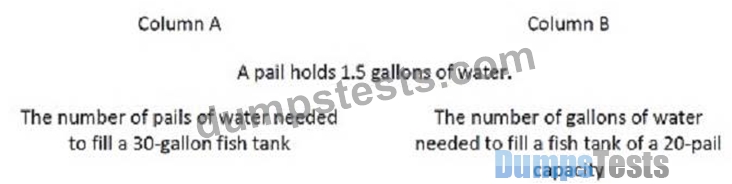
- A. The quantities are equal;
- B. The quantity in Column A is greater;
- C. The quantity in Column B is greater;
- D. The relationship cannot be determined from the information given.
Answer: C
Explanation:
Explanation/Reference:
Explanation:

Quantity A
; Quantity B
NEW QUESTION 170
The poet Paul Laurence Dunbar (1872-1906) was the premier Black writer of poetry that used the dialect of rural African Americans of the southern United States. Although Dunbar's works were both popular with readers and acclaimed by literary critics during his lifetime, after the First World War a radical shift occurred, at least in critical opinion of his poetry, and twentieth-century critical evaluation of his work has been generally negative. Some critics attacked his work on social grounds for failing to challenge plantation stereotypes of African Americans. Other critics, such as the poet James Weldon Johnson, argued from aesthetic grounds that dialect poetry in general was too limited as an artistic medium, and capable of producing only two effects: pathos and humor. The negative critical trend only began to reverse itself in the
1970s, when scholars began to emphasize the importance of mythic, psychological, and historical dimensions of Dunbar's works, focusing on the interior and exterior realities of African American life after the Civil War.
Which of the following general criticisms of dialect poetry is mentioned in the passage?
- A. The use of dialect in poetry tends to perpetuate plantation stereotypes of African Americans.
- B. Dialect poetry has only a limited degree of popular appeal
- C. Dialect poetry is highly limited in the number of artistic effects it can produce.
- D. Dialect poetry too often uses only the dialect of African Americans living in rural areas of the southern United States.
- E. Dialect poetry fails to represent mythic, psychological, and historical dimensions of experience.
Answer: C
NEW QUESTION 171
American history scholars generally attribute formation of the League of Indian Nations to Degandawida, who convinced the warring and fiercely autonomous Iroquois nations to embrace his radical idea for a league by tying it to familiar Iroquois customs and institutions. He associated the notion of peace and partnership with the Iroquois custom by which the families of slain warriors adopted war prisoners into the tribe. He invoked unquestioned social institutions as symbols, comparing the League to the traditional Iroquois clan in which several families share a "Longhouse" and likening the Great Council, comprised of representatives from each nation, to the Longhouse's ever-burning Council Fire. And he assigned to each nation specific duties in order to assuage its fear of losing national identity. (For instance, he assigned to the Onondagas, who were centrally positioned geographically, the role of perpetual hosts.) Perhaps most persuasive, however, was how Degandawida's League replicated the power structure of the traditional Iroquois clan. Each of the five Iroquois nations was comprised of matriarchal totemic clans in which the chiefs were men, the clan heads were women, and the chief's children were considered members of his wife's clan. Degandawida determined that the heads of each nation should select their League representatives, thereby effectively precluding the possibility of League representatives passing their power on to their sons, as well as decreasing the likelihood that a pro-war representative would be appointed. Iroquois unification under the League lasted about two centuries, when disagreement as to whether to become involved in the American Revolutionary war divided the Iroquois. The revolutionaries' success and their subsequent encroachment upon Iroquois lands forced many Iroquois to resettle in Canada, while those who remained behind lost respect from other Indian nations. The introduction of distilled spirits led to widespread alcoholism and, in turn, to a rapid decline of the culture and population.
The Quakers' influence impeded, yet in another sense contributed, to this decline. By establishing schools for the Iroquois and by introducing them to modern technology for agriculture and husbandry, the Quakers instilled some hope for the future yet undermined their sense of national identity. Ironically, it was the alcoholic halfbrother of Seneca, Cornplanter, the most outspoken proponent among the Iroquois for assimilation of white customs and institutions, who revived the Iroquois culture. Around 1800, Handsome Lake, a former member of the Great Council, established a new religion among the Iroquois that tied the more useful aspects of Christianity to traditional Indian beliefs and customs. Lake's teachings quickly became firmly entrenched among the Iroquois, sparking reunification and renewed confidence while also curbing rampant alcoholism. Lake's influence is still evident today: many modern- day Iroquois belong both to his religion and to one or another Christian sect Assuming that the reasons asserted in the passage for the decline of the Iroquois culture are historically representative of the decline of cultural minorities, which of the following developments would most likely contribute to the demise of a modern- day ethnic minority?
- A. The declaration of a national holiday commemorating a past war in which the minority group played an active role
- B. A bilingual education program in which children who are members of the minority group learn to read and write in both their traditional language and the language prevalent in the present culture
- C. A government-sponsored program to assist minority owned businesses in using computer technology to improve efficiency
- D. A tax credit for residential property owners who lease their property to members of the minority group
- E. Increased efforts by local government to eradicate the availability of illegal drugs
Answer: C
Explanation:
Explanation/Reference:
Explanation:
According to the passage, the Quakers' introduction of new technology to the Iroquois was partly responsible for the decline of the Iroquois culture in that it contributed to their loss of national identity.
Choice D presents a similar situation. Choice A is the second-best choice. Insofar as the children referred to in scenario choice A learn the language of the prevailing culture, assimilation and a resulting loss of ethnic identity might tend to occur. However, this sense of identity might be reinforced by their learning to read and write in their traditional language as well. Therefore, choice A is not as likely to lead to the demise of the minority group as choice (D), based upon the Iroquois' experience as discussed in the passage.
NEW QUESTION 172 
- A. Quantity A is greater.
- B. The two quantities are equal.
- C. Quantity B is greater.
- D. The relationship cannot be determined from the information given.
Answer: B
NEW QUESTION 173
Marie Curie was one of the most accomplished scientists in history. Together with her husband, Pierre, she discovered radium, an element widely used for treating cancer, and studied uranium and other radioactive substances. Pierre and Marie's amicable collaboration later helped to unlock the secrets of the atom. Marie was born in 1867 in Warsaw, Poland, where her father was a professor of physics. At the early age, she displayed a brilliant mind and a blithe personality. Her great exuberance for learning prompted her to continue with her studies after high school. She became disgruntled, however, when she learned that the university in Warsaw was closed to women.
Determined to receive a higher education, she defiantly left Poland and in 1891 entered the Sorbonne, a French university, where she earned her master's degree and doctorate in physics. Marie was fortunate to have studied at the Sorbonne with some of the greatest scientists of her day, one of whom was Pierre Curie. Marie and Pierre were married in 1895 and spent many productive years working together in the physics laboratory. A short time after they discovered radium, Pierre was killed by a horse-drawn wagon in
1906. Marie was stunned by this horrible misfortune and endured heartbreaking anguish. espondently she recalled their close relationship and the joy that they had shared in scientific research. The fact that she had two young daughters to raise by herself greatly increased her distress. Curie's feeling of desolation finally began to fade when she was asked to succeed her husband as a physics professor at the Sorbonne. She was the first woman to be given a professorship at the world-famous university. In 1911 she received the Nobel Prize in chemistry for isolating radium. Although Marie Curie eventually suffered a fatal illness from her long exposure to radium, she never became disillusioned about her work. Regardless of the consequences, she had dedicated herself to science and to revealing the mysteries of the physical world.
Marie ___ by leaving Poland and traveling to France to enter the Sorbonne.
- A. was distressed
- B. showed intelligence
- C. answer not available in article
- D. challenged authority
- E. behaved
Answer: D
Explanation:
Explanation/Reference:
Explanation:
NEW QUESTION 174
Suburbanization arguably ushered in numerous changes in (he way many people in the United States lived: the suburbs_________a society based on unprecedented consumption and intense privacy.
- A. enlivened
- B. validated
- C. represented
- D. inaugurated
- E. engendered
- F. affirmed
Answer: B,F
NEW QUESTION 175
American history scholars generally attribute formation of the League of Indian Nations to Degandawida, who convinced the warring and fiercely autonomous Iroquois nations to embrace his radical idea for a league by tying it to familiar Iroquois customs and institutions. He associated the notion of peace and partnership with the Iroquois custom by which the families of slain warriors adopted war prisoners into the tribe. He invoked unquestioned social institutions as symbols, comparing the League to the traditional Iroquois clan in which several families share a "Longhouse" and likening the Great Council, comprised of representatives from each nation, to the Longhouse's ever-burning Council Fire. And he assigned to each nation specific duties in order to assuage its fear of losing national identity. (For instance, he assigned to the Onondagas, who were centrally positioned geographically, the role of perpetual hosts.) Perhaps most persuasive, however, was how Degandawida's League replicated the power structure of the traditional Iroquois clan. Each of the five Iroquois nations was comprised of matriarchal totemic clans in which the chiefs were men, the clan heads were women, and the chief's children were considered members of his wife's clan. Degandawida determined that the heads of each nation should select their League representatives, thereby effectively precluding the possibility of League representatives passing their power on to their sons, as well as decreasing the likelihood that a pro-war representative would be appointed. Iroquois unification under the League lasted about two centuries, when disagreement as to whether to become involved in the American Revolutionary war divided the Iroquois. The revolutionaries' success and their subsequent encroachment upon Iroquois lands forced many Iroquois to resettle in Canada, while those who remained behind lost respect from other Indian nations. The introduction of distilled spirits led to widespread alcoholism and, in turn, to a rapid decline of the culture and population.
The Quakers' influence impeded, yet in another sense contributed, to this decline. By establishing schools for the Iroquois and by introducing them to modern technology for agriculture and husbandry, the Quakers instilled some hope for the future yet undermined their sense of national identity. Ironically, it was the alcoholic halfbrother of Seneca, Cornplanter, the most outspoken proponent among the Iroquois for assimilation of white customs and institutions, who revived the Iroquois culture. Around 1800, Handsome Lake, a former member of the Great Council, established a new religion among the Iroquois that tied the more useful aspects of Christianity to traditional Indian beliefs and customs. Lake's teachings quickly became firmly entrenched among the Iroquois, sparking reunification and renewed confidence while also curbing rampant alcoholism. Lake's influence is still evident today: many modern- day Iroquois belong both to his religion and to one or another Christian sect Which of the following best characterizes the structure of the passage as a whole?
- A. Competing views respecting an historical phenomenon are presented and then valuated based upon empirical evidence.
- B. An historical event is recounted; then possible explanations for the event are presented
- C. A theory is presented and then applied to two related historical phenomena.
- D. The inception of an historical phenomenon is examined; then the subsequent life of the phenomenon is traced.
- E. Two historical figures are introduced; then the nature and extent of their influence are compared.
Answer: D
Explanation:
Explanation/Reference:
Explanation:
The first and second paragraphs are concerned with the inception of the Iroquois League, while the third and fourth paragraphs outline the subsequent history of the League from its decline through its subsequent resurgence under Handsome Lake. Choice C recapitulates this overall structure.
NEW QUESTION 176
The village of Vestmannaeyjar, in the far northern country of Iceland, is as bright and clean and up-to-date as any American or Canadian suburb. It is located on the island of Heimaey, just off the mainland. One January night in 1973, however, householders were shocked from their sleep. In some backyards red-hot liquid was spurting from the ground.
Flaming "skyrockets" shot up and over the houses. The island's volcano, Helgafell, silent for seven thousand years, was violently erupting! Luckily, the island's fishing fleet was in port, and within twenty-four hours almost everyone was ferried to the mainland. But then the agony of the island began in earnest. As in a nightmare, fountains of burning lava spurted three hundred feet high. Black, baseball-size cinders rained down. An evilsmelling, eye-burning, throat-searing cloud of smoke and gas erupted into the air, and a river of lava flowed down the mountain. The constant shriek of escaping steam was punctuated by ear- splitting explosions. As time went on, the once pleasant village of Vestmannaeyjar took on a weird aspect.
Its street lamps still burning against the long Arctic night, the town lay under a thick blanket of cinders. All that could be seen above the ten-foot black drifts were the tips of street signs. Some houses had collapsed under the weight of cinders; others had burst into flames as the heat ignited their oil storage tanks. Lighting the whole lurid scene, fire continued to shoot from the mouth of the looming volcano. The eruption continued for six months. Scientists and reporters arrived from around the world to observe the awesome natural event. But the town did not die that easily. In July, when the eruption ceased, the people of Heimaey Island returned to assess the chances of rebuilding their homes and lives. They found tons of ash covering the ground. The Icelanders are a tough people, however, accustomed to the strange and violent nature of their Arctic land. They dug out their homes. They even used the cinders to build new roads and airport runways. Now the new homes of Heimaey are warmed from water pipes heated by molten lava.
The island's volcano had been inactive for ...
- A. seven hundred years
- B. seventy years
- C. seven thousand years
- D. seven thousand months
- E. seventy decades
Answer: C
Explanation:
Explanation/Reference:
Explanation:
NEW QUESTION 177
Exhibit.
- A. Quantity A is greater.
- B. The two quantities are equal.
- C. Quantity B is greater.
- D. The relationship cannot be determined from the information given.
Answer: A
NEW QUESTION 178
......
Pass Your Admission Tests Exam with GRE Exam Dumps: https://prep4sure.dumpstests.com/GRE-latest-test-dumps.html