

Latest [Jan 07, 2025] Realistic Verified Data-Architect Dumps
Pass Salesforce Data-Architect Exam Updated 260 Questions
Salesforce Data-Architect (Salesforce Certified Data Architect) Exam is a certification exam that focuses on testing an individual's knowledge and skills in designing and managing complex data architectures on the Salesforce platform. Data-Architect exam is designed for individuals who have a deep understanding of Salesforce data management concepts, data modeling, and architecture principles. Passing Data-Architect exam demonstrates a candidate's ability to design and implement complex data solutions on the Salesforce platform.
NEW QUESTION # 132
NTO has a loyalty program to reward repeat customers. The following conditions exists:
1. Reward levels are earned based on the amount spent during the previous 12 months.
2. The program will track every item a customer has bought and grant them points for discount.
3. The program generates 100 million records each month.
NTO customer support would like to see a summary of a customer's recent transaction and reward level(s) they have attained.
Which solution should the data architect use to provide the information within the salesforce for the customer support agents?
- A. Create a custom object in salesforce to capture and store all reward program. Populate nightly from the point-of-scale system, and present on the customer record.
- B. Create a custom big object to capture the reward program data and display it on the contact record and update nightly from the point-of-scale system.
- C. Capture the reward program data in an external data store and present the 12 months trailing summary in salesforce using salesforce connect and then external object.
- D. Provide a button so that the agent can quickly open the point of sales system displaying the customer history.
Answer: B
NEW QUESTION # 133
Universal Containers has a large number of Opportunity fields (100) that they want to track field history on. Which two actions should an architect perform in order to meet this requirement? Choose 2 answers
- A. Create a custom object to store the previous and new field values.
- B. Create a custom object to store a copy of the record when changed.
- C. Select the 100 fields in the Opportunity Set History Tracking page.
- D. Use Analytic Snapshots to store a copy of the record when changed.
Answer: A,B
Explanation:
Creating a custom object to store a copy of the record when changed and creating a custom object to store the previous and new field values are two possible actions that an architect can perform to meet the requirement of tracking field history on 100 Opportunity fields. A custom object can store more fields and records than the standard field history tracking feature, which has a limit of 20 fields per object and 18 or 24 months of data retention. A custom object can also be used for reporting and analysis of field history data. The other options are not feasible or effective for meeting the requirement
NEW QUESTION # 134
For a production cutover, a large number of Account records will be loaded into Salesforce from a legacy system. The legacy system does not have enough information to determine the Ownership for these Accounts upon initial load. Which two recommended options assign Account ownership to mitigate potential performance problems?
- A. Let a "system user" own all the Account records and make this user part of the highest-level role in the Role Hierarchy.
- B. Let the VP of the Sales department, who will report directly to the senior VP, own all the Account records.
- C. Let a "system user" own the Account records and assign this user to the lowest-level role in the Role Hierarchy.
- D. Let a "system user" own all the Account records without assigning any role to this user in Role Hierarchy.
Answer: C,D
Explanation:
The two recommended options to assign Account ownership to mitigate potential performance problems are to let a "system user" own all the Account records without assigning any role to this user in Role Hierarchy, or to let a "system user" own the Account records and assign this user to the lowest-level role in the Role Hierarchy. This is because these options would reduce the number of sharing calculations and rules that need to be applied to the Account records, and improve the performance and scalability of the system34. The other options are not recommended, as they would increase the sharing complexity and overhead, and potentially expose sensitive data to unauthorized users.
NEW QUESTION # 135
US is implementing salesforce and will be using salesforce to track customer complaints, provide white papers on products and provide subscription (Fee) - based support.
Which license type will US users need to fulfil US's requirements?
- A. Salesforce license.
- B. Lightning platform starter license.
- C. Sales cloud license
- D. Service cloud license.
Answer: D
NEW QUESTION # 136
Universal Containers (UC) is implementing a formal, cross -business -unit data governance program As part of the program, UC will implement a team to make decisions on enterprise -wide data governance. Which two roles are appropriate as members of this team? Choose 2 answers
- A. Salesforce Administrators
- B. Data Domain Stewards
- C. Analytics/BI Owners
- D. Operational Data Users
Answer: B,C
Explanation:
Analytics/BI Owners and Data Domain Stewards are appropriate roles as members of a team that makes decisions on enterprise-wide data governance. Analytics/BI Owners are responsible for defining the business requirements and metrics for data analysis and reporting, and Data Domain Stewards are responsible for defining and enforcing the data quality standards and rules for specific data domains. Salesforce Administrators and Operational Data Users are not suitable roles for this team, as they are more focused on the operational aspects of data management, such as configuration, maintenance, and usage.
NEW QUESTION # 137
In their legacy system. Universal Containers has a monthly accounts receivable report that compiles data from Accounts, Contacts, Opportunities, Orders. and Order Line Items. What difficulty will an architect run into when implementing this in Salesforce?
- A. Salesforce does not support Orders or Order Line Items.
- B. A report cannot contain data from Accounts and Contacts.
- C. Salesforce allows up to four objects in a single report type.
- D. Custom report types cannot contain Opportunity data.
Answer: C
NEW QUESTION # 138
Universal Containers (UC) uses the following Salesforce products:
Sales Cloud for customer management.
Marketing Cloud for marketing.
Einstein Analytics for business reporting.
UC occasionally gets a list of prospects from third-party source as comma-separated values (CSV) files for marketing purposes. Historically, UC would load contact Lead object in Salesforce and sync to Marketing Cloud to send marketing communications. The number of records in the Lead object has grown over time and has been consuming large amounts of storage in Sales Cloud, UC is looking for recommendations to reduce the storage and advice on how to optimize the marketing Cloud to send marketing communications. The number of records in the Lead object has grown over time and has been consuming large amounts of storage in Sales Cloud, UC is looking for recommendations to reduce the storage and advice on how to optimize the marketing process.
What should a data architect recommend to UC in order to immediately avoid storage issues in the future?
- A. Continue to use the existing process to use Lead object to sync with Marketing Cloud and delete Lead records from Sales after the sync is complete.
- B. Load the contacts directly to Marketing Cloud and have a reconciliation process to track prospects that are converted to customers.
- C. Load the CSV files in Einstein Analytics and sync with Marketing Cloud prior to sending marketing communications ;
- D. Load the CSV files in an external database and sync with Marketing Cloud prior to sending marketing communications.
Answer: C
NEW QUESTION # 139
Universal Containers (UC) has implemented Sales Cloud and it has been noticed that Sales reps are not entering enough data to run insightful reports and dashboards. UC executives would like to monitor and measure data quality metrics. What solution addresses this requirement?
- A. Export the data to an enterprise data warehouse and use BI tools for data quality.
- B. Use custom objects and fields to calculate data quality.
- C. Use third-party AppExchange tools to monitor and measure data quality.
- D. Generate reports to view the quality of sample data.
Answer: C
Explanation:
Using third-party AppExchange tools to monitor and measure data quality can address the requirement of UC executives by providing features such as data cleansing, deduplication, validation, enrichment, and scoring.
These tools can help improve the accuracy, completeness, and consistency of the data entered by sales reps .
NEW QUESTION # 140
Cloud Kicks has the following requirements:
* Their Shipment custom object must always relate to a Product, a Sender, and a Receiver (all separate custom objects).
* If a Shipment is currently associated with a Product, Sender, or Receiver, deletion of those records should not be allowed.
* Each custom object must have separate sharing models.
What should an Architect do to fulfill these requirements?
- A. Associate the Shipment to each parent record by using a VLOOKUP formula field.
- B. Create a required Lookup relationship to each of the three parent records.
- C. Create two Master-Detail and one Lookup relationship to the parent records.
- D. Create a Master-Detail relationship to each of the three parent records.
Answer: B
NEW QUESTION # 141
Universal Containers is creating a new B2C service offering for consumers to ship goods across continents. This is in addition to their well-established B2B offering. Their current Salesforce org uses the standard Account object to track B2B customers. They are expecting to have over 50,000,000 consumers over the next five years across their 50 business regions. B2C customers will be individuals. Household data is not required to be stored. What is the recommended data model for consumer account data to be stored in Salesforce?
- A. Use 50 umbrella Accounts for each region, with customers as associated Contacts.
- B. Create a new picklist value for B2C customers on the Account Type field.
- C. Use the Account object with Person Accounts and a new B2C page layout.
- D. Use the Account object with a newly created Record Type for B2C customers.
Answer: C
NEW QUESTION # 142
Universal Containers is creating a new B2C service offering for consumers to ship goods across continents.
This is in addition to their well-established B2B offering. Their current Salesforce org uses the standard Account object to track B2B customers. They are expecting to have over 50,000,000 consumers over the next five years across their 50 business regions. B2C customers will be individuals. Household data is not required to be stored. What is the recommended data model for consumer account data to be stored in Salesforce?
- A. Use 50 umbrella Accounts for each region, with customers as associated Contacts.
- B. Create a new picklist value for B2C customers on the Account Type field.
- C. Use the Account object with Person Accounts and a new B2C page layout.
- D. Use the Account object with a newly created Record Type for B2C customers.
Answer: C
Explanation:
The recommended data model for consumer account data to be stored in Salesforce is to use the Account object with Person Accounts and a new B2C page layout. Person Accounts are a special type of accounts that allow you to store information about individual consumers who are not associated with a business account2. Person Accounts have the following advantages3:
They allow you to use the same standard objects and features that you use for business accounts, such as contacts, opportunities, cases, etc.
They enable you to create different page layouts and record types for B2C and B2B customers, which allows you to customize the user interface and business logic for each segment.
They support large data volumes and can scale up to 50 million records or more, which meets the expected growth of consumers over the next five years.
NEW QUESTION # 143
Get Cloud Consulting needs to integrate two different systems with customer records into the Salesforce Account object. So that no duplicate records are created in Salesforce, Master Data Management will be used.
An Architect needs to determine which system is the system of record on a field level.
What should the Architect do to achieve this goal?
- A. Any field that is an input field in either external system will be overwritten by the last record integrated and can never have a system of record.
- B. The database schema for each external system should be reviewed, and fields with different names should always be separate fields in Salesforce.
- C. Master Data Management systems determine system of record, and the Architect doesn't have to think about what data is controlled by what system.
- D. Key stakeholders should review any fields that share the same purpose between systems to see how they will be used in Salesforce.
Answer: D
Explanation:
Key stakeholders from both systems should collaborate with the Architect to determine which system is the system of record on a field level is what the Architect should do to achieve this goal of integrating two different systems with customer records into the Salesforce Account object using Master Data Management. The system of record is the authoritative source of truth for a given entity or field in a given context. Different systems may have different levels of accuracy, completeness, timeliness, or relevance for different fields. Therefore, it is important to involve key stakeholders from both systems who have knowledge and expertise about their data quality and business needs to decide which system should be the system of record for each field. The Architect should facilitate this collaboration and document the decisions and rationale for each field. The other options are not correct or feasible, as they would either delegate or abdicate the responsibility of determining the system of record, ignore or disregard the input from key stakeholders, or assume or impose a default system of record without considering the data quality and business needs.
NEW QUESTION # 144
Universal Containers (UC) owns several Salesforce orgs across a variety of business units. UC management has declared that it needs the ability to report on Accounts and Opportunities from each org in one place. Once the data is brought together into a global view, management would like to use advanced Al-driven analytics on the dataset.
Which tool should a data architect recommend to accomplish this reporting requirement?
- A. Use Einstein Analytics for multi-org.
- B. Write a Python script to aggregate and visualize the data.
- C. Run standard reports and dashboards.
- D. Install a third-party AppExchange tool for multi-org reporting.
Answer: A
Explanation:
According to this article, Einstein Analytics for multi-org can help UC to report on accounts and opportunities from each org in one place. It can also provide advanced AI-driven analytics on the dataset using Einstein Discovery.
NEW QUESTION # 145
DreamHouse Realty has a data model as shown in the image. The Project object has a private sharing model, and it has Roll-Up summary fields to calculate the number of resources assigned to the project, total hours for the project, and the number of work items associated to the project.
There will be a large amount of time entry records to be loaded regularly from an external system into Salesforce.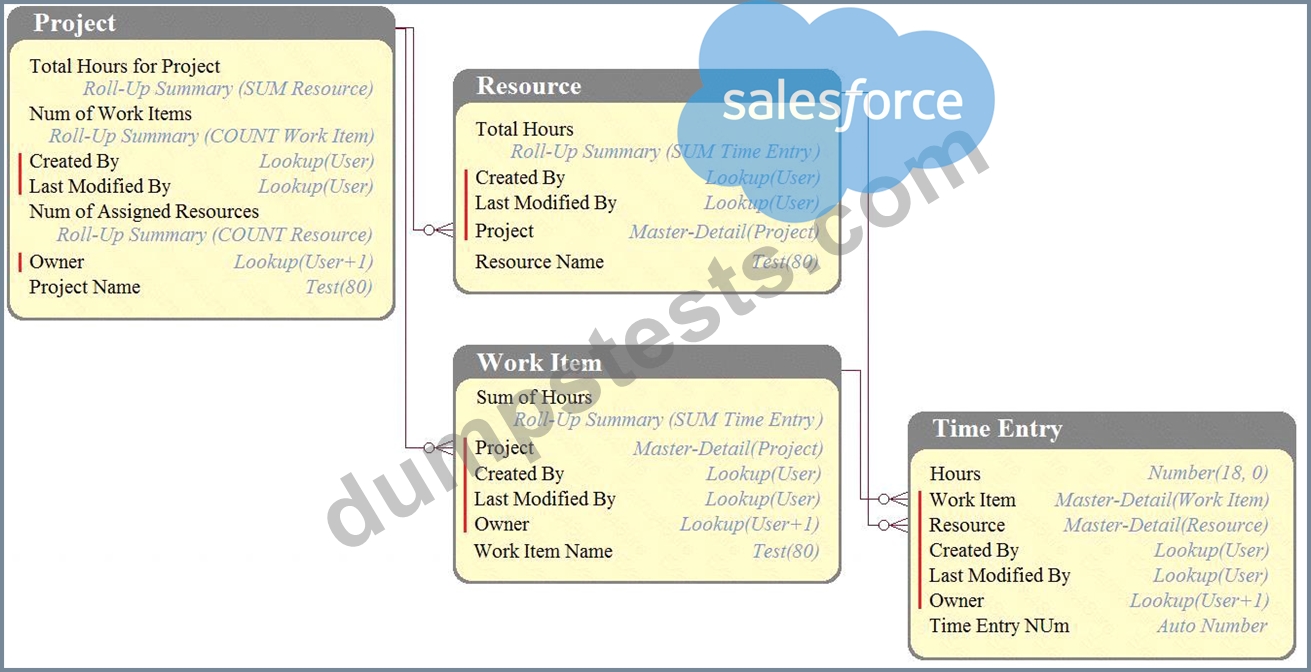
What should the Architect consider in this situation?
- A. Load all data using external IDs to link to parent records.
- B. Calculate summary values instead of Roll-Up by using triggers.
- C. Load all data after deferring sharing calculations.
- D. Calculate summary values instead of Roll-Up by using workflow.
Answer: C
Explanation:
According to the exam guide, one of the objectives is to "describe the use cases and considerations for deferring sharing calculations"1. This implies that option A is the correct way to load large amounts of data into Salesforce without affecting performance and data integrity. Deferring sharing calculations allows the data to be loaded first and then the sharing rules to be applied later2. Option B is not correct because workflows are not recommended for calculating summary values, as they can cause performance issues and data skew3. Option C is not correct because triggers are also not recommended for calculating summary values, as they can cause governor limit errors and data inconsistency. Option D is not correct because external IDs are used to link records from different systems, not to improve data loading performance.
NEW QUESTION # 146
What should a data architect do to provide additional guidance for users when they enter information in a standard field?
- A. Create a custom page with help text for user guidance.
- B. Provide custom help text under field properties.
- C. Add custom help text in default value for the field.
- D. Add a label field with help text adjacent to the custom field.
Answer: B
Explanation:
The correct answer is A. To provide additional guidance for users when they enter information in a standard field, a data architect should provide custom help text under field properties. This will display a help icon next to the field label that users can hover over to see the help text. Option B is incorrect because creating a custom page with help text for user guidance will require additional development effort and may not be easily accessible by users. Option C is incorrect because adding custom help text in default value for the field will overwrite the actual default value of the field and may confuse users. Option D is incorrect because adding a label field with help text adjacent to the custom field will clutter the page layout and may not be visible to users.
NEW QUESTION # 147
......
Get 2025 Updated Free Salesforce Data-Architect Exam Questions and Answer: https://prep4sure.dumpstests.com/Data-Architect-latest-test-dumps.html