

Free AZ-400 Exam Files Downloaded Instantly UPDATED [2024]
100% Pass Guaranteed Free AZ-400 Exam Dumps
Microsoft AZ-400 certification exam is intended to assess the candidate's abilities in designing and implementing DevOps solutions using Microsoft Azure. It is a comprehensive exam that tests the knowledge and skills required to create and manage DevOps workflows, including the ability to design and implement continuous integration and delivery pipelines, automate infrastructure and configuration management, and monitor and troubleshoot application performance.
NEW QUESTION # 91
You manage the Git repository for a large enterprise application.
You need to minimize the data size of the repository.
How should you complete the commands? To answer, select the appropriate options in the answer area.
NOTE: Each correct selection is worth one point.
Answer:
Explanation:
Explanation
Box 1: --aggressive
Cleanup unnecessary files and optimize the local repository:
get gc --aggressive
Box 2: prune
Prune all unreachable objects from the object database:
git prune
Reference:
https://gist.github.com/Zoramite/2039636
NEW QUESTION # 92
Your company deploys applications m Docket containers.
You want to detect known exploits in the Docket images used to provision the Docker containers.
You need to integrate image scanning into the application lifecycle. The solution must expose the exploits as early as possible during the application lifecycle.
What should you configure?
- A. manual tasks performed during the planning phase and the deployment phase
- B. a task executed in the continuous integration pipeline and a scheduled task that analyzes the production container.
- C. a task executed in the continuous deployment pipeline and a scheduled task against a running production container.
- D. a task executed in the continuous integration pipeline and a scheduled task that analyzes the image registry
Answer: D
Explanation:
Explanation
You can use the Docker task to sign into ACR and then use a subsequent script to pull an image and scan the container image for vulnerabilities.
Use the docker task in a build or release pipeline. This task can be used with Docker or Azure Container registry.
References:
https://docs.microsoft.com/en-us/azure/devops/articles/security-validation-cicd-pipeline?view=vsts
NEW QUESTION # 93
You have an Azure virtual machine named VM1 that runs Linux.
You plan to deploy the Desired State Configuration (DSC) extension to VM1.
You need to grant the Log Analytics agent the appropriate directory permissions.
How should you complete the command? To answer, select the appropriate options in the answer area.
NOTE: Each correct selection is worth one point.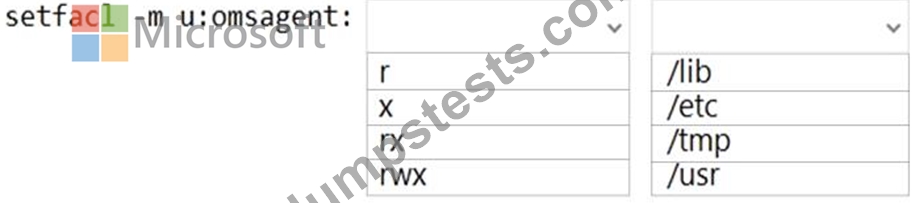
Answer:
Explanation:
Reference:
https://docs.microsoft.com/en-us/azure/automation/automation-dsc-onboarding
NEW QUESTION # 94
DRAG DROP
You need to recommend project metrics for dashboards in Azure DevOps.
Which chart widgets should you recommend for each metric? To answer, drag the appropriate chart widgets to the correct metrics. Each chart widget may be used once, more than once, or not at all. You may need to drag the split bar between panes or scroll to view content.
NOTE: Each correct selection is worth one point.
Answer:
Explanation:
Select and Place:
Explanation/Reference:
Explanation:
Box 1: Lead time
Lead time measures the total time elapsed from the creation of work items to their completion.
Box 2: Cycle time
Cycle time measures the time it takes for your team to complete work items once they begin actively working on them.
Box 3: Burndown
Burndown charts focus on remaining work within a specific time period.
Incorrect Answers:
Velocity provides a useful metric for these activities:
Support sprint planning
Forecast future sprints and the backlog items that can be completed
A guide for determining how well the team estimates and meets their planned commitments
References:
https://docs.microsoft.com/en-us/azure/devops/report/dashboards/velocity-guidance?view=vsts
https://docs.microsoft.com/en-us/azure/devops/report/dashboards/cycle-time-and-lead-time?view=vsts
https://docs.microsoft.com/en-us/azure/devops/report/dashboards/configure-burndown-burnup-widgets?
view=vsts
NEW QUESTION # 95
You plan to deploy a runbook that will create Azure AD user accounts.
You need to ensure that runbooks can run the Azure PowerShell cmdlets for Azure Active Directory.
To complete this task, sign in to the Microsoft Azure portal.
Answer:
Explanation:
See solution below.
Explanation
Azure Automation now ships with the Azure PowerShell module of version 0.8.6, which introduced the ability to non-interactively authenticate to Azure using OrgId (Azure Active Directory user) credential-based authentication. Using the steps below, you can set up Azure Automation to talk to Azure using this authentication type.
Step 1: Find the Azure Active Directory associated with the Azure subscription to manage:
1. Log in to the Azure portal as the service administrator for the Azure subscription you want to manage using Azure Automation. You can find this user by logging in to the Azure portal as any user with access to this Azure subscription, then clicking Settings, then Administrators.
2. Note the name of the directory associated with the Azure subscription you want to manage. You can find this directory by clicking Settings, then Subscriptions.
Step 2: Create an Azure Active Directory user in the directory associated with the Azure subscription to manage:
You can skip this step if you already have an Azure Active Directory user in this directory. and plan to use this OrgId to manage Azure.
1. In the Azure portal click on Active Directory service.
2. Click the directory name that is associated with this Azure subscription.
3. Click on the Users tab and then click the Add User button.
4. For type of user, select "New user in your organization." Enter a username for the user to create.
5. Fill out the user's profile. For role, pick "User." Don't enable multi-factor authentication. Multi-factor accounts cannot be used with Azure Automation.
6. Click Create.
7. Jot down the full username (including part after @ symbol) and temporary password.
Step 3: Allow this Azure Active Directory user to manage this Azure subscription.
1. Click on Settings (bottom Azure tab under StorSimple)
2. Click Administrators
3. Click the Add button. Type the full user name (including part after @ symbol) of the Azure Active Directory user you want to set up to manage Azure. For subscriptions, choose the Azure subscriptions you want this user to be able to manage. Click the check mark.
Step 4: Configure Azure Automation to use this Azure Active Directory user to manage this Azure subscription Create an Azure Automation credential asset containing the username and password of the Azure Active Directory user that you have just created. You can create a credential asset in Azure Automation by clicking into an Automation Account and then clicking the Assets tab, then the Add Setting button.
Note: Once you have set up the Azure Active Directory credential in Azure and Azure Automation, you can now manage Azure from Azure Automation runbooks using this credential.
References:
https://azure.microsoft.com/sv-se/blog/azure-automation-authenticating-to-azure-using-azure-active-directory/
NEW QUESTION # 96
Your company develops an app for OS. All users of the app have devices that are members of a private distribution group in Microsoft Visual Studio App Center.
You plan to distribute a new release of the app.
You need to identify which certificate file you require to distribute the new release from App Center.
Which file type should you upload to App Center?
- A. .pvk
- B. .cer
- C. .pfx
- D. .p12
Answer: D
Explanation:
Explanation
A successful IOS device build will produce an ipa file. In order to install the build on a device, it needs to be signed with a valid provisioning profile and certificate. To sign the builds produced from a branch, enable code signing in the configuration pane and upload a provisioning profile (.mobileprovision) and a valid certificate (.p12), along with the password for the certificate.
References:
https://docs.microsoft.com/en-us/appcenter/build/xamarin/ios/
NEW QUESTION # 97
You manage build and release pipelines by using Azure DevOps. Your entire managed environment resides in Azure.
You need to configure a service endpoint for accessing Azure Key Vault secrets. The solution must meet the following requirements:
Ensure that the secrets are retrieved by Azure DevOps.
Avoid persisting credentials and tokens in Azure DevOps.
How should you configure the service endpoint? To answer, select the appropriate options in the answer area.
NOTE: Each correct selection is worth one point.
Answer:
Explanation:
Explanation
Box 1: Azure Pipelines service connection
Box 2: Managed Service Identity Authentication
The managed identities for Azure resources feature in Azure Active Directory (Azure AD) provides Azure services with an automatically managed identity in Azure AD. You can use the identity to authenticate to any service that supports Azure AD authentication, including Key Vault, without any credentials in your code.
Reference:
https://docs.microsoft.com/en-us/azure/devops/pipelines/tasks/deploy/azure-key-vault
https://docs.microsoft.com/en-us/azure/active-directory/managed-identities-azure-resources/overview
NEW QUESTION # 98
Which branching strategy should you recommend for the investment planning applications suite?
- A. release isolation
- B. feature isolation
- C. development isolation
- D. main only
Answer: C
Explanation:
Scenario: A branching strategy that supports developing new functionality in isolation must be used.
Feature isolation is a special derivation of the development isolation, allowing you to branch one or more feature branches from main, as shown, or from your dev branches.
When you need to work on a particular feature, it might be a good idea to create a feature branch.
Incorrect Answers:
A: Release isolation introduces one or more release branches from main. The strategy allows concurrent release management, multiple and parallel releases, and codebase snapshots at release time.
B: The Main Only strategy can be folder-based or with the main folder converted to a Branch, to enable additional visibility features. You commit your changes to the main branch and optionally indicate development and release milestones with labels.
C: Development isolation: When you need to maintain and protect a stable main branch, you can branch one or more dev branches from main. It enables isolation and concurrent development. Work can be isolated in development branches by feature, organization, or temporary collaboration.
Reference:
https://docs.microsoft.com/en-us/azure/devops/repos/tfvc/branching-strategies-with-tfvc?view=azure-devops
NEW QUESTION # 99
You have an Azure DevOps organization named Contoso and an Azure subscription.
You use Azure DevOps to build and deploy a web app named App1. Azure Monitor is configured to generate an email notification in response to alerts generated whenever App1 generates a server-side error.
You need to receive notifications in Microsoft Teams whenever an Azure Monitor alert is generated.
Which two actions should you perform? Each correct answer presents part of the solution.
NOTE: Each correct selection is worth one point.
- A. Modify the Diagnostics settings in Azure Monitor.
- B. Create an Azure logic app that has an Azure DevOps trigger.
- C. Create an Azure Monitor workbook.
- D. Create an Azure logic app that has an HTTP request trigger.
- E. Modify an action group in Azure Monitor.
Answer: A,D
Explanation:
Explanation
https://docs.microsoft.com/en-us/azure/azure-monitor/platform/action-groups-logic-app
NEW QUESTION # 100
You need to recommend a solution for deploying charts by using Helm and Title to Azure Kubemets Service (AKS) in an RBAC-enabled cluster.
Which three commands should you recommend be run m sequence? To answer, move the appropriate commands from the list of commands to the answer area and arrange them in the correct order.
Answer:
Explanation:
Explanation
Step 1: Kubectl create
You can add a service account to Tiller using the --service-account <NAME> flag while you're configuring Helm (step 2 below). As a prerequisite, you'll have to create a role binding which specifies a role and a service account name that have been set up in advance.
Example: Service account with cluster-admin role
$ kubectl create -f rbac-config.yaml
serviceaccount "tiller" created
clusterrolebinding "tiller" created
$ helm init --service-account tiller
Step 2: helm init
To deploy a basic Tiller into an AKS cluster, use the helm init command.
Step 3: helm install
To install charts with Helm, use the helm install command and specify the name of the chart to install.
References:
https://docs.microsoft.com/en-us/azure/aks/kubernetes-helm
https://docs.helm.sh/using_helm/#tiller-namespaces-and-rbac
NEW QUESTION # 101
You are configuring the settings of a new Git repository in Azure Repos.
You need to ensure that pull requests in a branch meet the following criteria before they are merged:
* Committed code must compile successfully.
* Pull requests must have a Quality Gate status of Passed in SonarCloud.
Which policy type should you configure for each requirement? To answer, drag the appropriate policy types to the correct requirements. Each policy type may be used once, more than once, or not at all. You may need to drag the split bar between panes or scroll to view content.
NOTE: Each correct selection is worth one point.
Answer:
Explanation:
Box 1: A check-in policy
Administrators of Team Foundation version control can add check-in policy requirements. These check-in policies require the user to take actions when they conduct a check-in to source control.
By default, the following check-in policy types are available:
* Builds Requires that the last build was successful before a check-in.
* Code Analysis Requires that code analysis is run before check-in.
* Work Items Requires that one or more work items be associated with the check-in.
Box 2: Build policy
Reference:
https://docs.microsoft.com/en-us/azure/devops/repos/tfvc/add-check-policies
https://azuredevopslabs.com/labs/vstsextend/sonarcloud/
NEW QUESTION # 102
You manage an Azure web app that supports an e-commerce website.
You need to increase the logging level when the web app exceeds normal usage patterns. The solution must minimize administrative overhead.
Which two resources should you include in the solution? Each correct answer presents part of the solution.
NOTE: Each correct selection is worth one point.
- A. the Azure Monitor autoscale settings
- B. an Azure Monitor alert that uses an action group that has an email action
- C. an Azure Monitor alert that has a dynamic threshold
- D. an Azure Automation runbook
- E. an Azure Monitor alert that has a static threshold
Answer: B,D
NEW QUESTION # 103
You have a project in Azure DevOps that has three teams as shown in the Teams exhibit. (Click the Teams tab.)
You create a new dashboard named Dash1.
You configure the dashboard permissions for the Contoso project as shown in the Permissions exhibit (Click the Permissions tab.)
All other permissions have the default values set.
Answer:
Explanation:
Explanation
NEW QUESTION # 104
You need to create a notification if the peak average response time of an Azure web app named az400-9940427-main is more than five seconds when evaluated during a five-minute period. The notification must trigger the "https://contoso.com/notify" webhook.
To complete this task, sign in to the Microsoft Azure portal.
Answer:
Explanation:
1. Open Microsoft Azure Portal
2. Log into your Azure account and go to App Service and look under Monitoring then you will see Alert.
3. Select Add an alert rule
4. Configure the alert rule as per below and click Ok.
Source: Alert on Metrics
Resource Group: az400-9940427-main
Resource: az400-9940427-main
Threshold: 5
Period: Over the last 5 minutes
Webhook: https://contoso.com/notify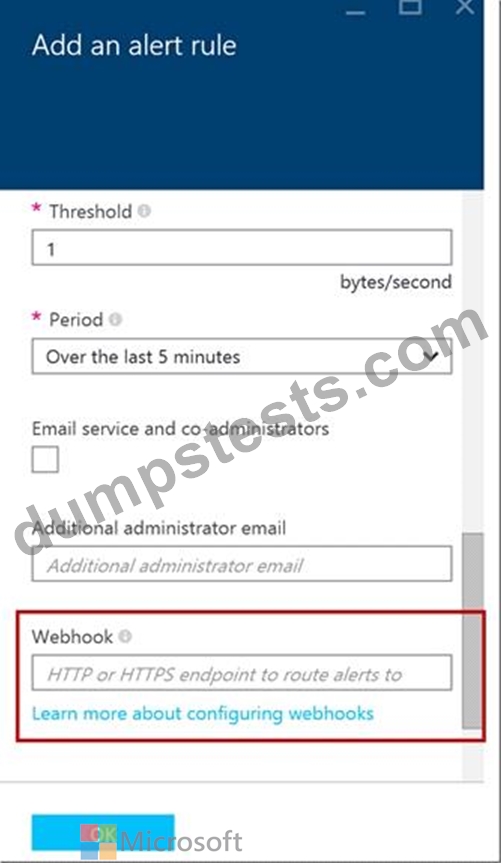
Reference:
https://azure.microsoft.com/es-es/blog/webhooks-for-azure-alerts/
NEW QUESTION # 105
You are developing an application. The application source has multiple branches.
You make several changes to a branch used for experimentation.
You need to update the main branch to capture the changes made to the experimentation branch and override the history of the Git repository.
Which Git option should you use?
- A. Merge
- B. Rebase
- C. Fetch
- D. Push
Answer: A
Explanation:
Create pull requests to review and merge code in a Git project. Pull requests let your team review code and give feedback on changes before merging it into the master branch.
Reference:
https://docs.microsoft.com/en-us/azure/devops/repos/git/pull-requests
NEW QUESTION # 106
Your company uses a Git repository in Azure Repos to manage the source code of a web application. The master branch is protected from direct updates. Developers work on new features in the topic branches.
Because of the high volume of requested features, it is difficult to follow the history of the changes to the master branch.
You need to enforce a pull request merge strategy. The strategy must meet the following requirements:
* Consolidate commit histories.
* Merge the changes into a single commit.
Which merge strategy should you use in the branch policy?
- A. fast-forward merge
- B. Git fetch
- C. squash merge
- D. no-fast-forward merge
Answer: C
Explanation:
Squash merging is a merge option that allows you to condense the Git history of topic branches when you complete a pull request. Instead of each commit on the topic branch being added to the history of the default branch, a squash merge takes all the file changes and adds them to a single new commit on the default branch.
A simple way to think about this is that squash merge gives you just the file changes, and a regular merge gives you the file changes and the commit history.
Note: Squash merging keeps your default branch histories clean and easy to follow without demanding any workflow changes on your team. Contributors to the topic branch work how they want in the topic branch, and the default branches keep a linear history through the use of squash merges. The commit history of a master branch updated with squash merges will have one commit for each merged branch. You can step through this history commit by commit to find out exactly when work was done.
References: https://docs.microsoft.com/en-us/azure/devops/repos/git/merging-with-squash
NEW QUESTION # 107
You currently use JIRA, Jenkins, and Octopus as part of your DevOps processes.
You plan to use Azure DevOps to replace these tools.
Which Azure DevOps service should you use to replace each tool? To answer, select the appropriate options in the answer area.
NOTE: Each correct selection is worth one point.
Answer:
Explanation: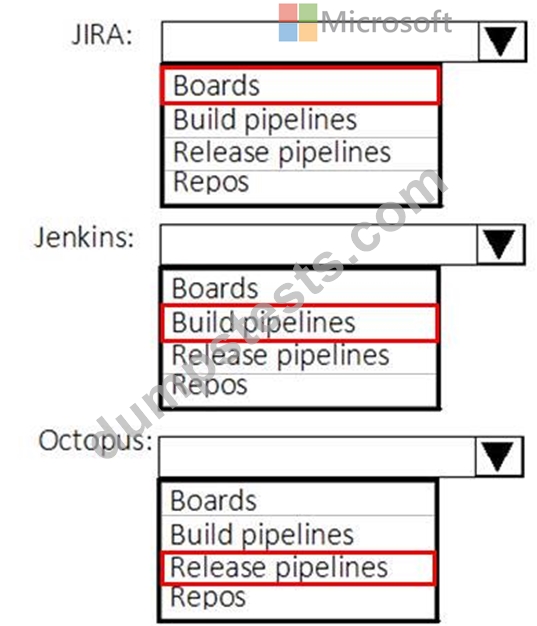
NEW QUESTION # 108
You use GitHub for source control.
A file that contains sensitive data is committed accidentally to the Get repository of a project.
You need to delete the file and its history form the repository.
Which two tools can you use? Each correct answer presents a complete solution.
NOTE: Each correct selection is worth one point.
- A. GitHub Desktop
- B. BFG Repo-Cleaner
- C. the git filter-branch command
- D. the git rebase command
Answer: B,D
Explanation:
Explanation
To entirely remove unwanted files from a repository's history you can use either the git filter-branch command or the BFG Repo-Cleaner open source tool.
Reference:
https://docs.github.com/en/github/authenticating-to-github/keeping-your-account-and-data-secure/removing-sens
NEW QUESTION # 109
You have app named App1. You have a Log Analytics workspace named Workspace1 that contains two tables named Events and Logs. App1 manage events in multiple locations and writes logs to Workspace1.
You need to query Workspace1 for all log entries related to Asia that occurred during the last two days.
In which order should you arrange the query statements?
Answer:
Explanation:
NEW QUESTION # 110
Note: This question is part of a series of questions that present the same scenario. Each question in the series contains a unique solution that might meet the stated goals. Some question sets might have more than one correct solution, while others might not have a correct solution.
After you answer a question in this section, you will NOT be able to return to it. As a result, these questions will not appear in the review screen.
You plan to create a release pipeline that will deploy Azure resources by using Azure Resource Manager templates. The release pipeline will create the following resources:
* Two resource groups
* Four Azure virtual machines in one resource group
* Two Azure SQL databases in other resource group
You need to recommend a solution to deploy the resources.
Solution: Create a single standalone template that will deploy all the resources.
Does this meet the goal?
- A. Yes
- B. No
Answer: B
Explanation:
Explanation
Explanation:
Use two templates, one for each resource group, and link the templates.
References:
https://docs.microsoft.com/en-us/azure/azure-resource-manager/resource-group-linked-templates
NEW QUESTION # 111
You plane to store signed images in an Azure Container Registry instance named az4009940427acr1.
You need to modify the SKU for az4009940427acr1 to support the planned images. The solution must minimize costs.
To complete this task, sign in to the Microsoft Azure portal.
1. Open Microsoft Azure Portal, and select the Azure Container Registry instance named az4009940427acr1.
2. Under Policies, select Content Trust > Enabled > Save.
Answer:
Explanation:
Explanation:
References:
https://docs.microsoft.com/en-us/azure/container-registry/container-registry-content-trust
NEW QUESTION # 112
Your company has a project in Azure DevOps named Project1.
All the developers at the company have Windows 10 devices.
You need to create a Git repository for Project1. The solution must meet the following requirements:
* Support large binary files.
* Store binary files outside of the repository.
* Use a standard Git workflow to maintain the metadata of the binary files by using commits to the repository.
Answer:
Explanation:
1 - Perform a custom installation of Git for Windows that includes Git Large File Storage (LFS0.
2 - Configure SSH key-based authentication.
3 - Configure Git Large File Storage (LFS) file tracking.
NEW QUESTION # 113
SIMULATION
You need to prepare a network security group (NSG) named az400-9940427-nsg1 to host an Azure DevOps pipeline agent. The solution must allow only the required outbound port for Azure DevOps and deny all other inbound and outbound access to the Internet.
To complete this task, sign in to the Microsoft Azure portal.
- A. 1. Open Microsoft Azure Portal and Log into your Azure account.
2. Select network security group (NSG) named az400-9940427-nsg1
3. Select Settings, Outbound security rules, and click Add
4. Click Advanced
5. Change the following settings:
* Destination Port range: 8080
* Protocol. TCP
* Action: Allow
Note: By default, Azure DevOps Server uses TCP Port 8080. - B. 1. Open Microsoft Azure Portal and Log into your Azure account.
2. Select network security group (NSG) named az400-9940427-nsg1
3. Select Settings, Outbound security rules, and click Add
4. Click Advanced
5. Change the following settings:
* Destination Port range: 9090
* Protocol. TCP
* Action: Allow
Note: By default, Azure DevOps Server uses TCP Port 8080.
Answer: A
Explanation:
References:
https://robertsmit.wordpress.com/2017/09/11/step-by-step-azure-network-security-groups-nsg-security-center-azure-nsg-network/
https://docs.microsoft.com/en-us/azure/devops/server/architecture/required-ports?view=azure-devops
NEW QUESTION # 114
You use Azure DevOps to manage the build and deployment of an app named App1.
You have a release pipeline that deploys a virtual machine named VM1.
You plan to monitor the release pipeline by using Azure Monitor
You need to create an alert to monitor the performance of VM1. The alert must be triggered when the average CPU usage exceeds 70 percent for five minutes. The alert must calculate the average once every minute.
How should you configure the alert rule? To answer, select the appropriate options in the answer area.
Answer:
Explanation:
Reference:
https://docs.microsoft.com/en-us/azure/azure-monitor/platform/alerts-metric-overview
NEW QUESTION # 115
You have an application named App1 that has a custom domain of app.contoso.com.
You create a test in Azure Application Insights as shown in the following exhibit.
Use the drop-down menus to select the answer choice that completes each statement based on the information presented in the graphic.
NOTE: Each correct selection is worth one point.
Answer:
Explanation:
Explanation:
Box 1: every five minutes at a random location
Test frequency: Sets how often the test is run from each test location. With a default frequency of five minutes and five test locations, your site is tested on average every minute.
Box 2:
Parse dependent requests: Test requests images, scripts, style files, and other files that are part of the web page under test. The recorded response time includes the time taken to get these files. The test fails if any of these resources cannot be successfully downloaded within the timeout for the whole test.
Reference:
https://docs.microsoft.com/en-us/azure/azure-monitor/app/monitor-web-app-availability
NEW QUESTION # 116
......
Latest AZ-400 dumps - Instant Download PDF: https://prep4sure.dumpstests.com/AZ-400-latest-test-dumps.html