

UPDATED [2025] Pass UiPath UiPath-SAIv1 Exam in First Attempt Guaranteed
Pass UiPath-SAIv1 Exam Latest Practice Questions
NEW QUESTION # 55
What is the function of the Immediate Panel in UiPath Studio during the debugging process?
- A. Modifying the values of variables and arguments at runtime during the debugging process.
- B. Displaying the performance analysis of all the operations, showing the execution time of each activity.
- C. Inspecting data at a certain point during debugging by evaluating variables, arguments, or statements.
- D. Displaying the next activity to be executed and its parent containers when the project is paused in debugging.
Answer: C
NEW QUESTION # 56
What is the correct order of migrating a dataset from Document Manager to a Modern Project? Instructions:
Drag the Description found on the left and drop on the correct Step found on the right.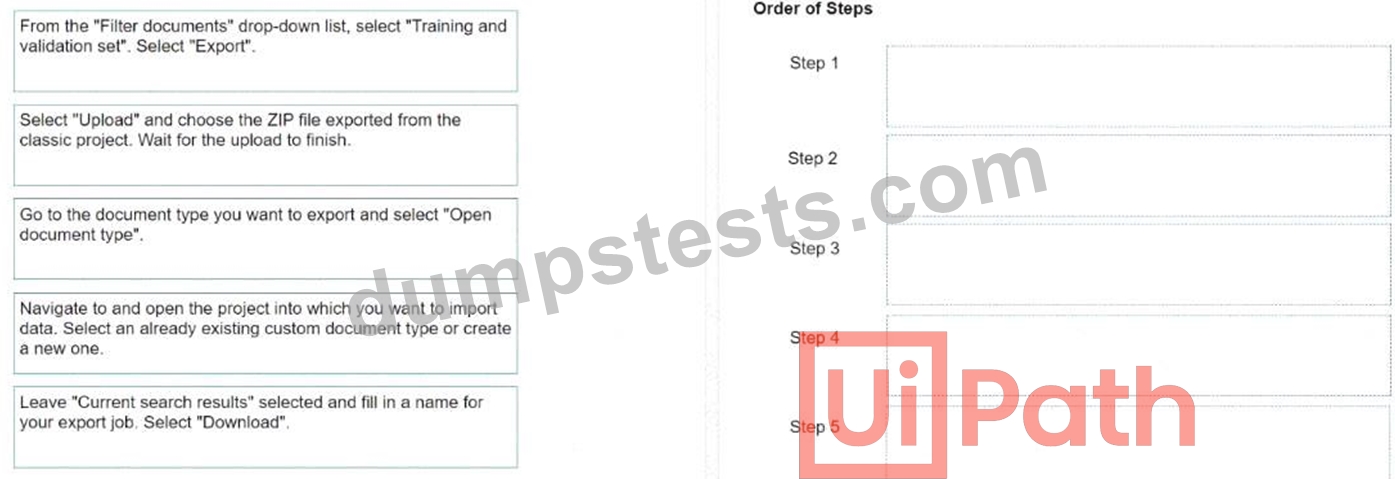
Answer:
Explanation: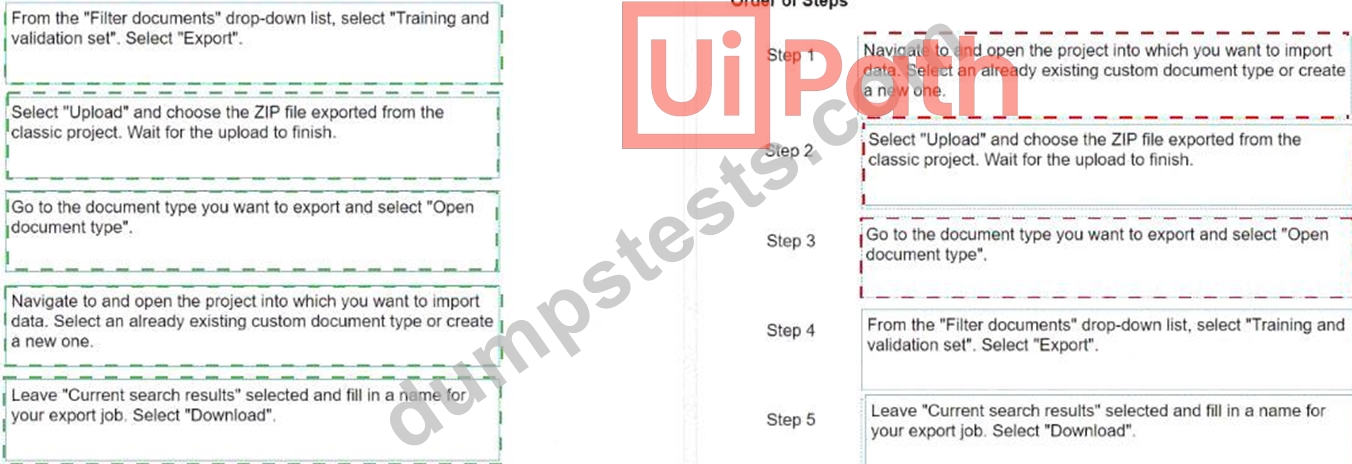
Explanation:
To organize the steps in the correct order for migrating a dataset from the Document Manager to a Modern Project, I'll analyze the instructions and then match the steps accordingly. Here's the logical order based on the descriptions:
* Step 1: Navigate to and open the project into which you want to import data. Select an already existing custom document type or create a new one.
* Step 2: Select "Upload" and choose the ZIP file exported from the classic project. Wait for the upload to finish.
* Step 3: Go to the document type you want to export and select "Open document type."
* Step 4: From the "Filter documents" drop-down list, select "Training and validation set." Select
"Export."
* Step 5: Leave "Current search results" selected and fill in a name for your export job. Select
"Download."
This should reflect the correct sequential process of migrating a dataset from Document Manager to a Modern Project.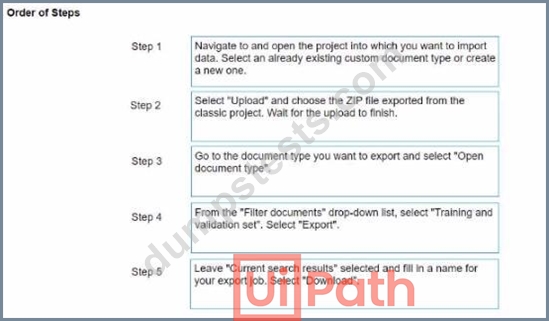
NEW QUESTION # 57
What is the role of the Taxonomy Manager?
- A. To select the type of ML that can be used in the project.
- B. To create and edit a Taxonomy file specific to the current automation project.
- C. To select which extractors are trained for each document type and field.
- D. To present a document processing specific user interface for validating and correcting automatic classification outputs.
Answer: B
Explanation:
The Taxonomy Manager is a tool that enables you to create and edit a Taxonomy file, which is an XML file that defines the document types and fields that are relevant for your automation project1. The Taxonomy file is used by the Classify Document Scope and Data Extraction Scope activities to perform document classification and data extraction, respectively2. The Taxonomy Manager allows you to add, remove, rename, or reorder document types and fields, as well as specify the data type, format, and validation rules for each field3. The Taxonomy Manager also provides a preview of the Taxonomy file and a validation feature to check for errors or inconsistencies.
References:
1: About Taxonomy Manager 2: About Document Understanding Framework 3: Using the Taxonomy Manager : Taxonomy Manager User Interface Description
NEW QUESTION # 58
Which log level in UiPath provides the most detailed information about the execution of activities?
- A. Error
- B. Warning
- C. Verbose
- D. Information
Answer: C
Explanation:
In UiPath, the Verbose log level offers the most detailed information about the execution of activities. It logs every possible detail about the automation operations, including variable changes, function calls, and external responses. This level is particularly useful for in-depth debugging and analysis.
UiPath Documentation
The hierarchy of log levels in ascending order of priority is as follows:
* Off: No logs are stored.
* Verbose: Logs all details about automation operations.
* Trace: Logs finer-grained informational events than the Debug level.
* Information: Logs informational messages that highlight the progress of the application.
* Warning: Logs potentially harmful situations.
* Error: Logs error events that might still allow the application to continue running.
* Fatal: Logs very severe error events that will presumably lead the application to abort.
Therefore, setting the log level to Verbose ensures that all possible details about the execution are captured, aiding in thorough diagnostics.
NEW QUESTION # 59
How do you load a taxonomy from a given non-default location text file into a variable?
Instructions: Drag the steps found on the "Left" and drop them on the "Right" in the correct order.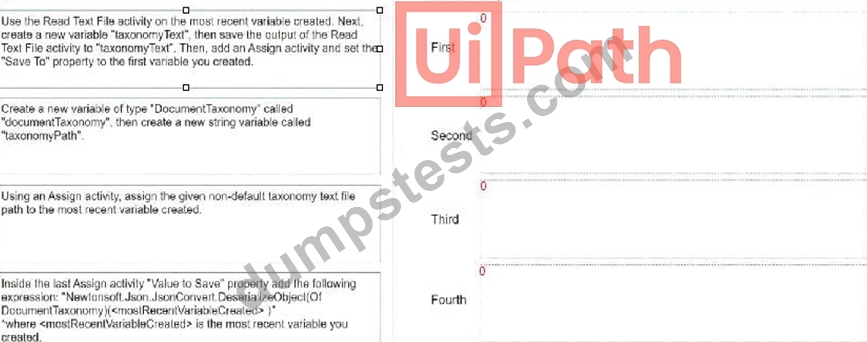
Answer:
Explanation:
Explanation: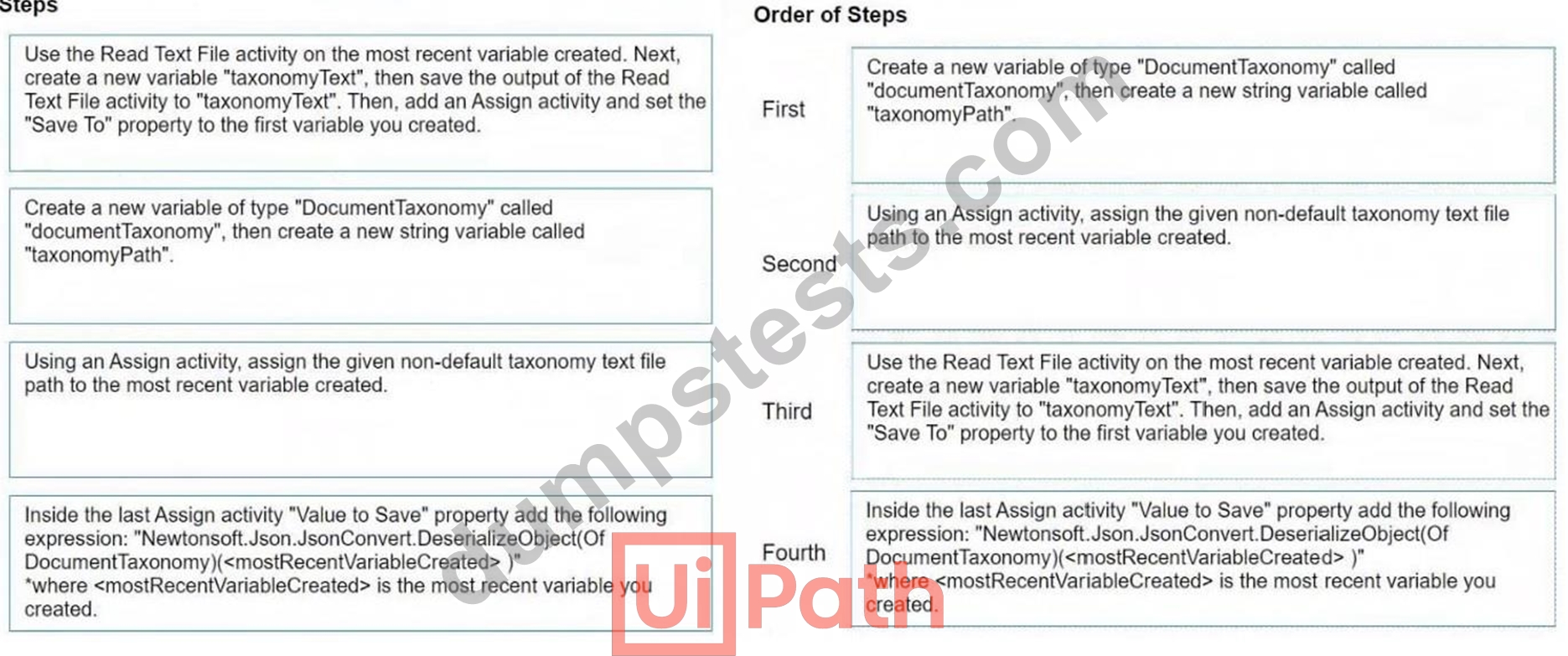
to load a taxonomy from a given non-default location text file into a variable, the order of steps should be as follows:
* Create a new variable of type 'DocumentTaxonomy' called 'documentTaxonomy', then create a new string variable called 'taxonomyPath'.
* This step involves setting up the necessary variables that will be used in the process. The
'documentTaxonomy' variable will hold the deserialized taxonomy object, and 'taxonomyPath' will store the path to the taxonomy file.
* Using an Assign activity, assign the given non-default taxonomy text file path to the most recent variable created.
* Here you will assign the path of the taxonomy file to the 'taxonomyPath' variable.
* Use the Read Text File activity on the 'taxonomyPath' variable created. Next, create a new variable 'taxonomyText', then save the output of the Read Text File activity to 'taxonomyText'.
* This step is where you read the contents of the taxonomy file using the 'Read Text File' activity.
The contents are stored in the 'taxonomyText' variable.
* Inside the last Assign activity 'Value to Save' property add the following expression: "Newtonsoft.
Json.JsonConvert.DeserializeObject(Of DocumentTaxonomy)(taxonomyText)" where ' taxonomyText' is the text read from the file and 'documentTaxonomy' (the most recent variable created) is the variable you created.
* In this final step, you will deserialize the JSON content from the 'taxonomyText' into a
'DocumentTaxonomy' object using the 'JsonConvert.DeserializeObject' method and assign it to the 'documentTaxonomy' variable.
Following these steps in this order will load the taxonomy from a text file into the 'documentTaxonomy' variable in UiPath.
NEW QUESTION # 60
What does the Automation Suite installer enable?
- A. Enables the deployment, management, and improvement of ML models locally with easy installation due to the automatic retrieval of the installer and associated artifacts from the internet.
- B. Enables the deployment, management, and improvement of ML models locally, and requires manual download of all the resources and then loading them into the node.
- C. Enables the deployment of the full UiPath Automation Platform in the environment of choice and contains everything in one package that can be deployed in multi-node mode with automatic scaling and built-in HA. monitor, configure, and upgrade.
- D. Enables the deployment, management, and improvement of ML models on UiPath Automation Cloud, and requires no infrastructure and no maintenance.
Answer: C
Explanation:
According to the UiPath documentation portal1, the Automation Suite installer is a single package that enables the deployment of the full UiPath Automation Platform in the environment of choice, whether on- premises or in the cloud. The Automation Suite installer contains all the components and dependencies required for the installation, such as the infrastructure, the orchestrator, the AI Center, the Action Center, the Insights, the Test Suite, and the Document Understanding. The Automation Suite installer also supports multi- node deployment with automatic scaling and built-in high availability, as well as easy monitoring, configuration, and upgrade options1. Therefore, option C is the correct answer, as it describes the features and benefits of the Automation Suite installer. Option A is incorrect, as it refers to the UiPath Automation Cloud, which is a different offering that does not require an installer. Option B is incorrect, as it describes a manual installation process that is not enabled by the Automation Suite installer. Option D is incorrect, as it confuses the Automation Suite installer with the installUiPathAS.sh script, which is a separate file that is used to launch the installer wizard2.
References: 1 Automation Suite - Overview 2 Automation Suite - Downloading the installation packages
NEW QUESTION # 61
When dealing with variable-length data, or data spanning over multiple pages of the document (e.g. item tables), what is the recommended data extraction methodology to be used?
- A. Rule-based data extraction.
- B. Hybrid data extraction.
- C. Model-based data extraction.
- D. Manual data extraction.
Answer: C
NEW QUESTION # 62
What does the Automation Suite installer enable?
- A. Enables the deployment, management, and improvement of ML models locally with easy installation due to the automatic retrieval of the installer and associated artifacts from the internet.
- B. Enables the deployment, management, and improvement of ML models locally, and requires manual download of all the resources and then loading them into the node.
- C. Enables the deployment of the full UiPath Automation Platform in the environment of choice and contains everything in one package that can be deployed in multi-node mode with automatic scaling and built-in HA. monitor, configure, and upgrade.
- D. Enables the deployment, management, and improvement of ML models on UiPath Automation Cloud, and requires no infrastructure and no maintenance.
Answer: C
NEW QUESTION # 63
What components are part of the Document Understanding Process template?
- A. Load Document. Categorization. Data Extraction, and Validation.
- B. Load Taxonomy, Digitization. Categorization. Data Validation, and Export.
- C. Import. Classification. Text Extractor, and Data Validation.
- D. Load Taxonomy, Digitization. Classification, Data Extraction, and Data Validation Export.
Answer: D
NEW QUESTION # 64
Having the taxonomy in a file, shared and updated across multiple projects, what is the most convenient way to load it in a UiPath Studio project?
- A. Using Load Taxonomy activity.
- B. Using DocumentTaxonomy.Deserialize method inside an Assign activity.
- C. Using Read Taxonomy activity.
- D. Using DeserializeTaxonomy activity.
Answer: A
NEW QUESTION # 65
What happens when multiple users try to label the same document concurrently?
- A. The changes made by all users are saved successfully.
- B. The changes made by one user override the changes made by others.
- C. Concurrent labeling is not allowed.
- D. A warning message is displayed to the other user(s) indicating unsuccessful changes.
Answer: D
NEW QUESTION # 66
What is the purpose of the "Explore" phase in UiPath Communications Mining?
- A. To fully review and correctly tag the model version, regardless if it's "Live" or "Staging".
- B. To provide each label/entity in a taxonomy with enough training examples so the model can make accurate predictions at scale.
- C. To use the bulk label functionality, a helpful tool to quickly train the model when searching for specific terms.
- D. To review the clusters of similar communications from a data set that unsupervised learning automatically found.
Answer: B
Explanation:
The Explore phase is the second phase of model training in UiPath Communications Mining, which is a solution that enables the analysis of large volumes of text-based communications using natural language processing and machine learning. The Explore phase builds on the foundations of the taxonomy that was created in the Discover phase by reviewing clusters and searching for different terms and phrases. The objective of the Explore phase is to provide each of the labels or entities that are important for the use case with enough varied and consistent training examples, so that the platform has sufficient training data from which to make accurate predictions across the entire dataset. The Explore phase is the core phase of model training, and requires the most time and effort, but also leads to better model performance and accuracy1.
References: 1: Communications Mining - Explore
NEW QUESTION # 67
What is the role of the dispatcher in the Document Understanding Process?
- A. To ensure one job is created for each input file.
- B. To manage downstream processes where the extracted Information is used
- C. To process multiple files simultaneously in bulk.
- D. To handle logging and exception mechanisms.
Answer: A
Explanation:
In the Document Understanding framework, the dispatcher is responsible for ensuring that one job is created for each input file. It works by submitting files to be processed individually, ensuring that each document or group of documents is handled as a separate transaction. This allows for more efficient processing and better tracking of each file, especially in high-volume workflows where managing each file as a separate job is critical for performance and error handling.
(Source: UiPath Documentation on Document Understanding)
NEW QUESTION # 68
Which Source Control Plugins can be connected at the same time?
- A. GIT, SVN, TFS
- B. You cannot connect to multiple plugins at the same time.
- C. GIT, TFS, Azure DevOps
- D. GIT, TFS
Answer: B
Explanation:
UiPath Studio does not allow connecting to multiple source control plugins at the same time. A single version control system (e.g., GIT, TFS, SVN) can be used per project to manage code versions.
NEW QUESTION # 69
How are UiPath RPA and AI Center used for process improvement?
- A. UiPath RPA and AI Center are independent tools that do not work together in process improvement.
RPA focuses on task automation, while AI Center is primarily used for training and deploying machine learning models. - B. UiPath RPA and AI Center work together in process improvement by utilizing RPA bots to execute models deployed in Action Center that can be monitored in Insights. The ML models process data and generate insights, which are then used by the RPA bots to make informed decisions and carry out automated actions.
- C. UiPath RPA and AI Center have overlapping functionalities, so they are not designed to work together in process improvement. Each tool serves different purposes and is used independently to achieve automation and AI capabilities, respectively.
- D. UiPath RPA and AI Center work together in process improvement by leveraging RPA capabilities to automate repetitive tasks and integrating AI Center to enhance decision-making and cognitive abilities.RPA bots can collect data, perform actions, and feed information to ML models in AI Center, which in turn can analyze the data and make predictions.
Answer: D
NEW QUESTION # 70
Which of the following is a best practice when choosing a UiPath ML (Machine Learning) Extractor?
- A. The cost of the ML Extractor should be the main consideration. Select the ML Extractor that offers the lowest price, regardless of its performance or suitability for the specific document understanding needs.
- B. The popularity of the ML Extractor among other UiPath users should be the primary factor. Opt for the ML Extractor that has the highest number of downloads or positive reviews.
- C. The size of the ML Extractor is the most important factor to consider. Bigger models always perform better and provide more accurate extraction results because the development team invested time and effort into creating the algorithm, which in turn will result in better performance for the trained model.
- D. Consider the document types, language, and data quality. It is important to select one that is specifically trained or optimized for the document types being processed. It is also important to take into account the quality and diversity of the training data used to train the ML Extractor to ensure accurate and reliable extraction results.
Answer: D
Explanation:
The best practice is to select an ML Extractor based on document types, language, and data quality. Choosing a model specifically optimized for the type of document being processed ensures higher accuracy and reliability. The quality and diversity of the training data used to develop the model play a significant role in its performance.
NEW QUESTION # 71
What is the primary function of the Wait for Classification Validation Task and Resume activity In UiPath's Document Understanding Framework?
- A. It prioritizes actions in Action Center based on document classification results, optimizing task management and allocation according to the importance of document classifications.
- B. It initiates the classification process for documents across different platforms, ensuring consistent and accurate document organization and categorization.
- C. It suspends the workflow until a specified document validation action is completed, ensuring human review and correction.
- D. It automatically validates classified data without human intervention, expediting document processing by removing the need for manual review and correction.
Answer: C
Explanation:
The "Wait for Classification Validation Task and Resume" activity in UiPath's Document Understanding Framework is primarily used to halt or suspend the workflow until a specified document classification validation task is completed by a human. This activity is part of the broader workflow to ensure that when automatic classification of documents cannot be confidently achieved, a human-in-the-loop (HITL) approach is followed to validate or correct classifications. Once the validation is performed in UiPath's Action Center by a human, the workflow is resumed, ensuring the proper handling of documents that require review and correction.
This is aligned with the design of the Action Center, which is integrated into UiPath's Document Understanding Framework. When dealing with document classification or extraction confidence issues, manual human validation tasks are often required, which is what this activity manages. It facilitates human oversight, preventing the automation from proceeding with potentially incorrect classifications.
Reference from UiPath documentation:
* UiPath Action Center explains how humans are involved in validation tasks to handle cases where classification or extraction needs manual review.
* Wait for Task and Resume Activity in UiPath Documentation explains how it waits for a task (such as document validation) to be completed in the Action Center before resuming the workflow.
For more details, you can consult the official UiPath documents:
* UiPath Document Understanding Framework
* Wait for Classification Validation Task and Resume
This functionality ensures that incorrect data processing due to automation can be caught and rectified by a human, improving accuracy in document handling workflows.
NEW QUESTION # 72
What is the definition of Machine Learning?
- A. An area of machine learning concerned with artificial neural networks. These are a series of algorithms that aim to recognize relationships in a set of data through a process that mimics biological neural networks.
- B. The theory and development of computer systems that are able to perform tasks that normally require human intelligence and decision making.
- C. A branch of artificial intelligence that deals with analyzing, understanding, and generating human natural languages. For example, NLP enables computers to hear speech, read text, interpret the text
/speech or measure the sentiment. - D. A sub-field of artificial intelligence that enables systems to learn from data. Systems learn from previous experience and information to deduce and predict future information. To do this they use algorithms that learn to perform a specific task without being explicitly programmed.
Answer: D
NEW QUESTION # 73
Which are all the options for managing ML Skills?
- A. ML skills can be created, updated to a new package version, rolled back to a previous package version, modified to use or not use GPU. made public or private, or deleted.
- B. ML skills can be created, stopped, redeployed, updated to a new package version, rolled back to a previous package version, made public or private, or deleted.
- C. ML skills can be created, stopped, redeployed, updated to a new package version, rolled back to a previous package version, modified to use or not use GPU. modified to use or not use Al units, made public or private, or deleted.
- D. ML skills can be created, stopped, redeployed, updated to a new package version, rolled back to a previous package version, modified to use or not use GPU. made public or private, or deleted.
Answer: C
Explanation:
In UiPath AI Center, ML Skills can be managed in various ways, allowing users to customize and control how these skills are deployed and used. The management options include:
* Creating a new ML skill.
* Stopping a deployed skill.
* Redeploying an ML skill.
* Updating to a new package version.
* Rolling back to a previous version if needed.
* Modifying GPU usage.
* Modifying the use of AI units.
* Making the skill public or private.
* Deleting an ML skill when no longer needed.
This provides flexibility for both managing the ML infrastructure and optimizing resources in real-time.
For more details, refer to:
* UiPath AI Center Documentation: Managing ML Skills
* ML Skill Management Options: Managing Machine Learning Skills in AI Center
NEW QUESTION # 74
Which of the following data structures in a UiPath workflow allow dynamic resizing, making it suitable for scenarios where the number of elements is not predetermined?
- A. List
- B. Tuple
- C. Integer
- D. Array
Answer: A
NEW QUESTION # 75
......
UiPath UiPath-SAIv1 Study Guide Archives : https://prep4sure.dumpstests.com/UiPath-SAIv1-latest-test-dumps.html