

Get Special Discount Offer on N10-009 Dumps PDF [UPDATED Nov-2025]
PDF Download CompTIA Test To Gain Brilliante Result!
NEW QUESTION # 191
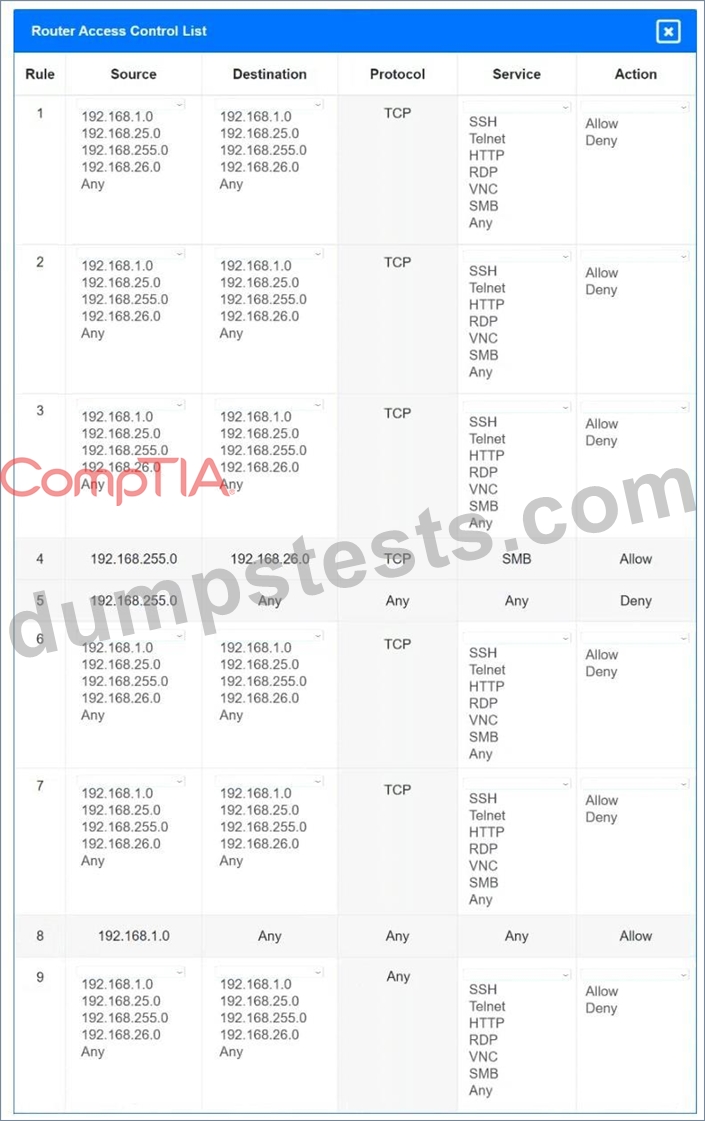
You have been tasked with implementing an ACL on the router that will:
1. Permit the most commonly used secure remote access technologies from the management network to all other local network segments
2. Ensure the user subnet cannot use the most commonly used remote access technologies in the Linux and Windows Server segments.
3. Prohibit any traffic that has not been specifically allowed.
INSTRUCTIONS
Use the drop-downs to complete the ACL
If at any time you would like to bring back the initial state of the simulation, please click the Reset All button.
Answer:
Explanation:
See the answer and solution below.
NEW QUESTION # 192
A network engineer wants to implement a new IDS between the switch and a router connected to the LAN.
The engineer does not want to introduce any latency by placing the IDS in line with the gateway. The engineer does want to ensure that the IDS sees all packets without any loss. Which of the following is the best way for the engineer to implement the IDS?
- A. Use Nmap software.
- B. Use a network tap.
- C. Use a protocol analyzer.
- D. Use a port mirror.
Answer: D
Explanation:
Reference: CompTIA Network+ Certification Exam Objectives - Network Security section.
NEW QUESTION # 193
Which of the following devices can operate in multiple layers of the OSI model?
- A. Modem
- B. Switch
- C. Transceiver
- D. Hub
Answer: B
Explanation:
Understanding Switches:
Layer 2 (Data Link Layer): Traditional switches operate primarily at Layer 2, where they use MAC addresses to forward frames within a local network.
Layer 3 (Network Layer): Layer 3 switches, also known as multilayer switches, can perform routing functions using IP addresses to forward packets between different networks.
Capabilities of Multilayer Switches:
VLANs and Inter-VLAN Routing: Multilayer switches can handle VLAN (Virtual Local Area Network) configurations and perform inter-VLAN routing, enabling communication between different VLANs.
Routing Protocols: They can run routing protocols like OSPF (Open Shortest Path First) and EIGRP (Enhanced Interior Gateway Routing Protocol) to manage traffic between networks.
Comparison with Other Devices:
Hub: Operates only at Layer 1 (Physical Layer) and simply repeats incoming signals to all ports.
Transceiver: Also operates at Layer 1, converting electrical signals to optical signals and vice versa.
Modem: Primarily operates at Layer 1 and Layer 2, modulating and demodulating signals for transmission over different types of media.
Practical Application:
Multilayer switches are commonly used in enterprise networks to optimize performance and manage complex routing and switching requirements within a single device.
Reference:
CompTIA Network+ study materials on network devices and the OSI model.
NEW QUESTION # 194
You have been tasked with implementing an ACL on the router that will:
1. Permit the most commonly used secure remote access technologies from the management network to all other local network segments
2. Ensure the user subnet cannot use the most commonly used remote access technologies in the Linux and Windows Server segments.
3. Prohibit any traffic that has not been specifically allowed.
INSTRUCTIONS
Use the drop-downs to complete the ACL
If at any time you would like to bring back the initial state of the simulation, please click the Reset All button.

Answer:
Explanation:
See the answer and solution below.
Explanation:
A screenshot of a computer screen AI-generated content may be incorrect.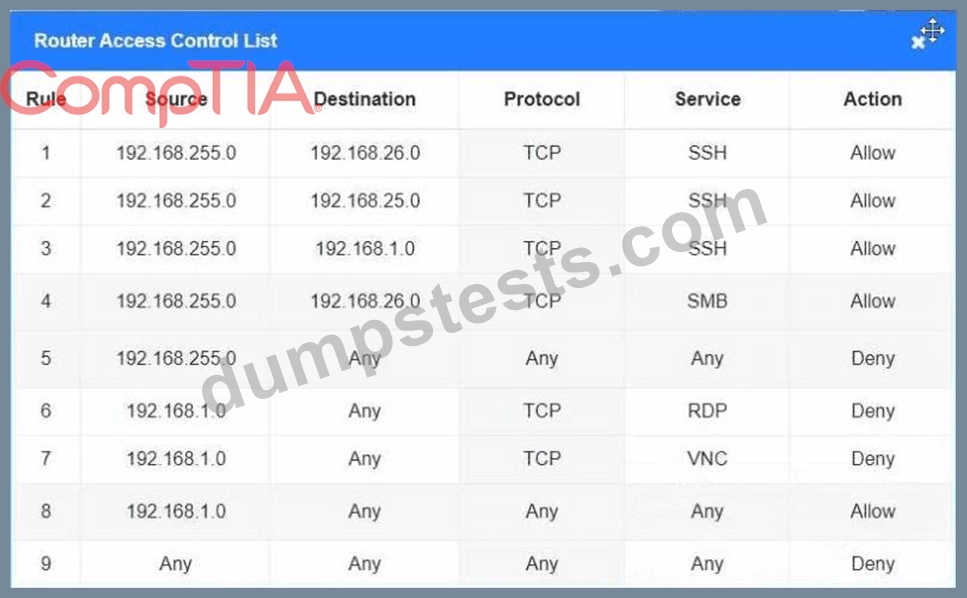
NEW QUESTION # 195
A network administrator wants users to be able to authenticate to the corporate network using a port-based authentication framework when accessing both wired and wireless devices. Which of the following is the best security feature to accomplish this task?
- A. 802.1X
- B. Access control list
- C. MAC filtering
- D. Port security
Answer: A
Explanation:
802.1X is a port-based network access control (PNAC) protocol that provides an authentication mechanism to devices wishing to connect to a LAN or WLAN. It is widely used for secure network access, ensuring that only authenticated devices can access the network, whether they are connecting via wired or wireless means.
802.1X works in conjunction with an authentication server, such as RADIUS, to validate the credentials of devices trying to connect.References:CompTIA Network+ study materials.
NEW QUESTION # 196
A technician needs to identify a computer on the network that is reportedly downloading unauthorized content. Which of the following should the technician use?
- A. Packet capture
- B. Port mirroring
- C. Performance monitoring
- D. Anomaly alerts
Answer: A
Explanation:
Packet Capture: This method captures and inspects network traffic to identify unauthorized downloads or malicious behavior. It provides detailed insight into the data being transmitted, making it the best tool for this scenario.
Anomaly alerts (A): Alerts may indicate unusual activity but do not provide detailed traffic analysis.
Port mirroring (B): Port mirroring can redirect traffic for analysis but requires a packet capture tool for deeper inspection.
Performance monitoring (C): Focuses on system performance metrics, not detailed traffic content.
Reference: CompTIA Network+ Official Study Guide, Domain 4.3 (Network Monitoring Tools).
NEW QUESTION # 197
Which of the following is used to store and deliver content to clients in a geographically distributed manner using edge servers?
- A. CDN
- B. DNS server
- C. SAN
- D. Load balancer
Answer: A
Explanation:
A Content Delivery Network (CDN) stores cached versions of content in edge locations to deliver data faster and more reliably to users based on geographical proximity.
From Andrew Ramdayal's guide:
"CDNs distribute content to multiple, geographically dispersed servers. This enhances performance and reliability for end-users by reducing latency and load times."
NEW QUESTION # 198
A network administrator needs to add 255 useable IP addresses to the network. A /24 is currently in use.
Which of the following prefixes would fulfill this need?
- A. /23
- B. /32
- C. /25
- D. /29
Answer: A
Explanation:
Explanation: A /23 subnet provides 512 total addresses, of which 510 are usable (subtracting 2 for network and broadcast addresses). This would satisfy the need for 255 additional addresses.
NEW QUESTION # 199
Users usually use RDP to connect to a terminal server with hostname TS19 that points to 10.0.100.19.
However, users recently have been unable to connect to TS19. The technician pings 10.0.100.19 and gets an unreachable error. Which of the following is the most likely cause?
- A. The users are on the wrong subnet.
- B. The DHCP server renewed the lease.
- C. The IP address was not reserved.
- D. The hostname was changed.
Answer: A
Explanation:
If a ping to 10.0.100.19 is unreachable, the most likely issue is that users are on the wrong subnet and cannot communicate with the server.
Breakdown of Options:
A:The users are on the wrong subnet. # Correct answer. If users are on a different subnet without proper routing, they won't reach the server.
B:The DHCP server renewed the lease. - Would change the client's IP, but the server's static IP should remain unchanged.
C:The IP address was not reserved. - DHCP reservations matter for dynamic IPs, but RDP servers typically have static IPs.
D:The hostname was changed. - Would affect DNS resolution, but pinging the IP directly would still work.
Reference:
CompTIA Network+ (N10-009) Official Study Guide - Domain 2.4: Explain subnetting concepts.
NEW QUESTION # 200
A user cannot access an external server for a client after connecting to a VPN. Which of the following commands would a support agent most likely use to examine the issue? (Select two).
- A. arp
- B. nslookup
- C. route print
- D. tcpdump
- E. dig
- F. tracert
Answer: C,F
Explanation:
When a user connects to a VPN and experiences connectivity issues to an external server, the problem is often related to routing or network path issues.
E:tracert:
Traces the path packets take from the user's device to the destination server.
Helps determine if the traffic is being blocked or misrouted.
F:route print:
Displays the device's routing table.
Helps diagnose whether traffic is being sent to the VPN tunnel instead of the correct external server.
Incorrect Options:
A:nslookup: Used for resolving domain names to IPs (DNS troubleshooting), but this issue is likely routing- related.
B:tcpdump: Captures packets for deep packet analysis, not typically the first step in diagnosing a VPN- related access issue.
C:arp: Used for resolving local network MAC addresses, not relevant for external VPN issues.
D:dig: Like nslookup, used for DNS queries, but not useful for routing problems.
NEW QUESTION # 201
SIMULATION
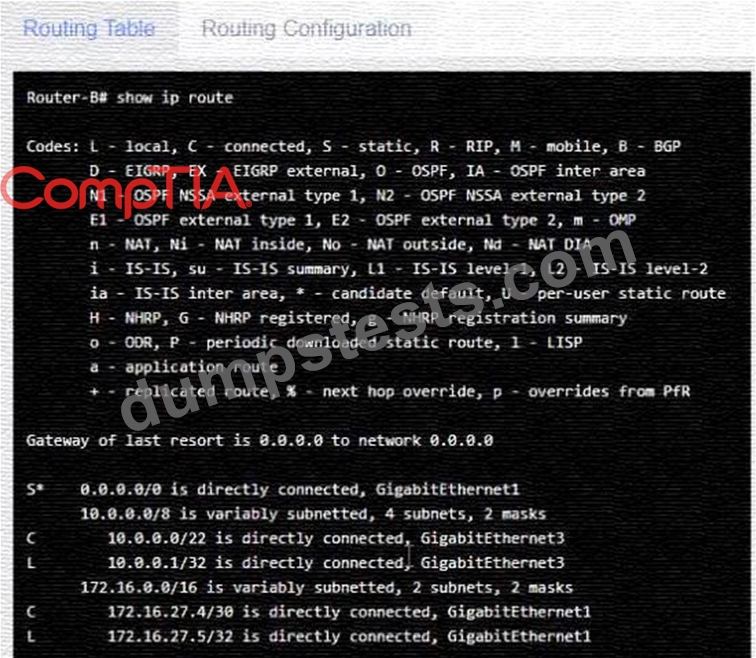
Users are unable to access files on their department share located on flle_server 2. The network administrator has been tasked with validating routing between networks hosting workstation A and file server 2.
INSTRUCTIONS
Click on each router to review output, identity any Issues, and configure the appropriate solution If at any time you would like to bring back the initial state of trie simulation, please clickthe reset All button; A diagram of a router Description automatically generated
Answer:
Explanation:
See the solution configuration below in Explanation.


NEW QUESTION # 202
Which of the following protocols has a default administrative distance value of 90?
- A. RIP
- B. EIGRP
- C. OSPF
- D. BGP
Answer: B
Explanation:
EIGRP (Enhanced Interior Gateway Routing Protocol) has a default administrative distance (AD) value of 90 for internal routes. The administrative distance is used to rate the trustworthiness of routing information received from different routing protocols. EIGRP, developed by Cisco, has an AD of 90, which is lower than that of RIP (120) and OSPF (110), making it more preferred if multiple protocols provide a route to the same destination.
NEW QUESTION # 203
A network administrator is configuring a new switch and wants to ensure that only assigned devices can connect to the switch. Which of the following should the administrator do?
- A. Disable unnecessaryservices.
- B. Enable port security.
- C. Implement a captive portal.
- D. Configure ACLs.
Answer: B
Explanation:
Reference: CompTIA Network+ Certification Exam Objectives - Network Security section.
NEW QUESTION # 204
A network administrator has been tasked with configuring a network for a new corporate office. The office consists of two buildings, separated by 50 feet with no physical connectivity. The configuration must meet the following requirements:
. Devices in both buildings should be
able to access the Internet.
. Security insists that all Internet traffic
be inspected before entering the
network.
. Desktops should not see traffic
destined for other devices.
INSTRUCTIONS
Select the appropriate network device for each location. If applicable, click on the magnifying glass next to any device which may require configuration updates and make any necessary changes.
Not all devices will be used, but all locations should be filled.
If at any time you would like to bring back the initial state of the simulation, please click the Reset All button.


Answer:
Explanation:
See the step by step complete solution below.
Explanation:
* Devices in both buildings should be able to access the Internet.
* Security insists that all Internet traffic be inspected before entering the network.
* Desktops should not see traffic destined for other devices.
Here is the corrected layout with explanation:
* Building A:
* Switch: Correctly placed to connect all desktops.
* Firewall: Correctly placed to inspect all incoming and outgoing traffic.
* Building B:
* Switch: Not needed. Instead, place a Wireless Access Point (WAP) to provide wireless connectivity for laptops and mobile devices.
* Between Buildings:
* Wireless Range Extender: Correctly placed to provide connectivity between the buildings wirelessly.
* Connection to the Internet:
* Router: Correctly placed to connect to the Internet and route traffic between the buildings and the Internet.
* Firewall: The firewall should be placed between the router and the internal network to inspect all traffic before it enters the network.
Corrected Setup:
* Top-left (Building A): Switch
* Bottom-left (Building A): Firewall (inspect traffic before it enters the network)
* Top-middle (Internet connection): Router
* Bottom-middle (between buildings): Wireless Range Extender
* Top-right (Building B): Wireless Access Point (WAP)
In this corrected setup, the WAP in Building B will connect wirelessly to the Wireless Range Extender, which is connected to the Router. The Router is connected to the Firewall to ensure all traffic is inspected before it enters the network.
Configuration for Wireless Range Extender:
* SSID: CORP
* Security Settings: WPA2 or WPA2 - Enterprise
* Key or Passphrase: [Enter a strong passphrase]
* Mode: [Set based on your network plan]
* Channel: [Set based on your network plan]
* Speed: Auto
* Duplex: Auto
With these settings, both buildings will have secure access to the Internet, and all traffic will be inspected by the firewall before entering the network. Desktops and other devices will not see traffic intended for others, maintaining the required security and privacy.
To configure the wireless range extender for security, follow these steps:
* SSID (Service Set Identifier):
* Ensure the SSID is set to "CORP" as shown in the exhibit.
* Security Settings:
* WPA2 or WPA2 - Enterprise: Choose one of these options for stronger security. WPA2- Enterprise provides more robust security with centralized authentication, which is ideal for a corporate environment.
* Key or Passphrase:
* If you select WPA2, enter a strong passphrase in the "Key or Passphrase" field.
* If you select WPA2 - Enterprise, you will need to configure additional settings for authentication servers, such as RADIUS, which is not shown in the exhibit.
* Wireless Mode and Channel:
* Set the appropriate mode and channel based on your network design and the environment to avoid interference. These settings are not specified in the exhibit, so set them according to your network plan.
* Wired Speed and Duplex:
* Set the speed to "Auto" unless you have specific requirements for 100 or 1000 Mbps.
* Set the duplex to "Auto" unless you need to specify half or full duplex based on your network equipment.
* Save Configuration:
* After making the necessary changes, click the "Save" button to apply the settings.
Here is how the configuration should look after adjustments:
* SSID: CORP
* Security Settings: WPA2 or WPA2 - Enterprise
* Key or Passphrase: [Enter a strong passphrase]
* Mode: [Set based on your network plan]
* Channel: [Set based on your network plan]
* Speed: Auto
* Duplex: Auto
Once these settings are configured, your wireless range extender will provide secure connectivity for devices in both buildings.
Firewall setting to to ensure complete compliance with the requirements and best security practices, consider the following adjustments and additions:
* DNS Rule: This rule allows DNS traffic from the internal network to any destination, which is fine.
* HTTPS Outbound: This rule allows HTTPS traffic from the internal network (assuming 192.169.0.1/24 is a typo and should be 192.168.0.1/24) to any destination, which is also good for secure web browsing.
* Management: This rule allows SSH access to the firewall for management purposes, which is necessary for administrative tasks.
* HTTPS Inbound: This rule denies inbound HTTPS traffic to the internal network, which is good unless you have a web server that needs to be accessible from the internet.
* HTTP Inbound: This rule denies inbound HTTP traffic to the internal network, which is correct for security purposes.
Suggested Additional Settings:
* Permit General Outbound Traffic: Allow general outbound traffic for web access, email, etc.
* Block All Other Traffic: Ensure that all other traffic is blocked to prevent unauthorized access.
Firewall Configuration Adjustments:
* Correct the Network Typo:
* Ensure that the subnet 192.169.0.1/24 is corrected to 192.168.0.1/24.
* Permit General Outbound Traffic:
* Rule Name: General Outbound
* Source: 192.168.0.1/24
* Destination: ANY
* Service: ANY
* Action: PERMIT
* Deny All Other Traffic:
* Rule Name: Block All
* Source: ANY
* Destination: ANY
* Service: ANY
* Action: DENY
Here is how your updated firewall settings should look:
Rule Name
Source
Destination
Service
Action
DNS Rule
192.168.0.1/24
ANY
DNS
PERMIT
HTTPS Outbound
192.168.0.1/24
ANY
HTTPS
PERMIT
Management
ANY
192.168.0.1/24
SSH
PERMIT
HTTPS Inbound
ANY
192.168.0.1/24
HTTPS
DENY
HTTP Inbound
ANY
192.168.0.1/24
HTTP
DENY
General Outbound
192.168.0.1/24
ANY
ANY
PERMIT
Block All
ANY
ANY
ANY
DENY
These settings ensure that:
* Internal devices can access DNS and HTTPS services externally.
* Management access via SSH is permitted.
* Inbound HTTP and HTTPS traffic is denied unless otherwise specified.
* General outbound traffic is allowed.
* All other traffic is blocked by default, ensuring a secure environment.
Make sure to save the settings after making these adjustments.
NEW QUESTION # 205
You have been tasked with implementing an ACL on the router that will:
1. Permit the most commonly used secure remote access technologies from the management network to all other local network segments
2. Ensure the user subnet cannot use the most commonly used remote access technologies in the Linux and Windows Server segments.
3. Prohibit any traffic that has not been specifically allowed.
INSTRUCTIONS
Use the drop-downs to complete the ACL
If at any time you would like to bring back the initial state of the simulation, please click the Reset All button.

Answer:
Explanation:
See the answer and solution below.
Explanation:
NEW QUESTION # 206
Which of the following troubleshooting steps would provide a change advisory board with the information needed to make a decision?
- A. Test the theory to determine cause.
- B. Establish a plan of action.
- C. Develop a theory of probable cause.
- D. Identify the problem.
Answer: B
Explanation:
Comprehensive and Detailed In-Depth Explanation:
A Change Advisory Board (CAB) reviews and approves network changes. Before approval, they need a detailed action plan outlining the change, potential impacts, and mitigation strategies.
* A Plan of Action includes risk assessments, rollback procedures, and deployment steps, which are critical for decision-making.
? Reference: CompTIA Network+ (N10-009) Official Study Guide - Section: Network Troubleshooting Methodologies
NEW QUESTION # 207
Which of the following steps of the troubleshooting methodology would most likely include checking through each level of the OSI model after the problem has been identified?
- A. Establish a theory.
- B. Create a plan of action.
- C. Implement the solution.
- D. Verify functionality.
Answer: D
Explanation:
* Introduction to Troubleshooting Methodology:
* Network troubleshooting involves a systematic approach to identifying and resolving network
* issues. The CompTIA Network+ certification emphasizes a structured troubleshooting methodology.
* Troubleshooting Steps:
* Identify the problem: Gather information, identify symptoms, and question users.
* Establish a theory of probable cause: Consider possible reasons for the issue.
* Test the theory to determine cause: Validate the theory with tests.
* Establish a plan of action to resolve the problem and implement the solution: Create and execute a resolution plan.
* Verify functionality and implement preventive measures: Ensure the solution works and prevent recurrence.
* Verifying Functionality:
* After implementing a solution, verifying functionality ensures that the problem is fully resolved.
This involves testing the network to confirm that it operates correctly.
* Checking through each level of the OSI model helps to ensure that all potential issues at different layers (physical, data link, network, transport, session, presentation, and application) are addressed.
* Explanation of the Options:
* A. Establish a theory: This step involves hypothesizing possible causes, not verifying functionality.
* B. Implement the solution: This step involves executing the resolution plan.
* C. Create a plan of action: This step involves planning the resolution, not verification.
* D. Verify functionality: This step involves comprehensive checks, including OSI model layers, to ensure the issue is fully resolved.
* Conclusion:
* Verifying functionality is a critical step in the troubleshooting process, ensuring that the network operates correctly after a solution is implemented. It involves thorough testing across all OSI model layers.
References:
* CompTIA Network+ guide explaining the troubleshooting methodology and the importance of verifying functionality (see page Ref 9†Basic Configuration Commands).
NEW QUESTION # 208
A company is implementing a wireless solution in a high-density environment. Which of the following 802.11 standards is used when a company is concerned about device saturation and converage?
- A. 802.11n
- B. 802.11ax
- C. 802.11g
- D. 802.11ac
Answer: B
Explanation:
802.11ax, also known as Wi-Fi 6, is designed for high-density environments and improves device saturation and coverage compared to previous standards.
* 802.11ac: While it offers high throughput, it is not optimized for high-density environments as effectively as 802.11ax.
* 802.11ax (Wi-Fi 6): Introduces features like OFDMA, MU-MIMO, and BSS Coloring, which enhance performance in crowded environments, reduce latency, and increase the number of devices that can be connected simultaneously.
* 802.11g and 802.11n: Older standards that do not offer the same level of efficiency or support for high device density as 802.11ax.
Network References:
* CompTIA Network+ N10-007 Official Certification Guide: Covers the 802.11 standards and their capabilities.
* Cisco Networking Academy: Provides training on Wi-Fi technologies and best practices for high-density deployments.
* Network+ Certification All-in-One Exam Guide: Discusses the various 802.11 standards and their applications in different environments.
NEW QUESTION # 209
Which of the following can beimplementedtoadd an additional layer of securitybetween acorporate networkandnetwork management interfaces?
- A. API interface
- B. Jump box
- C. Console server
- D. In-band management
Answer: B
Explanation:
Comprehensive and Detailed Explanation:
Ajump boxis ahardened, isolated systemthat providessecure accesstocritical infrastructure deviceslike routers and firewalls.
NEW QUESTION # 210
A technician is planning an equipement installation into a rack in a data center that practices hot aisle/cold aise ventilation. Which of the following directions should the equipement exhaust face when installed in the rack?
- A. Sides
- B. Front
- C. Rear
- D. Top
Answer: C
Explanation:
In a data center that practices hot aisle/cold aisle ventilation, equipment should be installed so that the exhaust faces the rear of the rack. This setup ensures that hot air is expelled into the hot aisle, maintaining proper airflow and cooling efficiency.
Hot Aisle/Cold Aisle Configuration: Equipment intake should face the cold aisle where cool air is supplied, and exhaust should face the hot aisle where hot air is expelled.
Cooling Efficiency: Proper orientation of equipment helps maintain an efficient cooling environment by segregating hot and cold air, preventing overheating and improving energy efficiency.
NEW QUESTION # 211
......
CompTIA N10-009 Exam Syllabus Topics:
| Topic | Details |
|---|---|
| Topic 1 |
|
| Topic 2 |
|
| Topic 3 |
|
N10-009 Dumps are Available for Instant Access: https://prep4sure.dumpstests.com/N10-009-latest-test-dumps.html